Original reference: Haliday AH (1836) An epitome of the British genera in the Order Thysanoptera with indications of a few of the species. Entomological Magazine 3: 439–451.
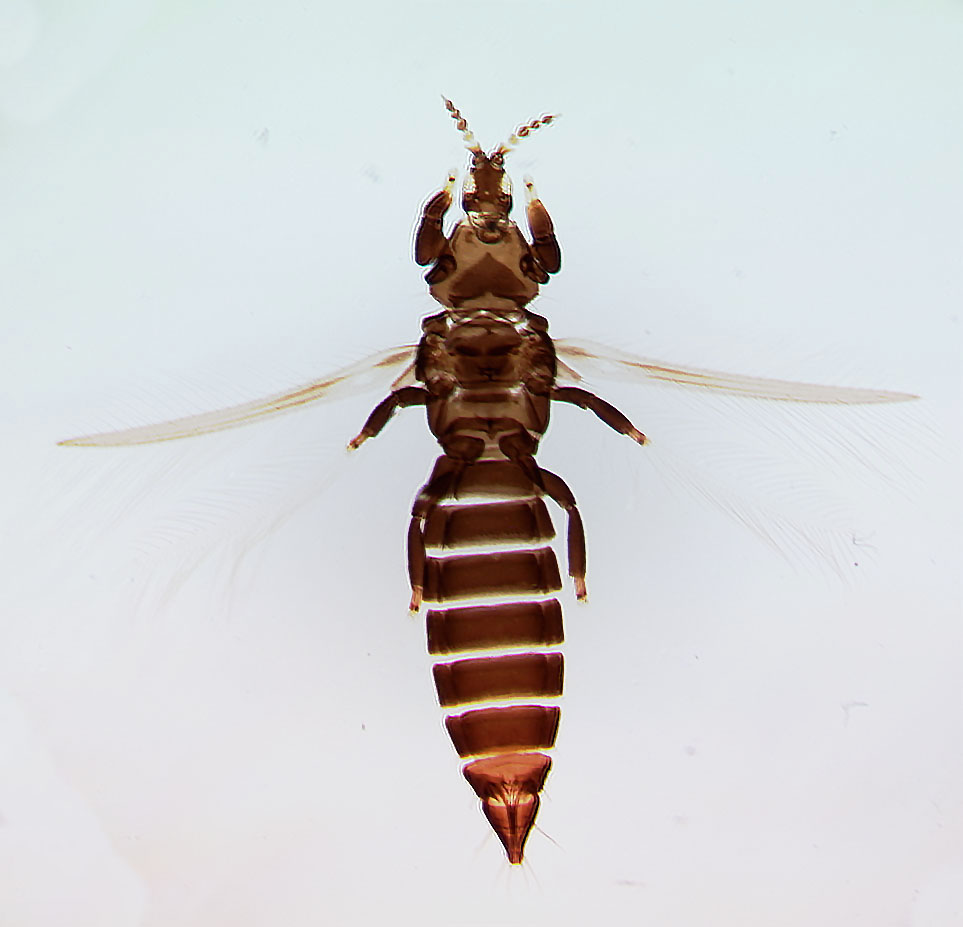
Body uniformly brown; tarsi yellow; fore wing strongly shaded. Head without conspicuous sculpture, vertex with three pairs of setae. Antennae 8-segmented, III & IV with simple sense cones; antennal segment I enlarged, II asymmetric with external lateral margin strongly produced. Pronotum trapezoidal and reticulate; two pairs of long posteroangular setae. Meso & metathoracic endofurca without spinula. Tarsi 2-segmented; fore coxae enlarged. Metanotum irregularly reticulate medially; paired campaniform sensilla present; median setal pair arising behind anterior margin. Fore wing first and second veins with few and sparse setae. Abdominal tergites with transverse lines of sculpture, posterior margin with craspedum; II–VIII with a pair of long and wide apart median setae; VIII with a complete craspedum. Sternites with small tubercles on posterior margin; three pairs of long posteromarginal setae; ovipositor small. Female macropterous, males always wingless.
Male much paler than female; ocelli absent; metanotum rectangular; circular pore plate on abdominal sternites III–VII.
Intraspecific variation
Not recorded.
Genus and similar species information
The genus Chirothrips includes more than 40 species, but species-level taxonomy of this group is not satisfactory (Mound & Marullo 1996). All members have short antennae, enlarged fore legs and trapezoidal pronotum. The genus is closely related to Arorathrips, but differs in having the mesothoracic endofurca well-developed, invaginated medially and with paired lateral arms. Chirothrips manicatus is easily distinguished from the other species from this genus recorded in Brazil, C.longiventralis, for having an asymmetrical antennomere II, with a strong lateral projection. Besides that, C. manicatus has the fore legs greatly swollen, and longer ocellar setae, especially the third pair. Nakahara & Foottit (2012) provided a key to Chirothrips species reported from the Americas.
World distribution
Described from Europe, it is now widely widespread around the world in temperate regions. In South America, it is recorded from Argentina and Brazil.
Distribution in Brazil*
Rio Grande do Sul.
*Literature and authors’ data only.
Life history
Breeding and pupating within the flowers of several grass species.
Economic importance
Referred to as a minor pest of grass seeds (Mound & Marullo 1996).
References suggested
Mound LA & Marullo R (1996) The Thrips of Central and South America: An Introduction. Memoirs on Entomology, International 6: 1–488.
Nakahara S & Foottit RG (2012) Review of Chirothrips and related genera (Thysanoptera: Thripidae) of the Americas, with descriptions of one new genus and four new species. Zootaxa 3251: 1–29.
Published in: 26/12/2016 Posted by: Mariana Lindner