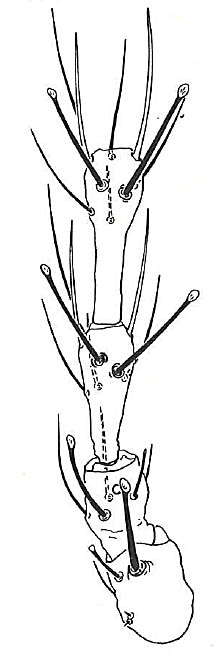
Zeugmatothrips pallidulus Hood, 1958: 225.
Original reference: Hood JD (1958) A new Zeugmatothrips from Brazil (Thysanoptera, Phlaeothripidae). Proceedings of the Entomological Society of Washington 60: 225–228.
Family
Phlaeothripidae, Idolothripinae
Nomenclatural information
https://thrips.info/wiki/Zeugmatothrips_pallidulus
Diagnosis
Female macropterous or micropterous; body bicolored, with head, thorax and abdominal segments I–II light brown, anterior region of head and remaining abdominal segments dark brown; legs mainly yellow, mid and hind coxae light brown, apexes and bases of femora and tibiae pale; antennomeres I–II dark brown, III–V yellow, VI yellow basally and brown apically, VII–VIII brown with yellowish base; wings yellowish, shaded medially and with a brown median line. Antennae 8-segmented, antennomere III with 2 and IV with 2 sense cones, III shorter than IV; basal antennomeres with stout and capitate setae dorsally: I with a major and a minor setae, II and V with one setae each, III and IV with two setae each. Head longer than wide, dorsal sculpture reticulated; 2 pairs of stout and capitate dorsal setae, median pair shorter than the postocular pair and located slightly behind it; maxillary stylets wide apart. Pronotum with 5 pairs of long, stout and capitate setae, anteroangular and epimeral pairs the longest; prosternal basantra absent. Metanotum reticulated, with a pair of long and stout median setae. Metathoracic sternopleural sutures absent. Pelta reticulated and divided: a larger median plate, with curved anterior margin and basal wings; and two smaller lateral plates, each bearing one long and capitate setae. Abdomen strongly reticulated; abdominal tergite II with 1 pair of well-developed lateral setae, III with 2 pairs; II–VII with 1 pair of wing-retaining setae. Tube almost cylinder-shaped, almost 6x as long as basal width, with several lateral setae. All legs similar in appearance, with many setae, some of which are stout and capitate; fore tarsi without a tooth. Fore wings without duplicated cilia.
Male micropterous. Appearance similar to female but paler; fore legs without a tarsal tooth. Pore plates absent.
Intraspecific variation
Unknown.
Genus and similar species information
Zeugmatothrips is a genus with almost 20 species, distributed across the tropical forests in the Americas. It has a series of unusual characteristics, which helps differentiate this genus from other Idolothripinae: antennae with stout and capitate dorsal setae on the basal segments, antennomere III shorter than IV; head longer than wide, with the median dorsal setae stout and capitate, frequently as long as the postocular setae; tarsal tooth absent both in males and females; fore wings without duplicated cilia; tube long with several lateral setae. Zeugmatothrips pallidulus shares many similarities with Z. cinctus and Z. gracilis, being distinguished from the former by having pale legs, and from the latter by the long and capitate metanotal median setae.A key to Zeugmatothrips species is available in Mound & Palmer (1986).
Distribution around the world
Described from Brazil.
Distribution in Brazil
http://fauna.jbrj.gov.br/fauna/faunadobrasil/90750
Life history
Found mainly in tropical forests, where it lives in large dead leaves, feeding on fungal spores.
Economic importance
Not recorded.
References suggested
Hood JD (1958) A new Zeugmatothrips from Brazil (Thysanoptera, Phlaeothripidae). Proceedings of the Entomological Society of Washington 60: 225–228.
Mound LA & Palmer JM (1983) The generic and tribal classification of spore-feeding Thysanoptera (Phlaeothripidae: Idolothripinae). Bulletin of the British Museum (Natural History). Entomology 46: 1–174.
Attendance
Brasil, Rio Grande do Sul, Rio Grande
Campus Carreiros: Av. Itália km 8
Bairro Carreiros
Thysanoptera © Todos Direitos Reservados 2026