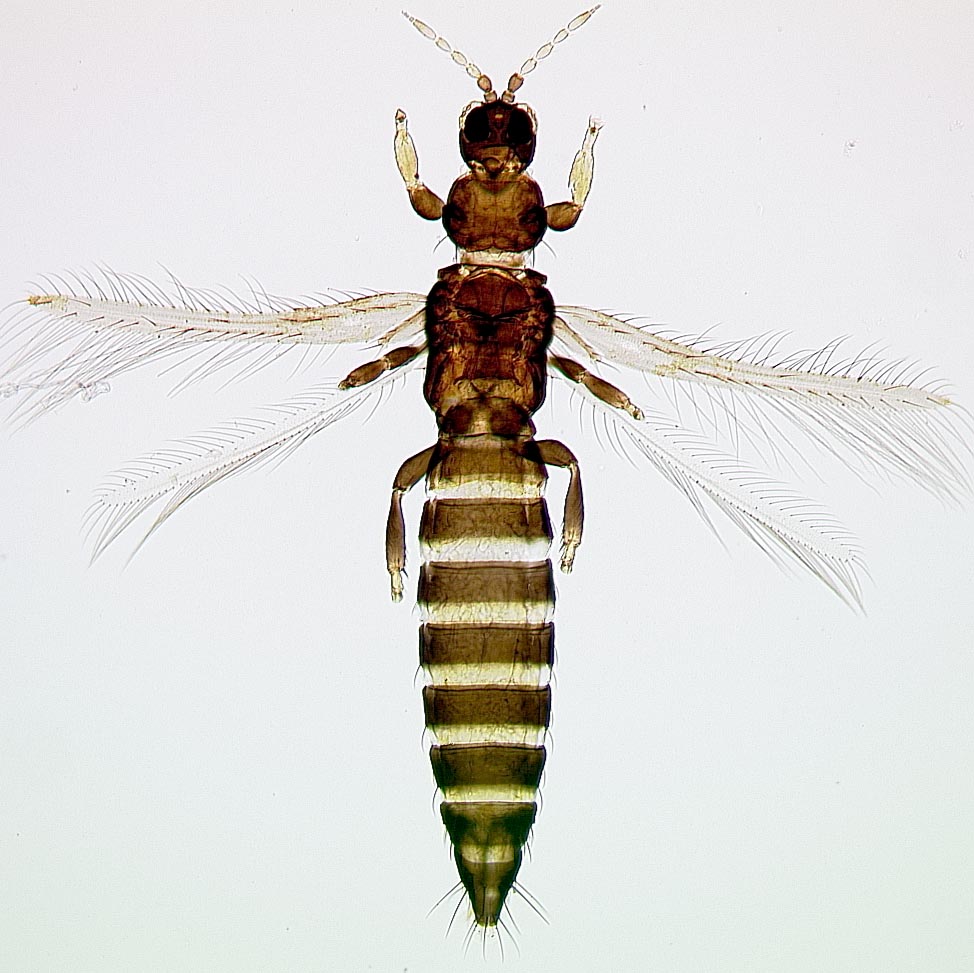
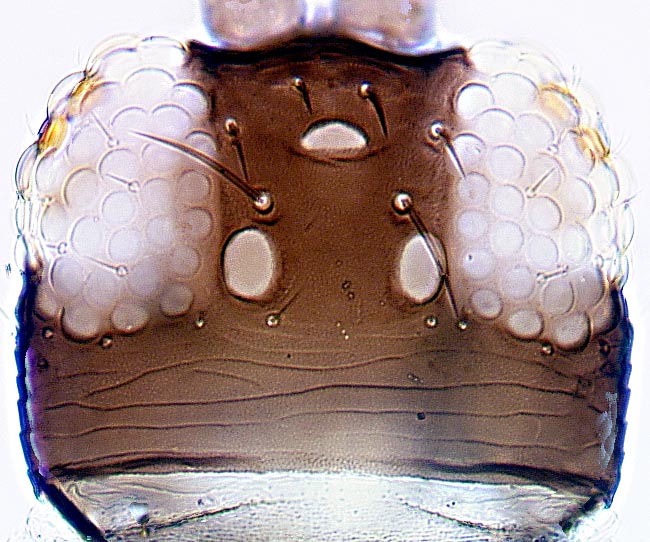
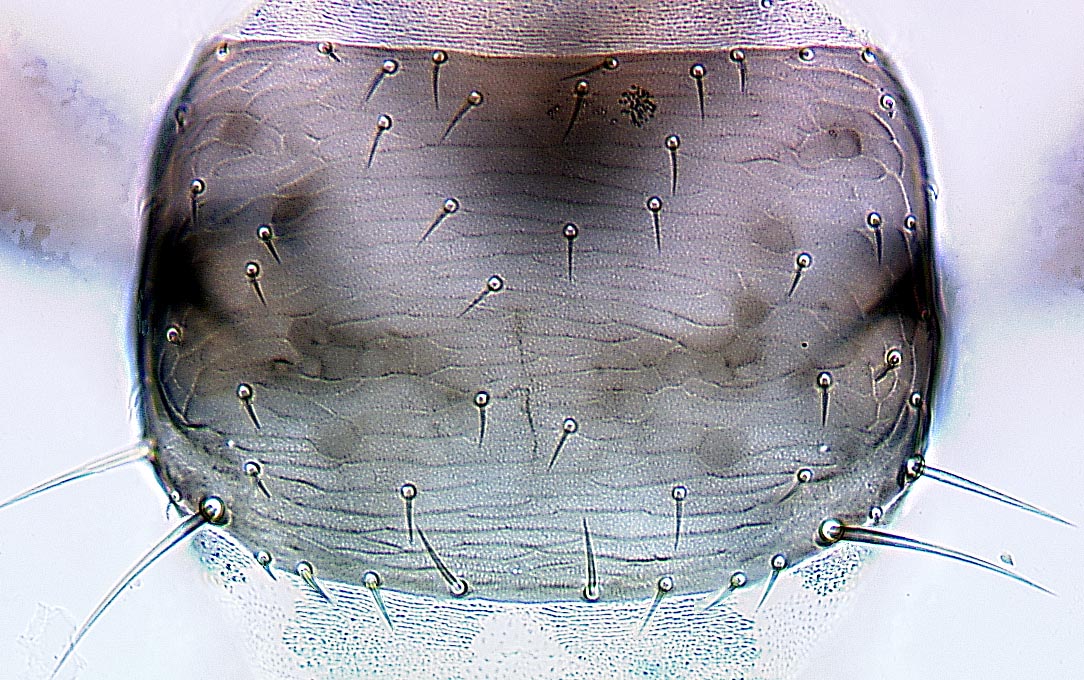
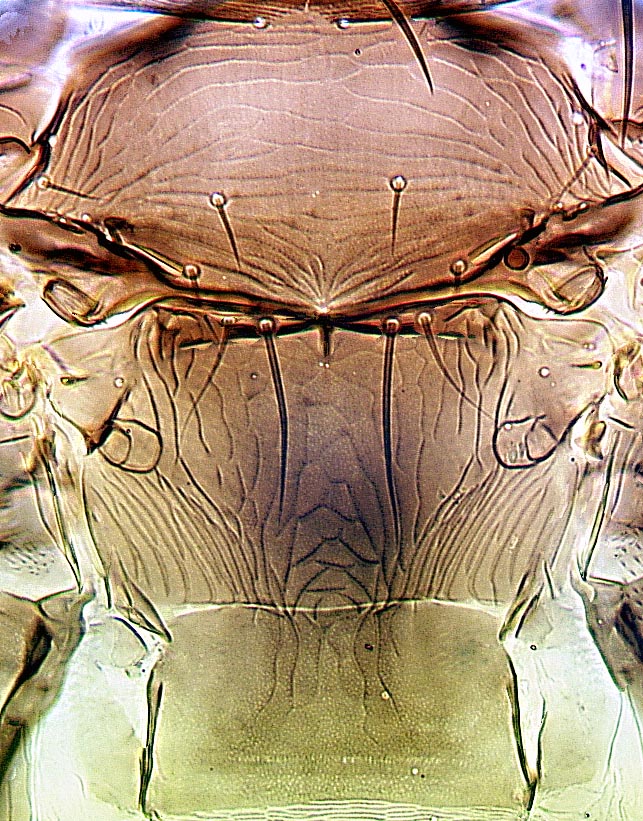
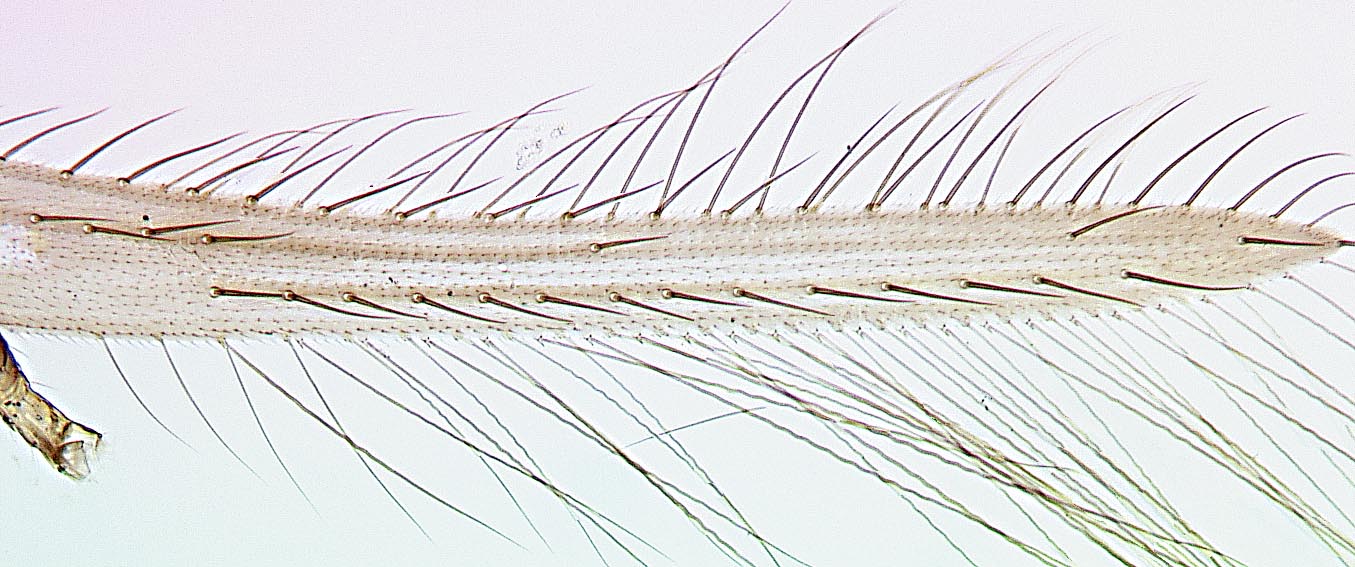
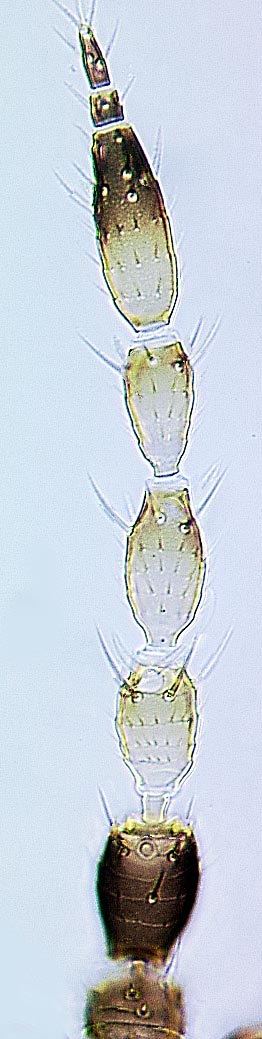
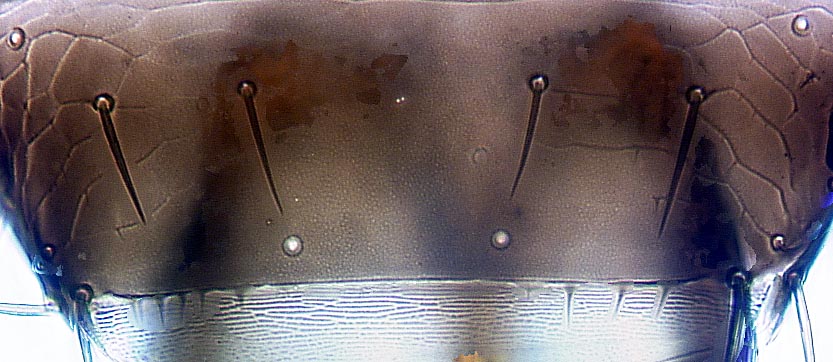
Body dark brown; tarsi and fore tibiae paler; antennal segments III–V and basal half of VI yellow; fore wings shaded brown. Head wider than long, with transverse lines of sculpture posteriorly; three pairs of ocellar setae present. Antennae 8-segmented, III & IV with short forked sense cones. Pronotum with many transverse lines of sculpture, two pairs of long posteroangular setae. Mesothoracic spinula present but metathoracic spinula absent. Metanotum reticulated; paired campaniform sensilla absent; two pairs of setae, median pair long and arising at anterior margin. Fore wing first vein with few sparse setae; second vein complete. Abdominal tergites III–VII with no sculpture medially, VIII with few scattered microtrichia anterior to spiracle, but lacking ctenidia; posteromarginal comb on VIII present only laterally; tergite X with complete longitudinal division. Sternites without discal setae, setae S1 on sternite VII arising in front of margin. Both sexes macropterous.
Male similar to female but smaller; tergite IX median setae longer than sub-median setae; sternites III–VII each with a large oval pore plate occupying half of length of each sternite.
Intraspecific variation
Not recorded.
Genus and similar species information
The genus Tenothrips comprises about 20 species, most of them described from Mediterranean region. The members have two pairs of long posteroangular setae on pronotum and sternite VII S1 setae arising in front of hind margin. This group is possibly related to Ceratothrips, which was also previously placed in Taeniothrips. Tenothrips frici is the only species in this genus recorded from the Americas.
Distribution around the world.
Probably originated from Mediterranean area, it is now widespread in Europe. It is also reported from Argentina, Australia, Colombia, New Zealand, USA.
Distribution in Brazil
Not recorded yet but likely to occur in South Brazil.
Life history
Breeding in flowers, particularly Asteraceae.
Economic importance
Not recorded.
References suggested
Mound LA & Marullo R (1996) The Thrips of Central and South America: An Introduction. Memoirs on Entomology, International 6: 1–488.