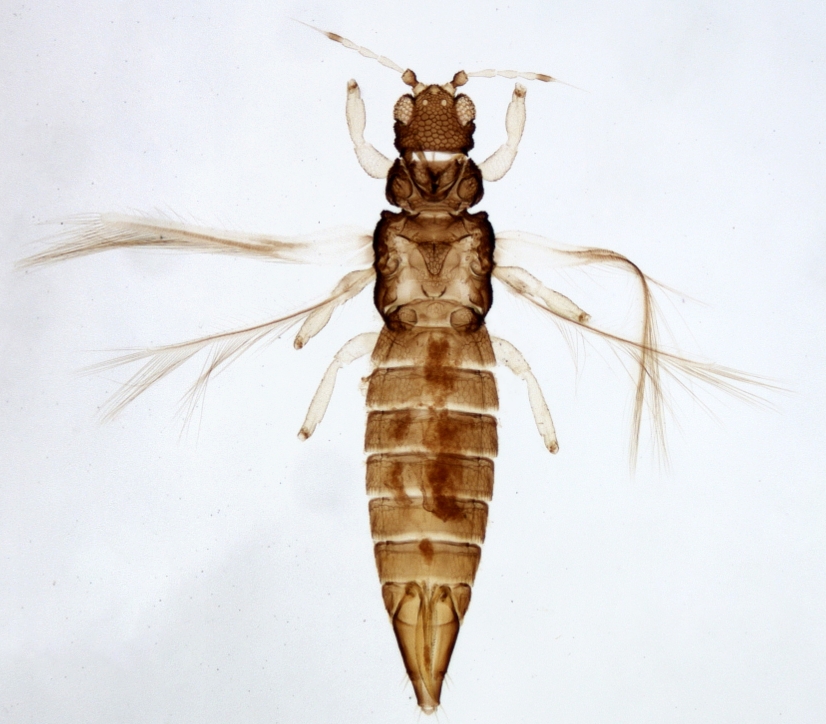
Female macropterous; body mainly brown with clear legs; antennae light-colored except for antennomeres II and VI almost entirely brown; forewings pale but dark along the veins and at base, clavus pale with base light brown. Head strongly sculptured, with lateral margins concave and constricted into a basal neck. Antennae 8-segmented, antennomeres III and IV with simple and elongate sense cones. Pronotum reticulate and without long setae. Meso- and metathoracic endofurca without spinula and with short arms. Mesonotum without longitudinal division medially. Metanotum forming a bold reticulated triangle, median setae small and campaniform sensilla present. Tarsi 1-segmented. Fore wing with rounded apex; both row of setae incomplete. Abdominal tergites II–VIII with one pair of long setae medially; lateral thirds and anterior margin largely reticulated; VIII with a posteromarginal comb of microtrichia; X short and usually with complete longitudinal division. Sternites reticulate and with three pairs of small posteromarginal setae.
Male macropterous. Similar in appearance to females but smaller, and with abdominal segments gradually paler toward the apex of abdomen. Tergite IX with three pairs of stout thorn-like setae; sternites III–VII with transverse pore plates.
Intraspecific variation
Unknown.
Genus and similar species information
This genus belongs to the subfamily Panchaeotothripinae and includes five Neotropical species. They have body strongly sculptured, simple and long sense cones on antennal segment III–IV, and fore wings with a distinctive rounded apex. Heliothrips flamengo is similar to the species H. haemorrhoidalis and H. angustior. It is distinguished from the first by uniformly brown abdomen and antennomere II (apex of the abdomen is yellow in H. haemorrhoidalis). It differs from H. angustior in having antennomere VI almost completely brown (only the apex is brown in H. angustior) and mesonotum with poligonal reticulation (transverse in H. angustior). An illustrated key to Heliothrips species is given by Silva et al. (2024).