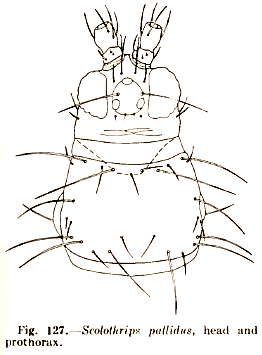
Colour white to light yellow; antennal segments I–II yellow, III–VIII greyish; fore wings largely pale with three small dark transverse bands, basally, medially and subapically. Head as wide as long, with three pairs of ocellar setae, pair III as long as head and arising on anterior margins of ocellar triangle. Antennae 8-segmented, III & IV with forked sense cones. Pronotum almost square and convex laterally, with few transverse lines of sculpture and six pairs of very long setae. Meso & metathoracic spinula well developed. Metanotum weakly reticulated, with two pairs of setae. Tarsi 2-segmented. Fore wing with first and second row of setae interrupted. Both sexes fully winged.
Male smaller than females, with transverse pore plates on abdominal sternites.
Intraspecific variation
Unknown.
Genus and similar species information
This Old World genus comprises about 15 species, and its members can be easily recognized by the six pairs of unusually long pronotal setae. However, species identification in this group is more difficult and relies heavily on character states based on colour. Scolothrips pallidus is one of the palest species in the genus, with the body almost fully white or light yellow, without dark spots on the abdomen. However, it is structurally very similar to S. sexmaculatus, and it is possible that it represents a pale form of that species. A key to Scolothrips species is available in Mound (2011).
Distribution around the world
Described from the United States of America. Recorded from Argentina, Brazil, Galapagos Islands and Iraq.
Stannard LJ (1968) The Thrips, or Thysanoptera, of Illinois. Bulletin of the Illinois Natural History Survey 29: 213-552. DOI: https://doi.org/10.21900/j.inhs.v29.166
Mound LA (2011) Species recognition in the genus Scolothrips (Thysanoptera, Thripidae), predators of leaf-feeding mites. Zootaxa 2797: 45–53. DOI; https://doi.org/10.11646/zootaxa.2797.1.
Published in: 14/07/2026 Posted by: Mariana Lindner