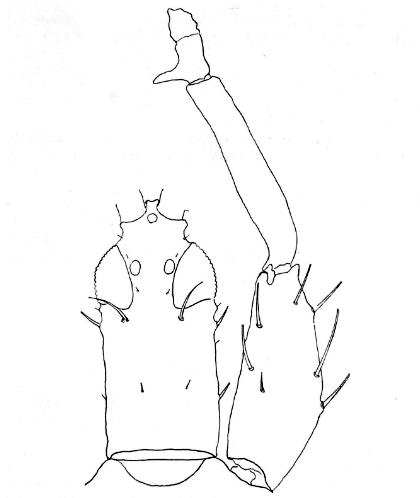
Actinothrips gargantua de Santis, 1960: 57.
Referência original: de Santis L (1960) Un nuevo Tisanóptero gigante del Brasil. Actas y trabajos del Primer Congreso Sudamericano de Zoología 3: 57–60.
Família
Phlaeothripidae, Idolothripinae
Informações sobre nomenclatura
https://thrips.info/wiki/Actinothrips_gargantua
Diagnose
Macho macróptero; coloração do corpo majoritariamente castanho-escura, abdômen quase preto, tarsos medianos e posteriores mais claros;antenômero I castanho-escuro, II castanho basalmente e mais claro apicalmente, demais antenômeros majoritariamente amarelados com ápices e bases escurecidos; asas quase hialinas, linha mediana castanho-escura. Antena com 8 segmentos, antenômeros III com 1 e IV com 2 cones sensoriais; antenômeros III–V extremamente alongados e em forma de clava. Cabeça mais longa que larga, estriada transversalmente; com um par de cerdas pós-oculares longas e dois pares de cerdas laterais robustas; margens laterais retas. Pronoto com 2 pares de cerdas bem desenvolvidas (anteroangular e epimeral), demais cerdas curtas; prosterno com basantra ausente. Mesonoto com esculturação poligonal irregular. Metanoto irregularmente reticulado, com um par de cerdas longas e robustas medialmente, e múltiplas cerdas curtas finas nos ângulos anteriores. Metatórax com suturas esternopleurais ausentes. Tergitos abdominais II–VII com 1 par de cerdas retentoras de asas. Placas porosas ausentes. Tubo cilíndrico, pouco mais de 8x mais longo que a largura basal, com múltiplas cerdas laterais. Pernas anteriores robustas; fêmur anterior com uma fileira de 3 cerdas apicalmente; tarso anterior com dente tarsal grande. Asas anteriores com cerca de 53–58 cerdas duplicadas.
Fêmea desconhecida.
Variação intraespecífica
Desconhecida.
Informações do gênero e espécies similares
Actinothrips é um gênero com 13 espécies, todas da região Neotropical. Faz parte de um grupo de gêneros de Idolothripinae que apresentam cabeça longa, projetada à frente dos olhos e com múltiplas cerdas longas, basantra fracamente desenvolvida ou ausente, suturas esternopleurais do metatórax ausentes, e tubo muito alongado, com múltiplas cerdas lateralmente. Machos de diversas espécies de Actinothrips apresentam grande variação morfológica, com formas menores e maiores; enquanto as fêmeas de diferentes táxons tendem a ser muito semelhantes, dificultando a distinção entre espécies. Machos de Actinothrips gargantua diferem de machos de A. bondari e A. trichaetus por possuírem um longo dente tarsal; e de A. femoralis e A. pedalis pela menor quantidade de cones sensoriais nos antenômeros III e IV, além de possuir apenas dois pares de cerdas pronotais mais longas.Uma chave para machos de algumas espécies de Actinothrips está disponível em Mound (1991).
Distribuição no mundo
Descrita do Brasil.
Distribuição no Brasil
http://fauna.jbrj.gov.br/fauna/faunadobrasil/51651
História de vida
Vive em folhas e galhos mortos, onde alimenta-se de esporos de fungos.
Importância econômica
Sem registro.
Referências sugeridas
de Santis L (1960) Un nuevo Tisanóptero gigante del Brasil. Actas y trabajos del Primer Congreso Sudamericano de Zoología 3: 57–60.
Atendimento
Brasil, Rio Grande do Sul, Rio Grande
Campus Carreiros: Av. Itália km 8
Bairro Carreiros
Mapa do site
Thysanoptera © Todos Direitos Reservados 2026