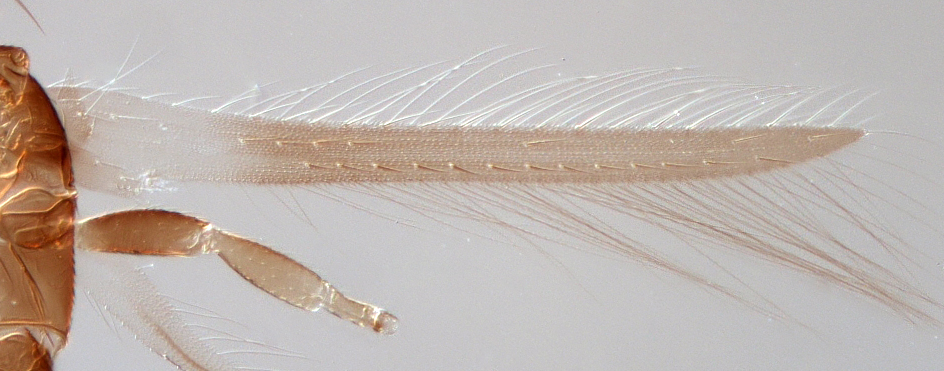
Taenothrips eucharii (Whetzel, 1923: 30).
Original reference: Whetzel, HH (1923) Report of the plant pathologist for the period January 1st to May 31st,1922. Reports Board and Deptartment of Agriculture, Bermuda, 1922: 28–32.
Family
Thripidae, Thripinae
Nomenclatural information
http://thrips.info/wiki/Taenothrips_eucharii
Diagnosis
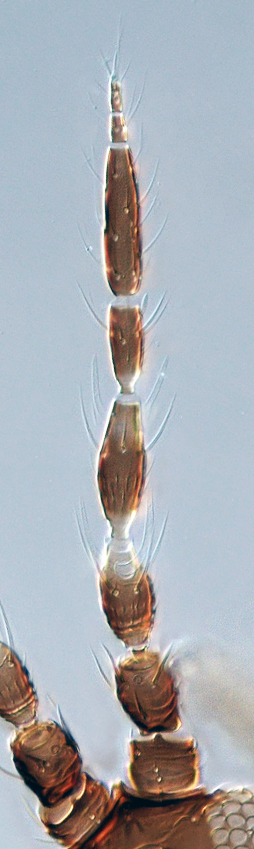
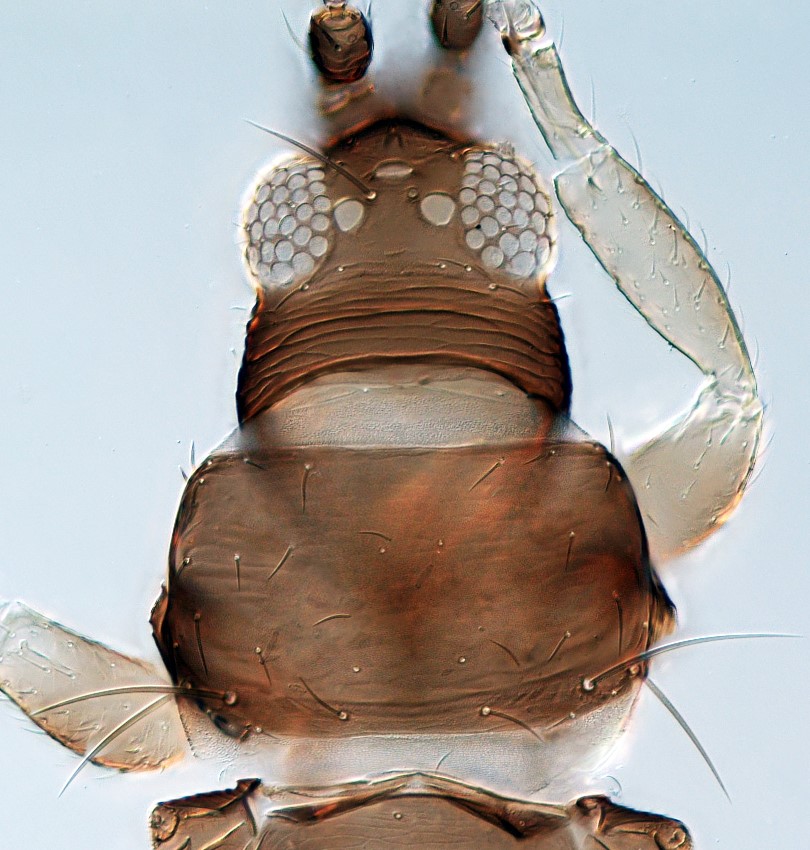
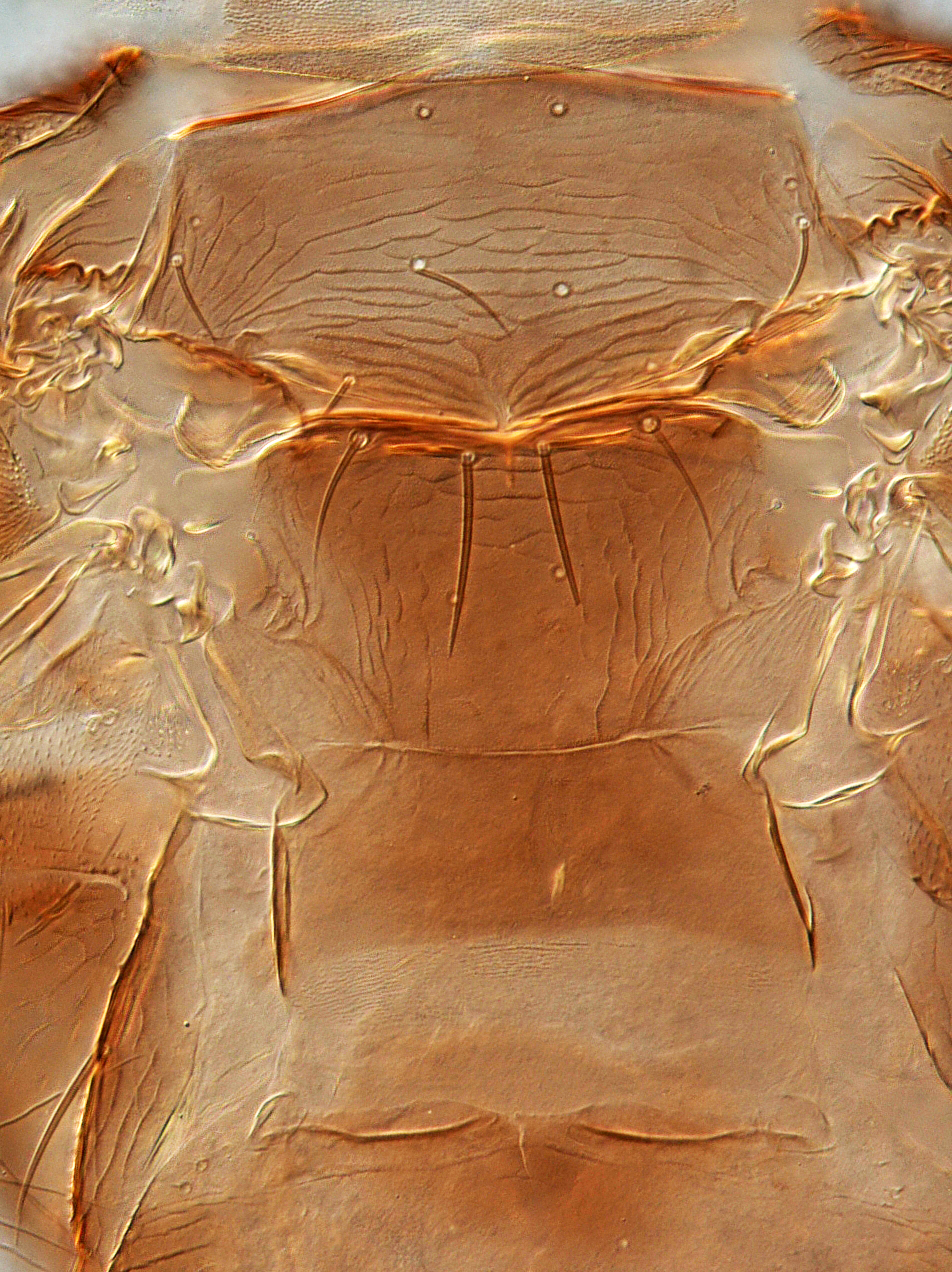
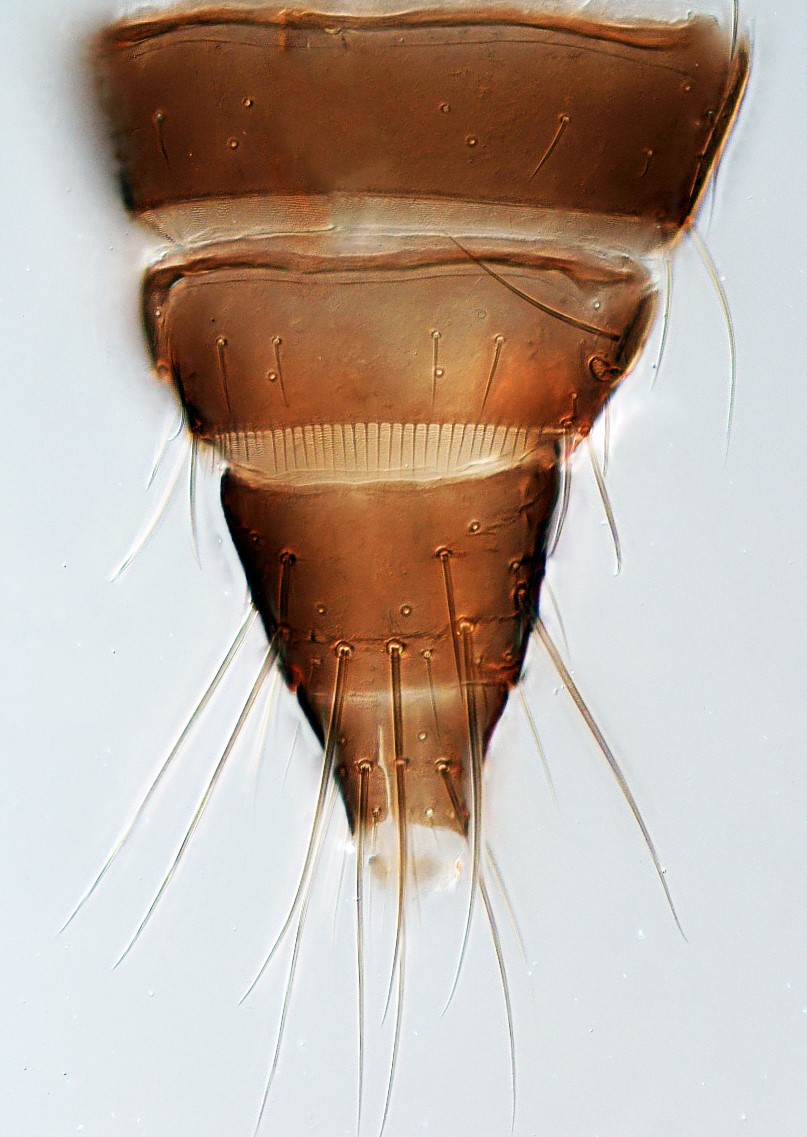
Body dark brown, tarsi yellow, tibiae variable but yellow at least at the apex, although sometimes almost light yellow; apex of antennal segment III yellowish; fore wings brown but with pale basally. Head longer than wide, projecting slightly in front of the eyes, genae convex but narrowed behind the eyes; 2 pairs of ocellar setae present. Pronotum without sculpture, with few discal setae, 2 pairs of long posteroangular setae. Metanotum weakly reticulated, campaniform sensilla present, median setae close to each other and near the anterior margin. Mesothoracic spinula present but metathoracic spinula absent. Fore wing first vein with 1 seta medially and 2 setae near the apex; second row of setae complete. Abdominal tergites without sculpture between setae S2; posterior margin on tergite VIII with a comb of long and regular microtrichia. Sternites without discal setae, setae S1 and S2 on sternite VII situated in front of the margin. Both sexes macropterous.
Male smaller than the female; tergite VIII with complete comb of long teeth, IX with 2 pairs of long dorsal setae, with the lateral pair arising anteriorly to the median pair; sternites III–VII each with a broad and transverse pore plate.
Intraspecific variation
Not recorded.
Genus and similar species information
The genus Taeniothrips comprises about 30 extant species, most of them described from Asian. Members have head long and with convex cheeks, pronotum with two pairs of long posteroangular setae, and a posteromarginal comb on tergite VIII with fine and long teeth. Taeniothrips eucharii is the only species of the genus currently confirmed for Brazil. The North American species Taeniothrips inconsequens (Uzel, 1895), although cited for Brazil in the past century, is considered a misidentification. These two species can be differentiated by the predominantly brown antenna in T. eucharii, only with the apex yellow in segment III. Additionally, T. inconsequens is characterized by having a terminal claw on the anterior tarsus and median metanotal setae arising further apart from each other (Mound & Tree, 2008; Cavalleri & Lima, 2024).
Distribution around the world.
Originally described from Asia, it is currently recorded in Brazil, China, Japan, South Korea, USA, Bermuda, Iran, the Netherlands, and Australia.
Distribution in Brazil
http://fauna.jbrj.gov.br/fauna/faunadobrasil/236668
Life history
Lives on flowers and leaves of monocotyledons, particularly Amaryllidaceae, Asparagaceae, and Liliaceae. It is mentioned causing discoloration in the leaves of ornamental Amaryllidaceae, especially in Asia.
Economic importance
Can cause damage to ornamental plants such as Crinum, Eucharis, and Hymenocallis (Mound & Tree, 2008), and has also been reported as a vector of the Hippeastrum chlorotic ringspot virus (HCRV) in China (Xu et al., 2017).
References suggested
Cavalleri A & Lima EFB (2024) First record of Taeniothrips eucharii in South America, a vector of the Hippeastrum chlorotic ringspot virus. Bulletin of Insectology, 77(1), 109–112
Mound LA & Tree D (2008) The oriental lily-flower thrips, Taeniothrips eucharii (Whetzel) (Thysanoptera: Thripidae) new to Australia. Australian Entomologist, 35, 159–160.
Xu Y, et al. (2017) Identification of Taeniothrips eucharii (Thysanoptera: Thripidae) as a vector of Hippeastrum chlorotic ringspot virus in Southern China. Plant Disease, 101, 1597–1600.
Attendance
Brasil, Rio Grande do Sul, Rio Grande
Campus Carreiros: Av. Itália km 8
Bairro Carreiros
Thysanoptera © Todos Direitos Reservados 2026