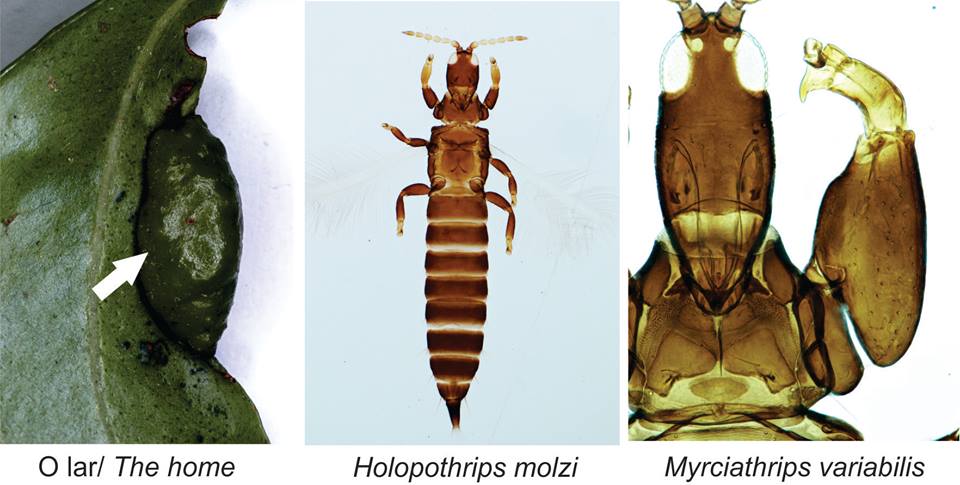
Some thrips species are known for inducing modifications in plant tissue, known as galls (photo), almost always induced by their feeding. These thrips live inside this structure, where they usually complete all their life cycle.
In southern Brazil, a Thysanoptera gall induced in leaves of Myrcia guianensis has been recently observed containing 2 thrips species: Holopothrips molzi and Myrciathrips variabilis. The first species induces the gall formation, while the second invades the structure for sheltering, feeding and reproduction! These invaders are interesting for being found only inside these galls, suggesting a specific relationship and a dependency on the galling thrips species.
During laboratory observations we did not detected any dispute or direct fight between the two species, which occur together in most cases. This is curious because the invader thrips usually has a large abundance inside the galls and the females of this species have very enlarged fore legs (see photo). Both thrips species had not been described before these studies. Surely other interesting systems involving Thysanoptera galls still wait for discovery!
More information about these systems are available on the following articles:
Cavalleri, A., Lindner, M.F. & Mendonça Jr., M.S. (2016) New Neotropical Haplothripini (Thysanoptera: Phlaeothripidae) with a key to Central and South American genera. Journal of Natural History 50 (21-22): 1389-1410.
Lindner, M.F., Mendonça Jr., M.S. & Cavalleri, A. (2016) Holopothrips molzi sp.n. (Thysanoptera, Phlaeothripidae): natural history and interactions in Myrtaceae galls. Zootaxa 4114 (2): 139-148.
Attendance
Brasil, Rio Grande do Sul, Rio Grande
Campus Carreiros: Av. Itália km 8
Bairro Carreiros
Thysanoptera © Todos Direitos Reservados 2026