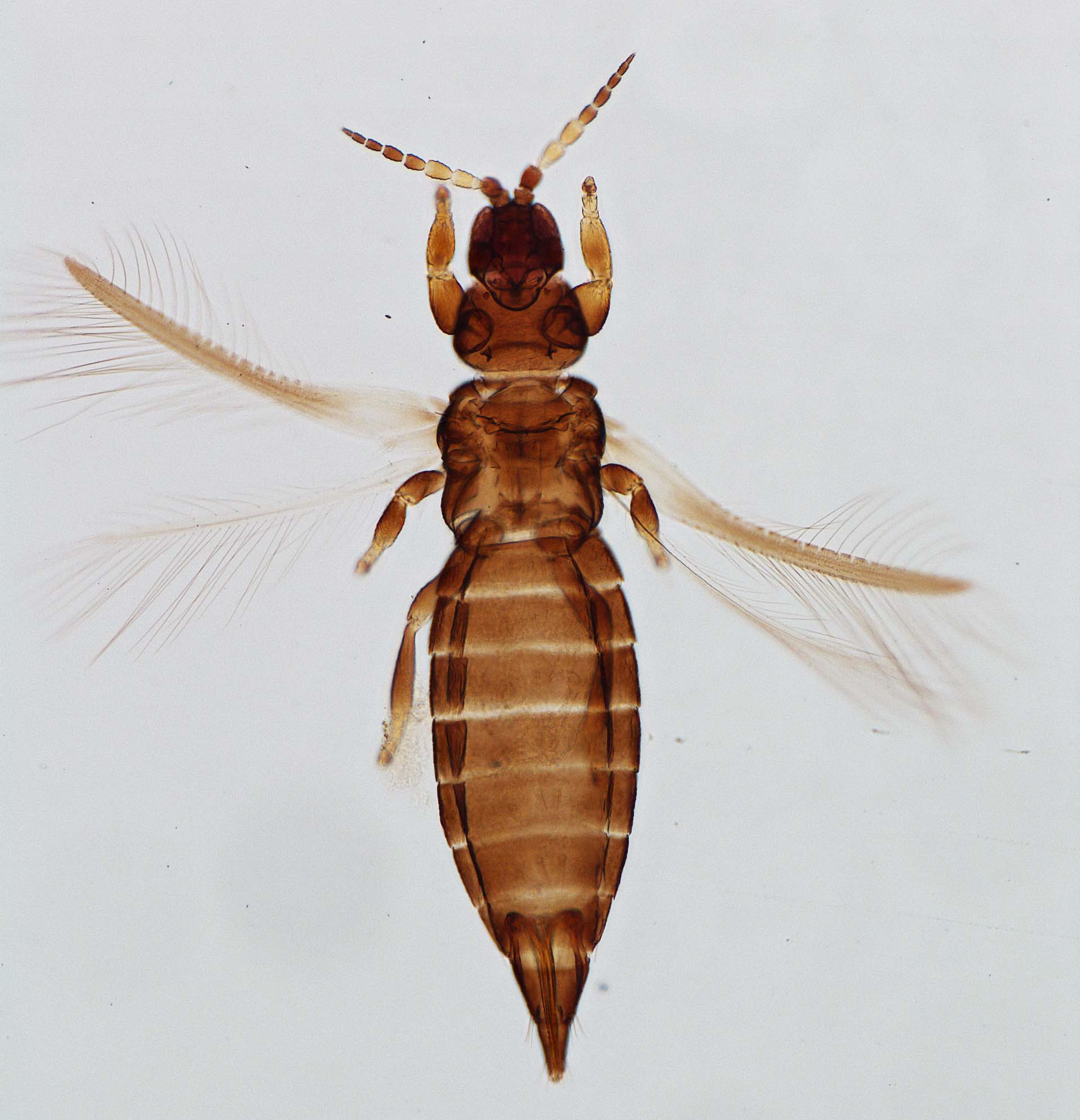
Original reference: Pereyra V & Cavalleri A (2012) The genus Heterothrips (Thysanoptera) in Brazil, with an identification key and seven new species. Zootaxa 3237: 1–23.
Body brown; femora largely brown; tibiae brown with pale apex, tarsi paler; antennal segments I–II & V–IX brown, III–IV pale brown; fore wing brown but paler sub-basally. Head wider than long, with no long setae; ocellar region with three pairs of setae. Antennae 9-segmented, segments III & IV each with one transverse row of sensorial pores at apex. Pronotum broadly reticulate, without long setae; mesonotum with transversely elongate reticles; metanotum with concentric lines of sculpture, not forming a triangle, covered with microtrichia. Fore wing with two rows of minute brown setae. Abdominal tergites II–VII with broad and continuous posterior craspedum, bearing a fringe of fine microtrichia. Abdominal tergites I–VIII with few sculpture lines medially, bearing small microtrichia; lateral thirds of tergites I–VIII covered with fine microtrichia. Sternites with well developed posterior craspedum bearing microtrichia and II–VI with no discal setae.
Male smaller and paler than female; sternites III (or IV)–VIII each one with a small oval pore plate at antecostal ridge.
Intraspecific variation
Not recorded.
Genus and similar species information
Heterothrips Hood is the largest genus in the family Heterothripidae, currently comprising more than 70 species. It is restricted to the Americas and two informal groups were proposed by Moulton (1932). Species placed in “group I” bear a posteromarginal fringe of independent microtrichia on the abdominal tergites, whereas species in “group II” have microtrichia that arise on the posterior margin of the tergites from a well-developed craspedum. Antennal segments III & IV each bears apically a circumpolar sensorium with one or more rows of pores. H. australis seems to be related to H. savanicus, these two being similar in the shape of the antennal segments and sensorial pore bands. However, H. australis is distinctive in having continuous craspedal lobes on the posterior margin of the abdominal tergites. A key to Heterothrips species recorded from Brazil is given by Pereyra & Cavalleri (2012).