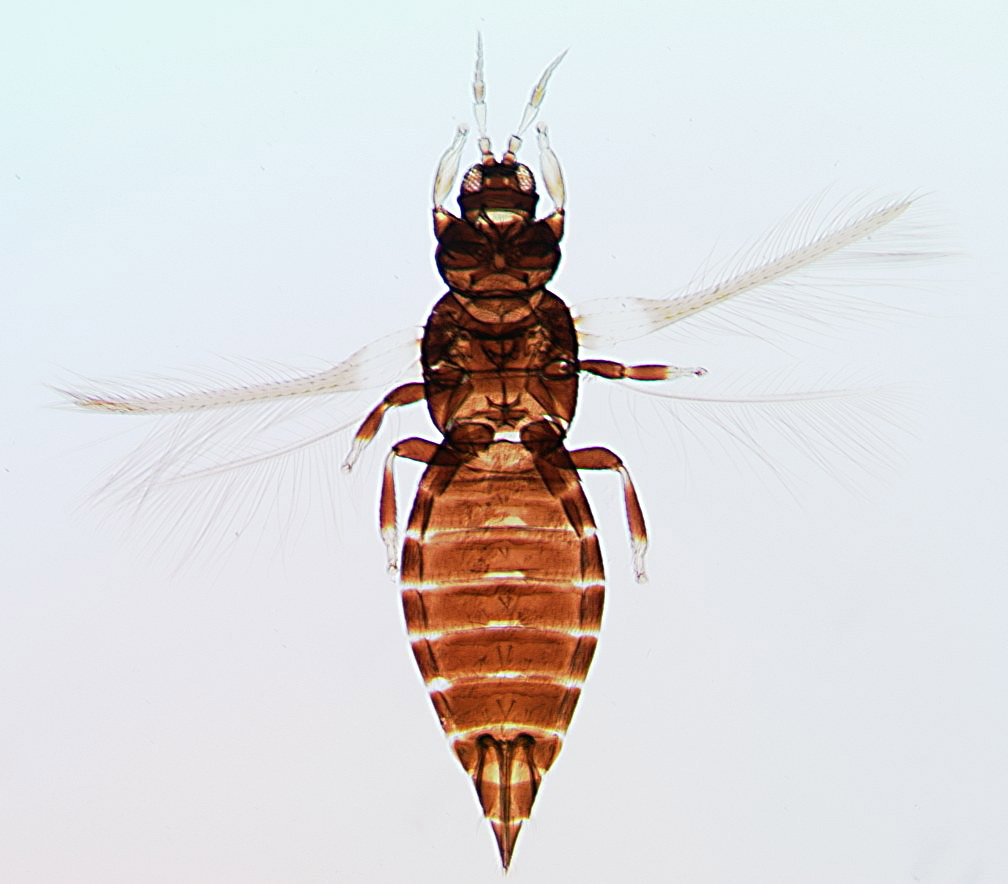
Body largely brown; fore tibiae and all tarsi paler; antennal segment III yellow; fore wing brown with a pale band near the base. Head wider than long, with a transverse ridge close behind the eyes; ocellar region with three pairs of setae; interantennal projection with widely separated arms. Antennae 9-segmented, segments III & IV each with two rows of sensorial pores. Pronotum without lines of sculpture and no long setae; mesonotum reticulate; metascutum triangular, strongly reticulated and without internal markings. Fore wing with two rows of conspicuous brown setae. Abdominal tergites I–VII without microtrichia on lateral thirds and posterior margin with craspedal lobes laterally, each lobe bearing minute teeth. Tergites II–V posterior margin with few microtrichia medially, VI–VIII with a complete fringe of microtrichia medially. Sternites II–VI posterior margins with well-developed craspeda bearing microtrichia; III–VII with few small discal setae.
Male smaller but similar in colouration; intermediate abdominal sternites without discal setae, sternites III–VIII with large transverse pore plates.
Intraspecific variation
Length of antennal segment III is variable and hind legs sometimes with yellow markings.
Genus and similar species information
Scutothrips includes only four flower-feeding species, all described from the Neotropics. These species exhibit a metanotum with a triangle of strong sculpture (as in Aulacothrips) and a pronounced transverse ridge on the head behind the eyes. A key to the four species of Scutothrips was provided by Mound & Marullo (1996), including one species from Costa Rica, two from Peru, and S. nudus, which is the only species recorded from Brazil.
Flower-feeding species closely associated with Malpighiaceae plants in Brazilian savannah. Adults have been studied from Diplopterys pubipetala and Niedenzuella glabra flowers (Malpighiaceae).
Economic importance
Not recorded.
References suggested
Mound LA & Marullo R (1996) The Thrips of Central and South America: An Introduction. Memoirs on Entomology, International 6: 1–488.
Published in: 21/12/2016 Posted by: Mariana Lindner