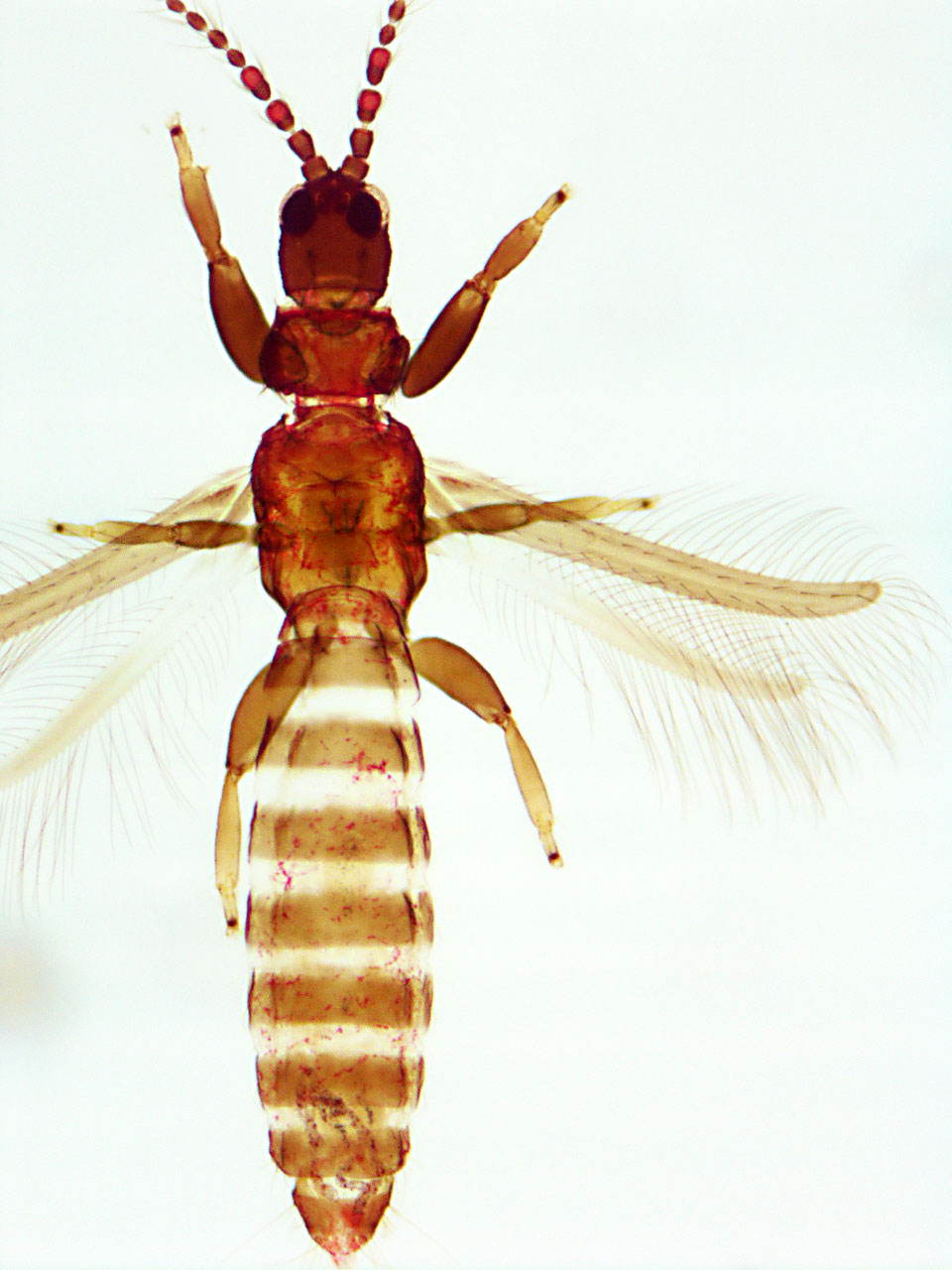
Body brown, with red internal pigmentation present; abdomen paler; tibiae yellowish apically, tarsi yellow; antennae extensively brown, except for the yellowish bases of V–IX; sensorial areas on III and IV bright red and conspicuous; fore wings brown, slightly paler between veins. Head with one pair of long ocellar setae; a pair of long postocular setae. Antennae 9-segmented, III & IV each with a greatly enlarged transverse sensorium occupying half of the segment surface. Pronotum transverse with a pair of long midlateral setae. Tarsi 2-segmented and fore tibia with a well developed tooth. Fore wing with both rows of setae complete. Abdominal tergites without microtrichia and X with a pair of well developed trichobothria. Sternites III–VII with no discal setae; ovipositor atrophied. Female macropterous.
Male unknown.
Intraspecific variation
Not recorded.
Genus and similar species information
This is the only species in this South American genus, showing the most complete set of plesiomorphic character states amongst all Thysanoptera (Mound & Marullo 1996). The abdomen of D. gemmatus resembles that of Merothrips species, although there are no sternal discal setae and sternites VII and VIII are distinct from each other (Mound & O’Neill 1974).
Lives on dead branches, and possibly feeds on fungal hyphae.
Economic importance
Not recorded.
References suggested
Mound LA & O'Neill K (1974) Taxonomy of the Merothripidae, with ecological and phylogenetic considerations (Thysanoptera). Journal of Natural History 8: 481–509.
Mound LA & Marullo R (1996) The Thrips of Central and South America: An Introduction. Memoirs on Entomology, International 6: 1–488.
Published in: 23/12/2016 Posted by: Mariana Lindner