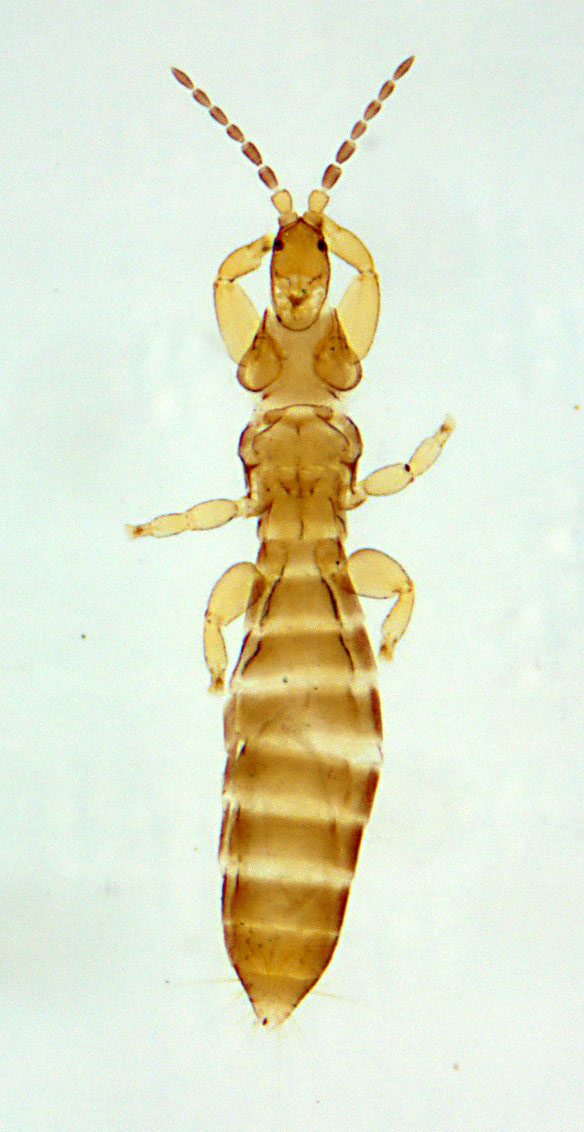
Body brown to yellowish brown. Head smooth, with one pair of long ocellar setae also one pair of postocular setae well developed. Antennae 8-segmented, III & IV each with transverse sensorium at apex. Pronotum entirely sculptured with faint and curved reticulation medially; widest at posterior and with one pair of long posteroangular setae. Meso & metathoracic spinula present.Mesonotum with a long setae arising laterally; metanotum with weak sculpture medially; paired campaniform sensilla present. Fore wing with both rows of setae complete. Tarsi 2-segmented. Abdominal tergites without microtrichia and X with a pair of stout trichobothria. Sternites III–VII with few discal setae; ovipositor weakly developed. Female macroptera or aptera, male always wingless.
Male smaller and paler; with a dorsal glandular area on head; fore tibia with a stout tooth, fore femora usually enlarged and with a basal tubercle.
Intraspecific variation
Not recorded.
Genus and similar species information
Merothrips includes 13 extant species, many of them described from the Neotropics. They all have antennae 8-segmented and the transverse sensoria on segments III & IV are and sometimes slightly inflated. Many species are known only from apterous forms. Merothrips morganis is distinctive in having pronotum with curved sculpture medially. A key to Merothrips species is given by Mound & O’Neill (1974).
World distribution
Widespread; described from USA and recorded from Australia, Galapagos Islands, India, Kenya and Panama.
Lives on dead branches, and possibly feeds on fungal hyphae.
Economic importance
Not recorded.
References suggested
Mound LA & O'Neill K (1974) Taxonomy of the Merothripidae, with ecological and phylogenetic considerations (Thysanoptera). Journal of Natural History 8: 481–509.
Mound LA & Marullo R (1996) The Thrips of Central and South America: An Introduction. Memoirs on Entomology, International 6: 1–488.
Mound LA & Marullo R (1996) The Thrips of Central and South America: An Introduction. Memoirs on Entomology, International 6: 1–488.
Published in: 23/12/2016 Posted by: Mariana Lindner