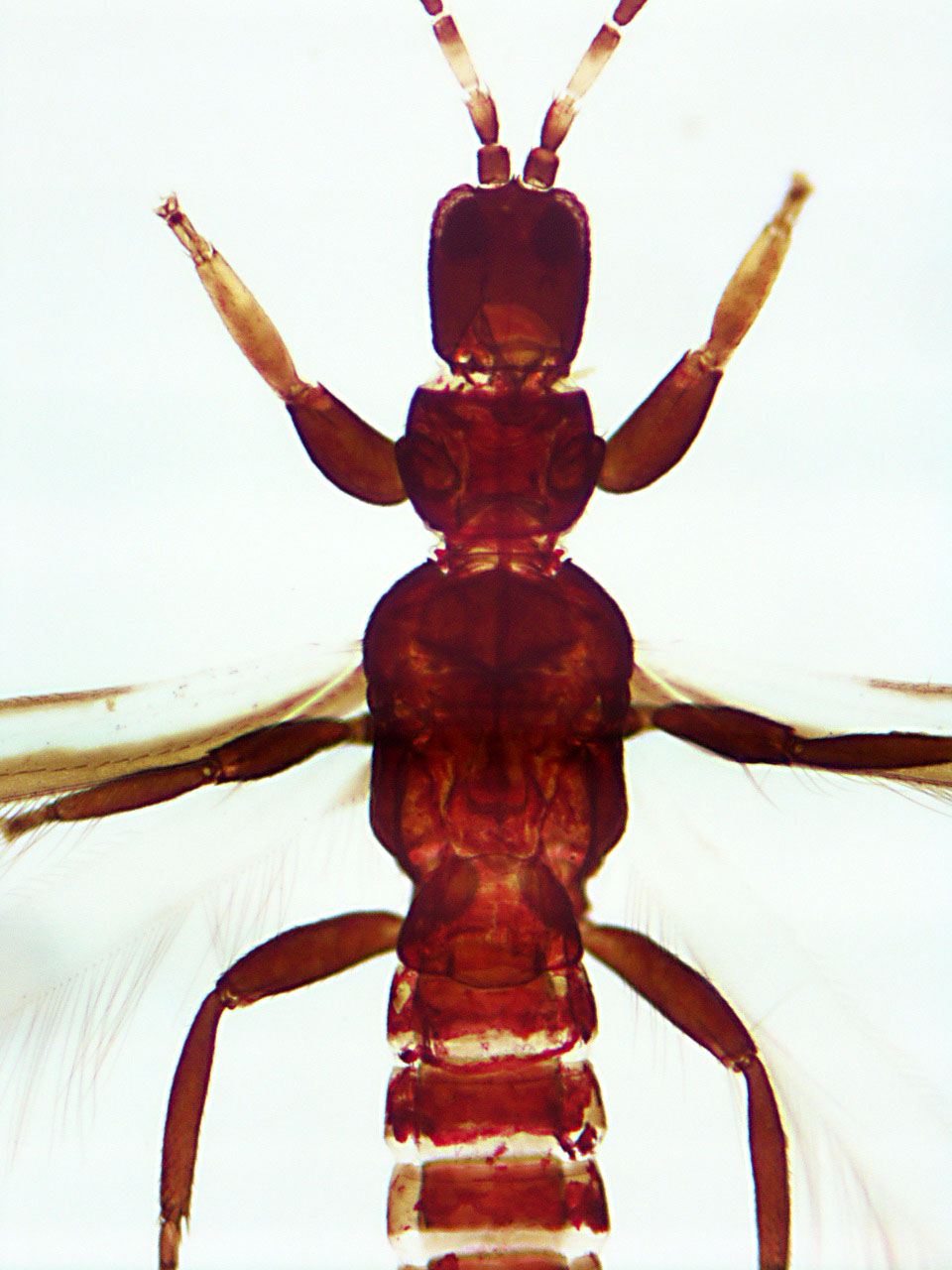
Body uniformly dark brown; fore tibiae paler; antennal segment III yellow in basal third; fore wing longitudinally darkened on posterior half and along costa, without a transverse dark band. Head about as long as wide, without long setae, eyes prolonged ventrally; distal maxillary palp segment subdivided in several small units. Antennae 9-segmented; III & IV each with a short linear sensorium, which is remarkably longer on IV; sensoria without internal markings, not curving around apex of segments. Pronotum smooth, with no long setae. Mesonotum transversely reticulate with two pairs of setae medially. Metanotum with reticulate sculpture medially; median setae close to posterior margin of sclerite; paired campaniform sensilla present. Fore wing broad, with two rows of setae; costa with setae but no cilia. Abdominal tergite not I constricted at base, tergites with weak lines of sculpture; tergite X with pair of small trichobothria. Sternites III–VII with only two pairs of posteromarginal setae, with several discal setae.
Male unknown.
Intraspecific variation
Not recorded.
Genus and similar species information
Erythrothrips is a New World genus that comprises 12 species of large dark and ant-mimic aeolothripids. The members of this genus are remarkable in having abdominal sternites bearing several discal setae, and maxillary and labial palps with distal segment subdivided into small units. Erythrothrips brasiliensis is particularly similar to E. costalis from Peru. This species can be distinguished from the other Brazilian species, E. loripes, by the quadrate head and by the colour of antennal segment III, which is pale on basal two-thirds. A key to Erythrothrips species is provided by Mound & Marullo (1993).
Mound LA & Marullo R (1993) The Erythrothrips complex of tropical Aeolothripidae (Thysanoptera) with a new Australian genus and a new South African species. Entomologica Scandinavica 24: 285–291.
Published in: 23/12/2016 Posted by: Mariana Lindner