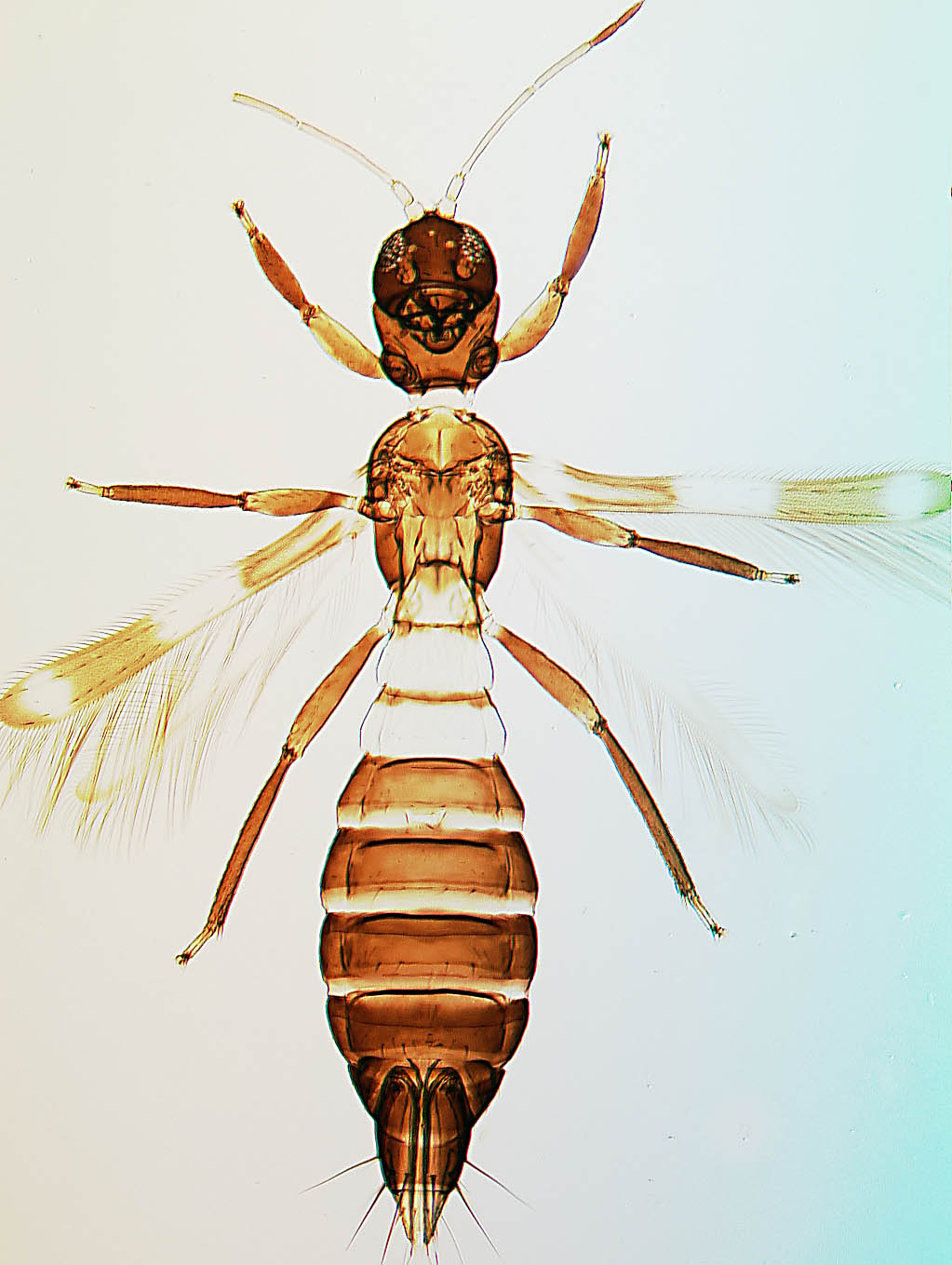
Body and legs largely dark brown, abdominal segments II & III sharply yellow except anterior margins; antennal segments I–IV yellow; tergite X also yellowish; fore wing banded, largely brown with transverse white band sub-basally, medially and sub-apically. Head wider than long, without long setae; recessed into prothorax; eyes prolonged ventrally. Maxillary palps 3-segmented. Antennae 9-segmented; III exceptionally long, more than 3.0 times as long as II; segments III & IV with linear sensory areas extending into basal quarter of segment, these areas with characteristic scalloped margins. Pronotum smooth, with no long setae. Metanotum without sculpture medially; median setae small, close to posterior margin. Fore wing with two complete rows of widely spaced setae. Abdominal tergites with discal setae small; tergite X with pair of very small trichobothria. Sternites III–VII with two pairs of posteromarginal setae, and two pairs of discal setae laterally.
Male similar in colour but with smaller and slender body; antennae exceptionally long.
Intraspecific variation
Not recorded.
Genus and similar species information
Franklinothrips is a pan-tropical genus which comprises 16 described species. Females have abdominal segments I & II more or less constricted and sometimes sharply pale, thus producing an ant-like body. Antennal segments III & IV are also exceptionally long and slender, segment III about 10.0 times as long as wide and with sinuous sensoria. F. tenuicornis was described from Panama and the fore wing pattern is similar to that of F. vespiformis, but antennal segment IV is much paler than in that species. Mound & Reynaud (2005) provided a key to the world Franklinothrips species.
World distribution
Widespread in Central and South America, including Argentina, Bolivia, Brazil, Ecuador, Mexico, Panama, Paraguay, Peru, Puerto Rico, Surinam, Trinidad and Venezuela.