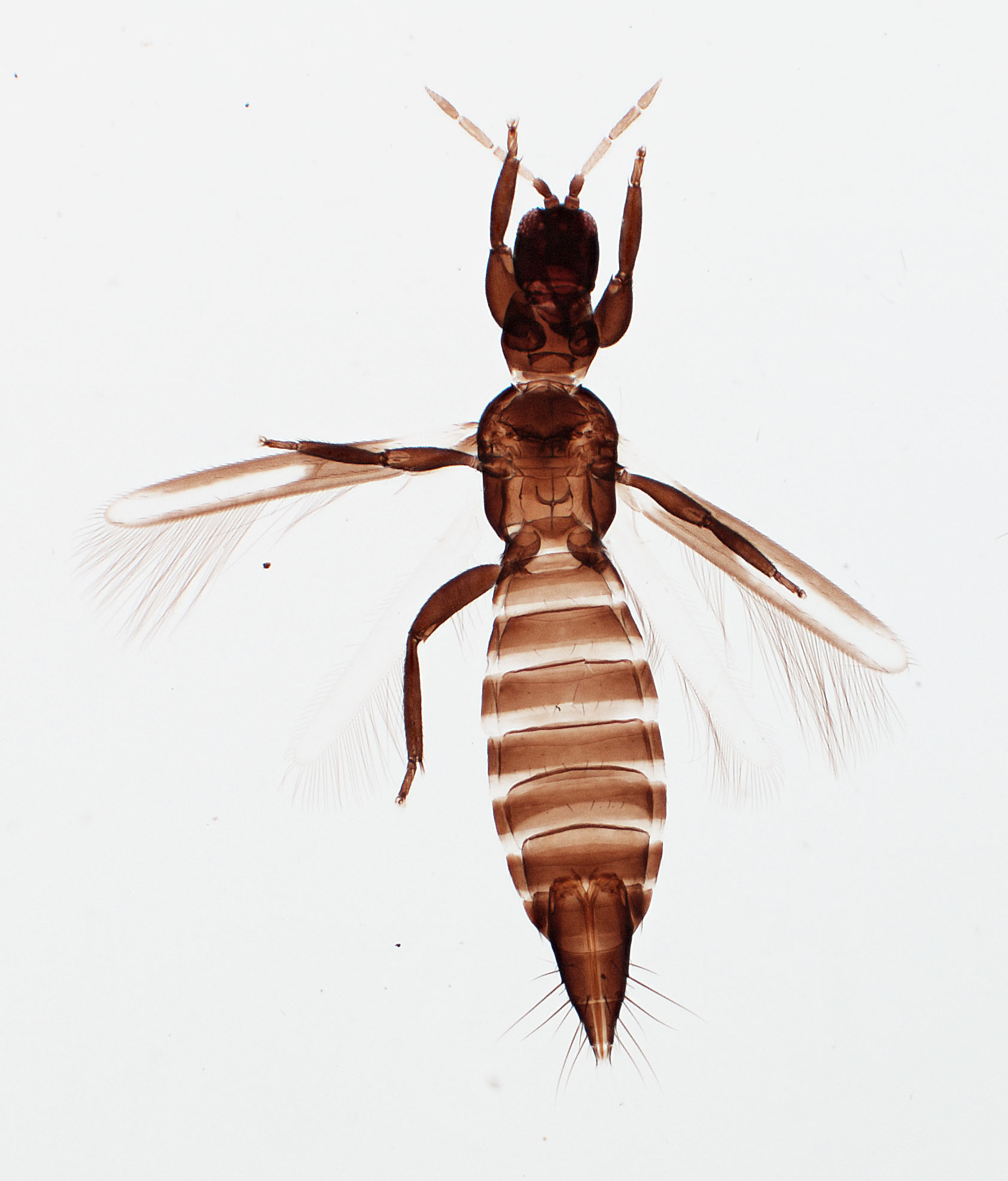
Body extensively dark brown, abdominal segments I–VII slightly paler; antennal segments III–IX light brown. Fore wing with longitudinal dark bands along anterior and posterior margins toward wing apex, clavus uniformly brown. Head about as long as wide; about 8 pairs of postocular setae in irregular double row; one pair of short setae between posterior ocelli. Antennae 9-segmented; III & IV with linear sensorium, on III straight and extending to basal half of segment, on IV curving around apex and extending to basal third of segment. Pronotum smooth, with no long setae; mesonotum and metanotum closely striate. Fore wing with two complete rows of small setae. Abdominal tergite I broad, covering the entire dorsal surface of segment; tergal median setae small and wide apart; tergite IX slightly longer than VIII; abdominal sternite III with 3 pairs of postero-marginal setae, IV–VII with 4 pairs; discal setae absent.
Male unknown.
Intraspecific variation
Not recorded.
Genus and similar species information
Ambaeolothrips is a Neotropical genus that comprises three species, all of them with antennae 9-segmented and meso & metanotum very closely striate.This group apparently shares many character states with species in the genera Aeolothrips and the Asian Streothrips.Ambaeolothrips pampeanus is the only species recorded from Brazil and a key to species is given by Mound et al. (2016).
Mound LA, Cavalleri A, O’Donnell CH, Infante F, Ortiz A & Goldarazena A (2016) Ambaeolothrips: a new genus of Neotropical Aeolothripidae (Thysanoptera), with observations on the type-species from mango trees in Mexico. Zootaxa 4132: 413–421.
Published in: 23/12/2016 Posted by: Mariana Lindner