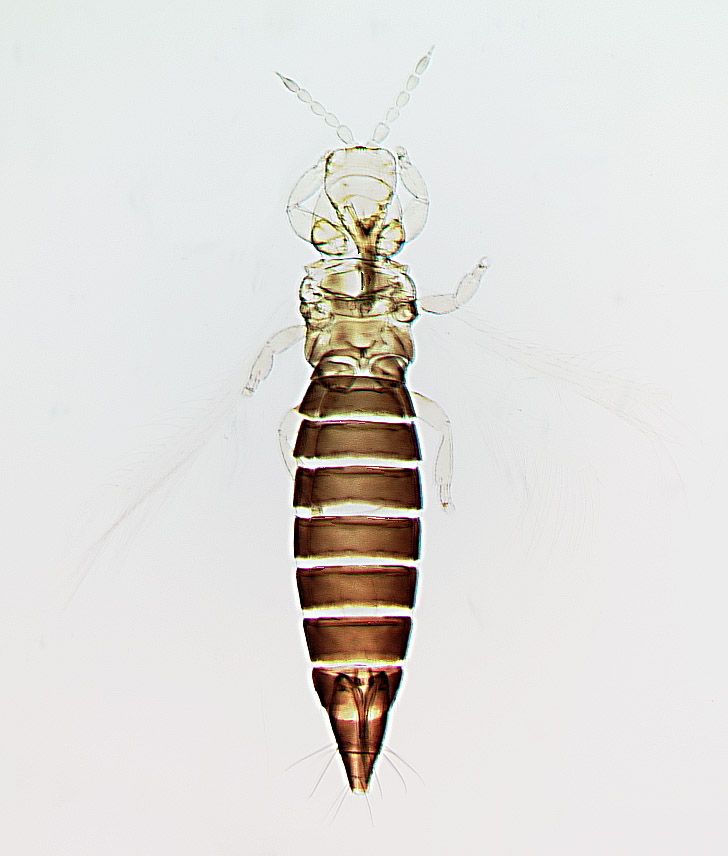
Body bicoloured, head, thorax and legs yellowish brown; abdomen uniformly dark brown; antennal segments I–IV yellow, V slightly shaded, VI–VIII light brown; fore wing uniformly pale. Head without strong sculpture, with three pairs of ocellar setae; ocellar setae III scarcely longer than posterior ocelli length; mouth cone unusually long and pointed. Antennae 8-segmented, III & IV with forked sense cones. Pronotum with faint transverse sculpture lines and two pairs of moderately long posteroangular setae; setae on anterior margin not distinctly longer than discal setae. Meso and metathoracic endofurca without spinula. Metanotum rectangular in micropterous form; broadly reticulate medially; paired campaniform sensilla present; two pairs of long setae arising at anterior margin. Tarsi 2-segmented. Fore wing with first and second vein rows of setae complete and closely spaced. Abdominal tergites with reticulate sculpture and without microtrichia; VI–VIII with ctenidia laterally, on VIII anterolateral to spiracle; II–VIII with a pair of short and widely separated median setae; VIII with an entire craspedum. Sternites without discal setae, with lobed craspedum and three pairs of long posteromarginal setae. Female macropterous or micropterous, male usually micropterous.
Male similar to female, slightly paler; small transverse pore plate on abdominal sternites III–VII.
Intraspecific variation
Antennal segments VI–VIII sometimes paler; pronotal posteroangular setae sometimes small; fore wing length variable in micropterae.
Genus and similar species information
Aneristothrips is a South American genus which includes only two species, one described from Argentina and the other from Brazil. The mouth-cone is remarkably long and pointed, reaching the mesosternum. This group shares some characteristics with Frankliniella, but has a well developed craspedum on abdominal tergites I–VIII and lacks a spinula on the mesothoracic endofurca. A. claripennis cannot be satisfactorily distinguished from A. rostratus, although the second does not have long posteroangular setae on pronotum.
Breeding on flowers of Achyrocline satureoides (Asteraceae).
Economic importance
Not recorded.
References suggested
Cavalleri A, Romanowski HP & Redaelli L (2006) Thrips species (Insecta: Thysanoptera) inhabiting plants of the Parque Estadual de Itapuã, Viamão, Rio Grande do Sul state, Brazil. Revista Brasileira de Zoologia 23(2): 367–374.
Mound LA & Marullo R (1996) The Thrips of Central and South America: An Introduction. Memoirs on Entomology, International 6: 1–488.
Published in: 23/12/2016 Posted by: Mariana Lindner