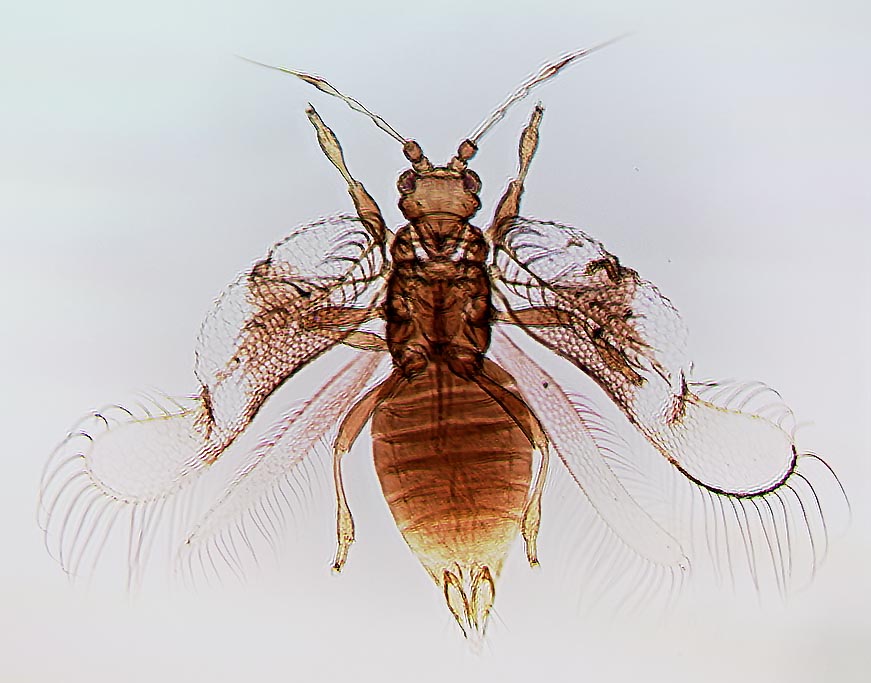
Body brown to yellowish brown, legs paler than body; antennal segment I concolorous with head, II–VIII brown; fore wing with a dark band medially. Antennae 8-segmented, III & IV each with a simple sense cone, VII–VIII elongate. Head transverse, strongly reticulate, ocelli present, mouth cone short and rounded. Pronotum transverse, with no long setae. Mesothoracic endofurca without spinula, metathoracic endofurca with long curved paired arms, which are wide apart and extend to mesothorax. Metanotum irregularly reticulate, campaniform sensilla present, one pair of long setae medially. Tarsi 1-segmented. Fore wing greatly inflated and reticulate, first and second veins incomplete with setae scarcely visible. Tergites weakly reticulate, with few and sparse microtrichia laterally; craspedum absent. Sternites reticulate, without craspedum. Both sexes winged. Both sexes winged.
Male similar to female, without ocelli; apical flat portion of fore wing shorter than in female; posterior fringe cilia wanting; broad transverse pore plate on each of sternites VII–VIII.
Intraspecific variation
Antennal segments III & IV sometimes yellowish brown. Metanotal campaniform sensilla sometimes absent.
Genus and similar species information
The genus Arachisothrips includes two other species: A. latipennis and A. seticornis, all described from the Neotropics. They are remarkable in having fore wings greatly inflated and hexagonally reticulated. A. millsi lacks an anterior pair of metanotal setae, which are well developed in A. latipennis. However, the separation of A.seticornis needs further examination (Mound & Marullo 1996).
World distribution
Described from Jamaica and also recorded from Brazil, Costa Rica and Mexico.