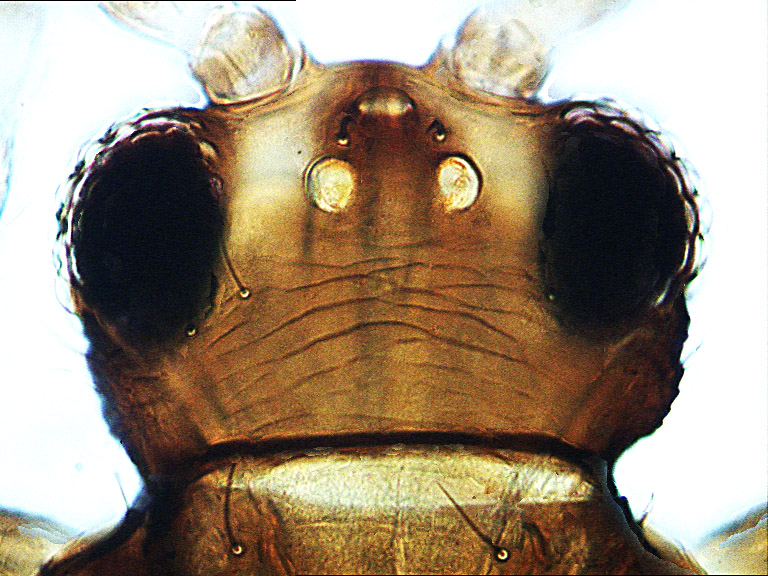
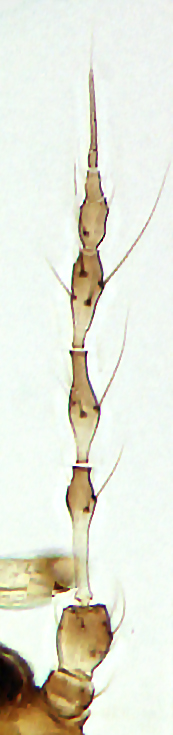
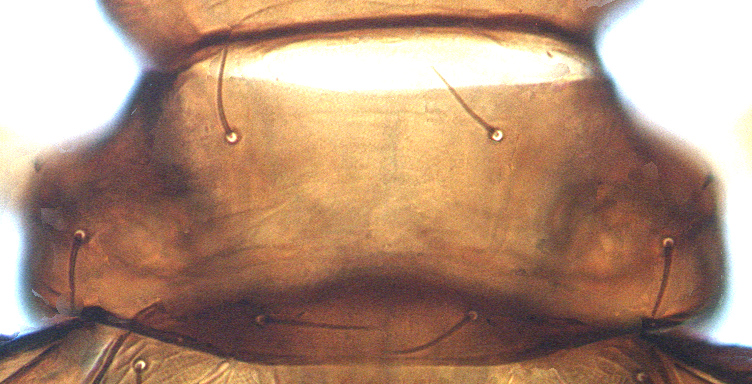
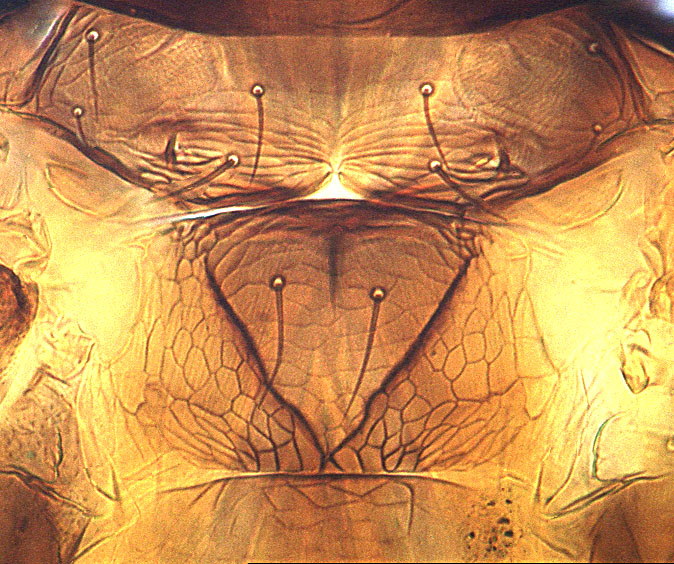
Body dark brown, tarsi and apical third of mid and hind tibiae yellow; antennal segments I–II and VI–VIII light brown; fore wing uniformly shaded, with white transverse band sub-basally and diffuse paler area sub-apically. Head transverse, slightly constricted basally; with transverse lines of sculpture medially; only one pair of ocellar setae; occipital ridge not developed. Antennae 8-segmented, III and IV with an apical neck and long, simple sense cones. Tarsi 1-segmented. Pronotum smooth, with three pairs of long setae arising well behind margins. Metanotum with sculptured triangle, and pair of long, pointed setae; campaniform sensilla absent. Metafurca lyre-shaped with long but widely separated arms. Fore wing veins with few and widely spaced setae. Abdominal tergites with elongate reticulation on lateral thirds, many microtrichia medially; VIII with comb of long microtrichia; X not divided medially. Both sexes macropterous.
Male similar to female in structure but smaller; tergite IX with two pairs of spine-like setae; sternites III–VII with transverse pore plates.
Intraspecific variation
Not recorded.
Genus and similar species information
The Neotropical genus Brachyurothrips includes this one species, which is possibly related to Selenothrips rubrocinctus. Both have similar head format and long dark setae on the fore wings. However, B. anomalus can be distinguished by the simple sense cones on antennal segments III & IV and the lack of ocellar setae pairs I & II.
World distribution
Described from Seychelles, it is also reported from Africa (Sierra Leone and South Africa) and Brazil.