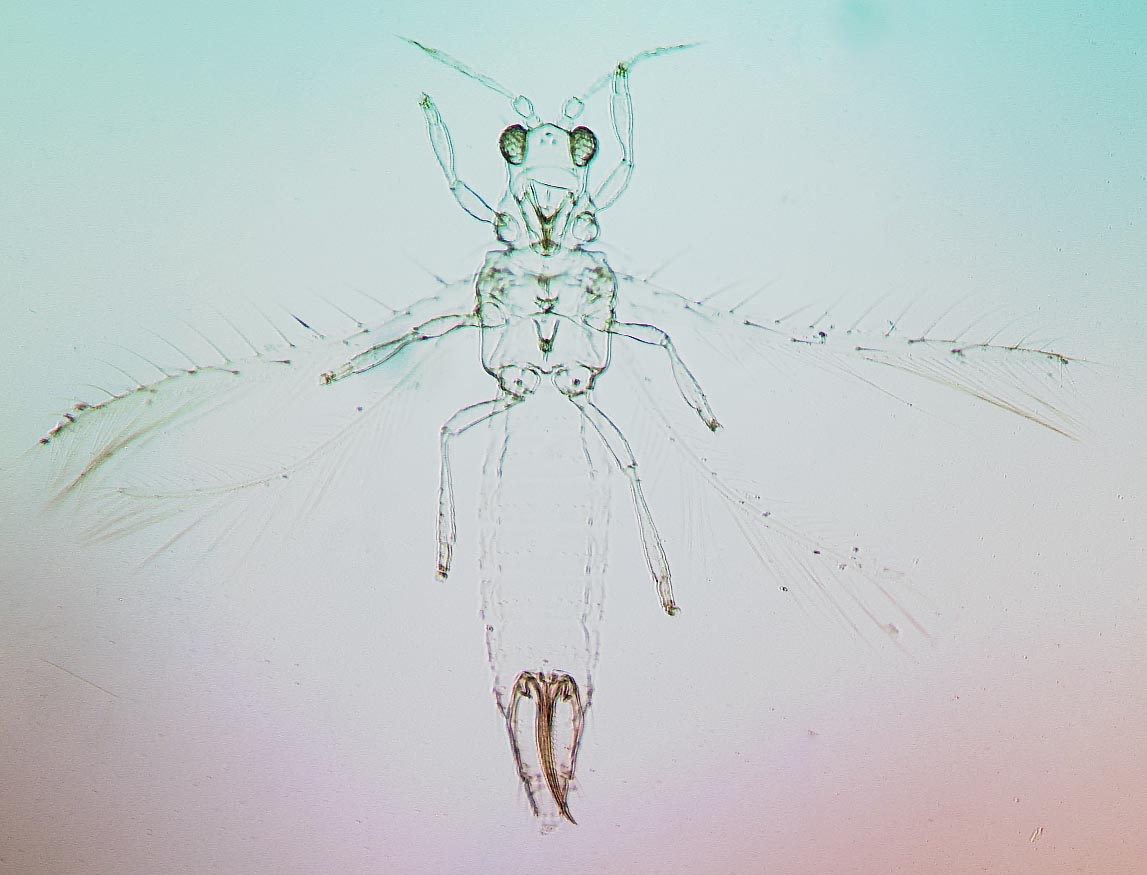
Body uniformly white; fore wing uniformly pale. Head with reticulate sculpture posteriorly; eyes large and strongly pigmented; ocellar setae I absent; one pair of remarkable long and stout postocular setae. Antennae 8-segmented, III with forked sense cone short, IV with one long simple sense cone and ventral forked sense cone. Pronotum without reticulation; two pairs of long posteroangular setae; setae on anterior margin not distinctly longer than discal setae. Mesothoracic spinula present; metathoracic endofurca with long and curved arms, without spinula. Metanotum with elongate reticulation medially; paired campaniform sensilla absent; two pairs of short setae, median pair arising well behind anterior margin. Tarsi 2-segmented. Fore wing first and second veins with few, long and sparse setae. Abdominal tergites without reticulation; II–VIII with pair of small setae medially; VIII with dentate craspedum; IX with rows of fine microtrichia. Sternites with craspeda, without discal setae; four pairs of long posteromarginal setae. Both sexes macropterous.
Male sternites III–VII each with small pore plate; tergite IX with two thorn-like setae.
Intraspecific variation
Not recorded.
Genus and similar species information
The genus Bradinothrips is Neotropical in origin and includes only one other species, B. williamsi, which is brown in colour with legs yellowish. The members of this group are characteristic in having the pedicel of antennal segment III elongate and abdominal tergites and sternites all with a broad unlobed craspedum.
World distribution
Described from Ecuador, it is also recorded from Brazil and introduced to Europe.