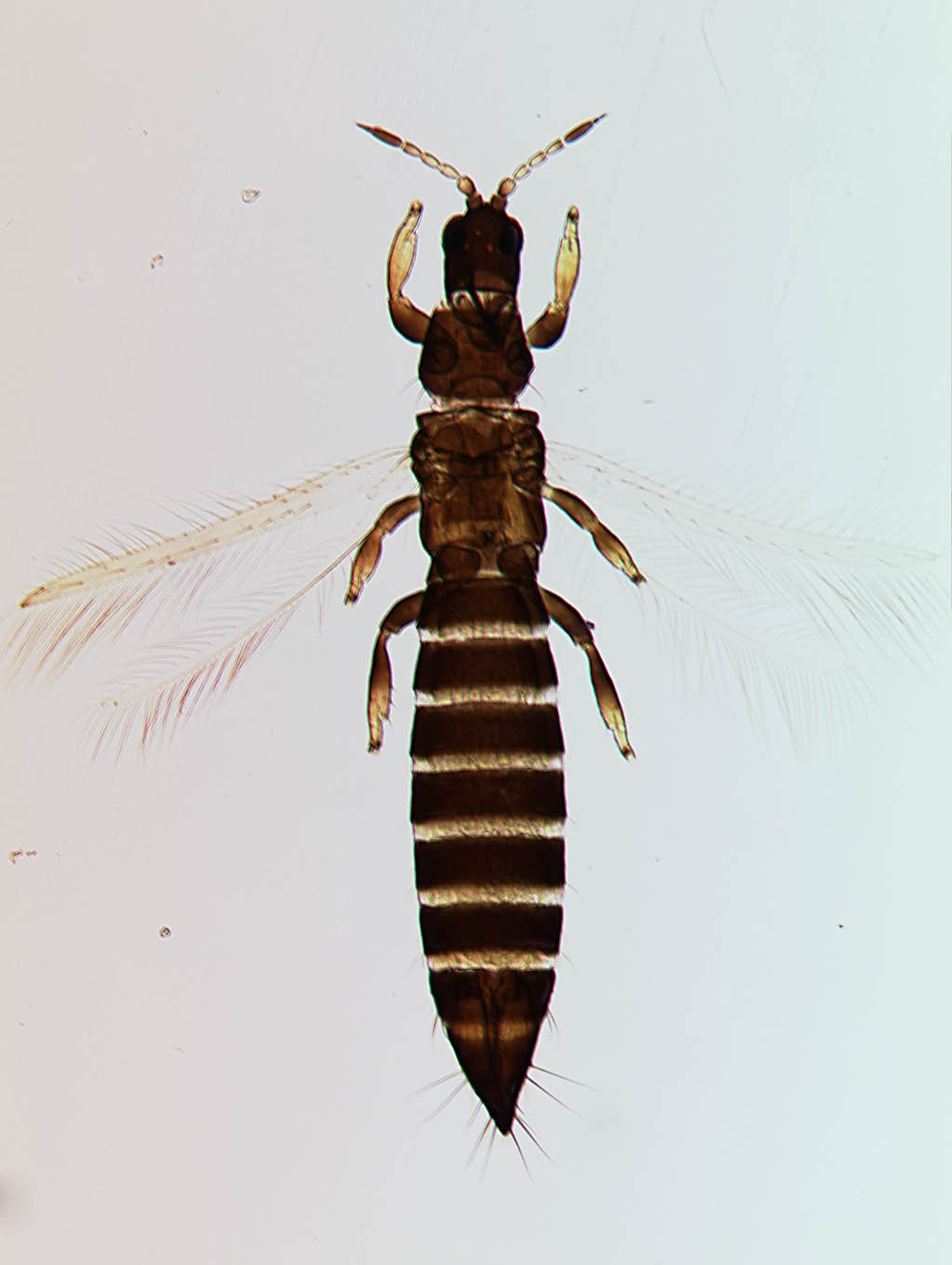
Body brown; tarsi and fore tibia extensively yellow, also apex of mid and hind tibiae; antennal segments I–II & VI–VIII brown, III–V yellow; fore wing slightly shaded. Head with few lines of sculpture posteriorly, with three pairs of ocellar setae. Antennae 8-segmented, III & IV each with simple sense cone. Pronotum slightly trapezoidal without reticulation; two pairs of long posteroangular setae; one pair of long setae anteriorly. Meso & metathoracic spinula not developed. Metanotum with transverse lines of irregular sculpture medially; campaniform sensilla absent; two pairs of long setae at anterior margin. Tarsi 2-segmented. Fore wing first vein setal row widely interrupted, second vein setal row essentially complete. Abdominal tergites with transverse lines of sculpture on lateral thirds; II–VIII with pair of small, widely separated setae medially; VIII with entire craspedum; IX unusually long; X with complete longitudinal division. Sternites without craspeda or discal setae; three pairs of long posteromarginal setae. Female macropterous and male micropterous.
Male bicoloured, body extensively brown but pterothorax and abdominal segment I bright yellow; ocelli and wings reduced; metanotum rectangular; abdominal sternites without pore plates; tergite IX with two pairs of thorn-like setae.
Intraspecific variation
Stannard (1968) treated what is now considered B. venustus as two or three different species. Bhatti (1984) discussed variation between several species. Females with sharply bicoloured body have been studied from grasses in South Brazil.
Genus and similar species information
The genus Bregmatothrips comprises nine species which are common in tropical and subtropical areas. B. venustus is the only species recorded from Brazil, and Mound (2011) provided a preliminary key to the world species.
World distribution
Widely distributed in the Americas, from USA to Argentina.
Breeding on leaves of grasses. In Brazil, it was collected on Eleusine indica, Zea mays and rice (Poaceae).
Economic importance
Probably associated with leaf damage on Zea mays (Hoddle et al. 2008).
References suggested
Bhatti JS (1984) A remarkable Bregmatothrips–like new genus from Africa, with a review of Bregmatothrips Hood and Plutonothrips Priesner. Annals of Entomology 2: 83–97.
Hoddle MS, Mound LA & Paris DL (2012) Thrips of California. CBIT Publishing, Queensland. Available at http://keys.lucidcentral.org/keys/v3/thrips_of_california/ Thrips_of_California.html
Mound LA (2011) Grass-dependent Thysanoptera of the family Thripidae from Australia. Zootaxa 3064: 1–40.
Stannard LJ (1968) The Thrips, or Thysanoptera, of Illinois. Bulletin of the Illinois Natural History Survey 29: 213–552.
Published in: 23/12/2016 Posted by: Mariana Lindner