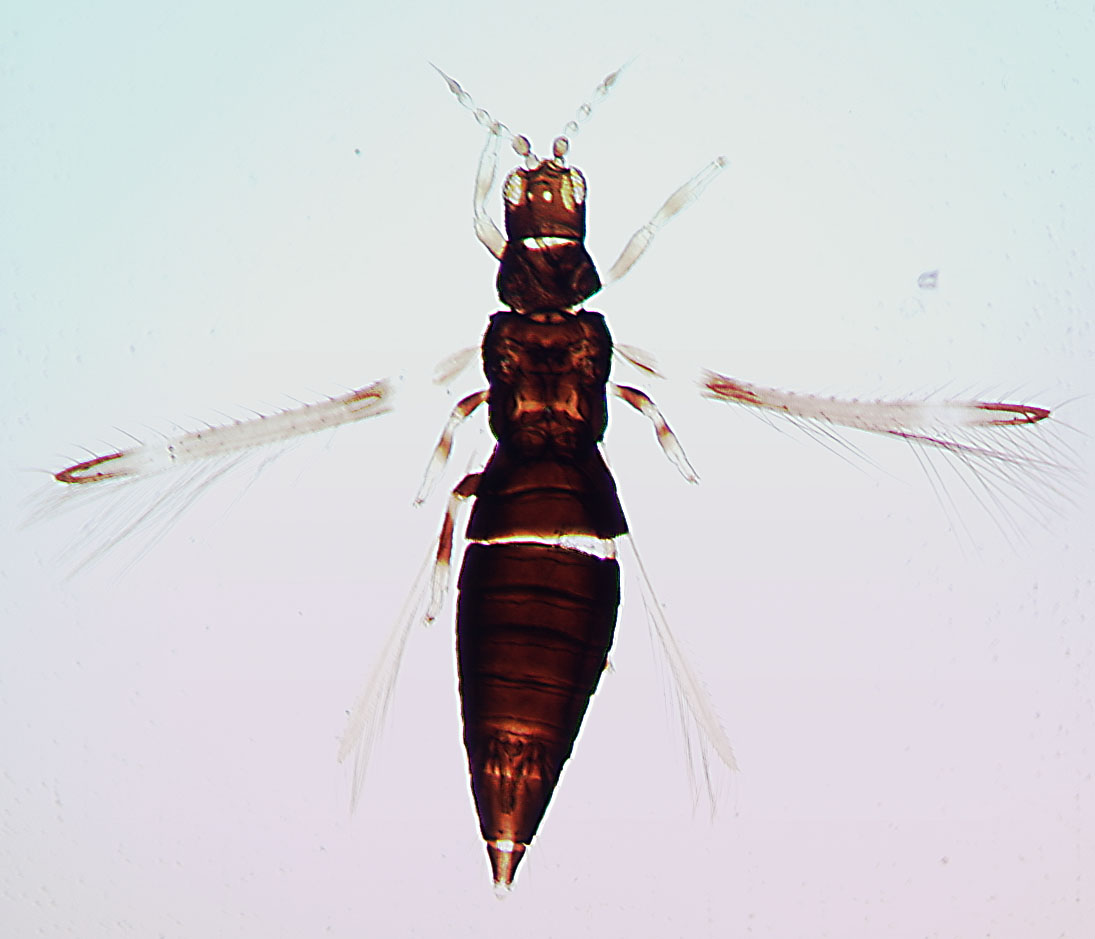
Caliothrips fasciatus (Pergande, 1895: 391).
Original reference: Pergande T (1895) Observations on certain Thripidae. Insect Life 7: 390–395.
Family
Thripidae, Panchaetothripinae
Nomenclatural information
http://thrips.info/wiki/Caliothrips_fasciatus
Diagnosis
Body dark brown; tarsi yellow, also base and apex of tibiae; antennal segments III–V yellow with brown apex; fore wing clearly banded, pale in basal quarter, dark band medially, a clearly defined subapical pale band; apex dark. Antennae 8-segmented, III & IV with forked sense cones. Head strongly reticulate and without prominent setae. Pronotum transverse and with no long setae; strongly reticulate, reticles with many wrinkle-like internal markings. Mesothoracic endofurca without spinula; methathoracic endofurca with long curved paired arms extending to mesothorax. Metanotum reticulate, median setae long and wide apart. Fore wing with setal rows incomplete on both veins. Tarsi 1-segmented; hind coxae with coiled internal apodeme. Abdominal tergites II–VIII with a median pair of setae small; posterior margins with craspedum, toothed laterally; lateral thirds of tergites reticulate, III–VIII not distinctively sculptured anteromedially. Sternites with craspedum, with three pairs of long posteromarginal setae.
Male similar to female in colour but smaller; sternites III–VII each with a small transverse pore plate.
Intraspecific variation
Not recorded.
Genus and similar species information
The genus Caliothrips includes 21 species, of which about half are described from North America. These species have wrinkles or dot shaped markings within the reticles of their body sculpture. The metathoracic furca is distinctive, with long curved paired arms extending to the mesothorax. C. fasciatus is similar in colour and sculpture to C. insularis, but the subapical pale band on the fore wing is clearly defined as in C. phaseoli. Nakahara (1991) also stated that C. fasciatus has no anteromarginal sculpture on abdominal tergites III–VIII and the pronotal internal markings form vermiform wrinkles, contrasting with the short lines and raised dots in C. insularis reticles.
World distribution
Described from USA, it is now widespread in Central America, and is recorded from Brazil.
Distribution in Brazil*
Bahia, Ceará, Rio de Janeiro and Rio Grande do Sul.
*Literature and authors’ data only.
Life history
Breeding on leaves of several plant species, particularly Fabaceae. No host plant records are available from Brazil. It is commonly named the “Californian bean thrips” in the USA.
Economic importance
Recorded as damaging bean and citrus crops (Hoddle et al. 2006).
References suggested
Hoddle MS, Stosic CD & Mound LA (2006) Populations of North American bean thrips, Caliothrips fasciatus (Pergande) (Thysanoptera: Thripidae: Panchaetothripinae) not detected in Australia. Australian Journal of Entomology 45: 122–129.
Mound LA & Marullo R (1996) The Thrips of Central and South America: An Introduction. Memoirs on Entomology, International 6: 1–488.
Mound LA, Zhang H-R, Bei Y-W(2011) Caliothrips tongi sp.n. (Thysanoptera, Thripidae) from China, and a dubious record of North American Bean Thrips. Zootaxa 2736: 57–62.
Nakahara S (1991) Two new species of Caliothrips (Thysanoptera: Thripidae) and a key to the Nearctic species. Journal of the New York Entomological Society 99: 97–103.
Wilson TH (1975) A monograph of the subfamily Panchaetothripinae (Thysanoptera: Thripidae). Memoirs of the American Entomological Institute 23: 1–354.
Attendance
Brasil, Rio Grande do Sul, Rio Grande
Campus Carreiros: Av. Itália km 8
Bairro Carreiros
Thysanoptera © Todos Direitos Reservados 2026