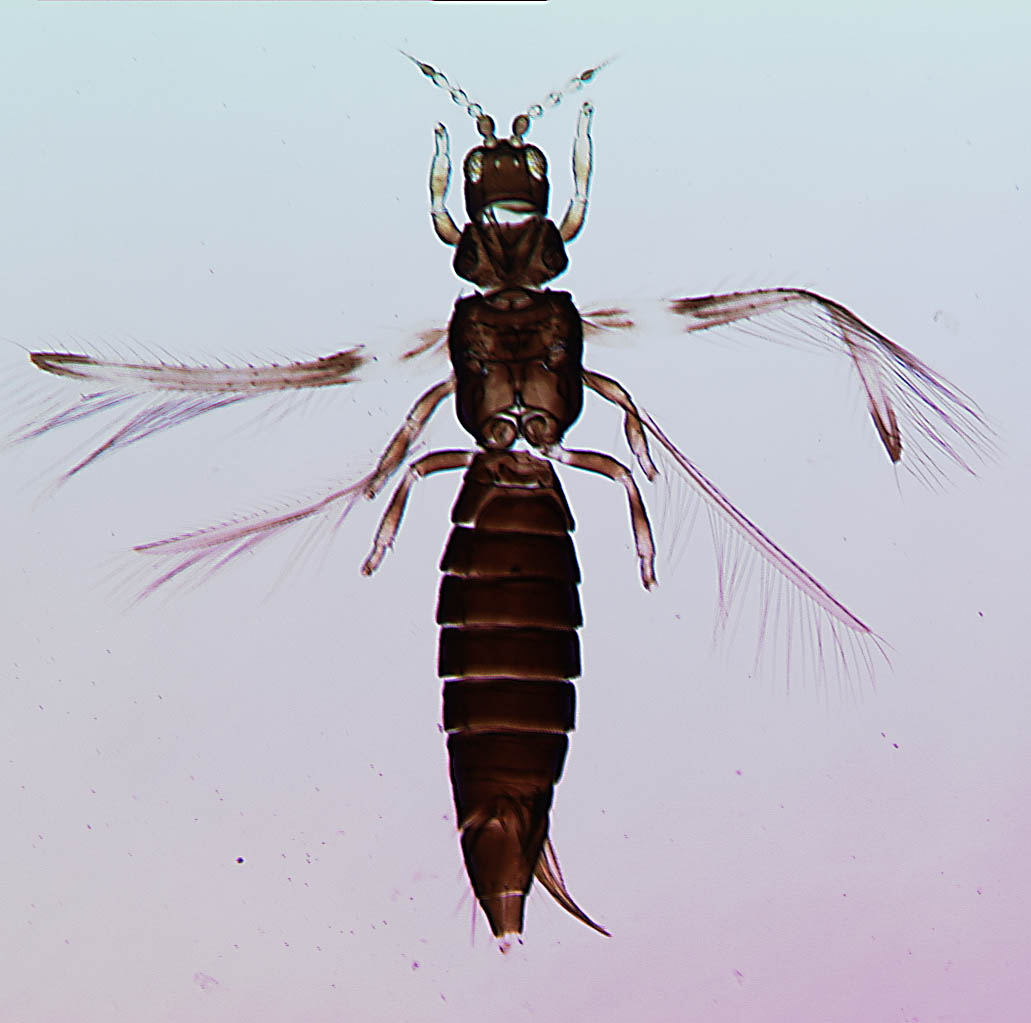
Body dark brown; tarsi and apices of tibiae yellow; antennal segments I–II & VI–VIII brown, III–V yellow but slightly shaded with brown in apical half; fore wing banded, with base brown; a sub-basal white band followed by a brown band; with a small white sub-apical area and apex dark brown. Antennae 8-segmented, III & IV each with a long forked sense cone. Pronotum with no long setae, median reticles irregular near anterior margin, with many internal markings in form of short lines and raised dots. Mesothoracic endofurca without spinula; methathoracic endofurca with long curved paired arms extending to mesothorax. Metanotum irregularly reticulate, campaniform sensilla absent, one pair of major setae near anterior margin. Tarsi 1-segmented; hind coxae with coiled internal apodeme. Fore wing with setal rows incomplete on both veins. Tergites II–VIII with large polygonal reticulation on lateral thirds; reticulations extending to anterior median half of tergites; VIII bearing craspedum medially, but with tooth-like microtrichia laterally; X with incomplete median split. Sternites with transverse reticulation.
Male not studied.
Intraspecific variation
Small white subapical area on fore wing varying in length.
Genus and similar species information
The genus Caliothrips includes 21 species, of which about half are described from North America. These species have wrinkles or dot shaped markings within the reticles of their body sculpture. The metathoracic furca is distinctive, with long curved paired arms extending to mesothorax. Caliothrips insularis is similar in colour and sculpture to C. fasciatus, but the subapical pale band on the fore wing is not clearly defined. Nakahara (1991) also stated that C. insularis has short lines and raised dots inside the reticles, while C. fasciatus has no anteromarginal sculpture on abdominal tergites III–VIII, and the pronotal internal markings form vermiform wrinkles.
World distribution
Described from USA and also recorded from Central America, Venezuela and Brazil.
Breeding on leaves, usually on dorsal surface. No information about host plant associations is available.
Economic importance
Not recorded.
References suggested
Mound LA & Marullo R (1996) The Thrips of Central and South America: An Introduction. Memoirs on Entomology, International 6: 1–488.
Nakahara S (1991) Two new species of Caliothrips (Thysanoptera: Thripidae) and a key to the Nearctic species. Journal of the New York Entomological Society 99: 97–103.
Wilson TH (1975) A monograph of the subfamily Panchaetothripinae (Thysanoptera: Thripidae). Memoirs of the American Entomological Institute 23: 1–354.
Published in: 23/12/2016 Posted by: Mariana Lindner