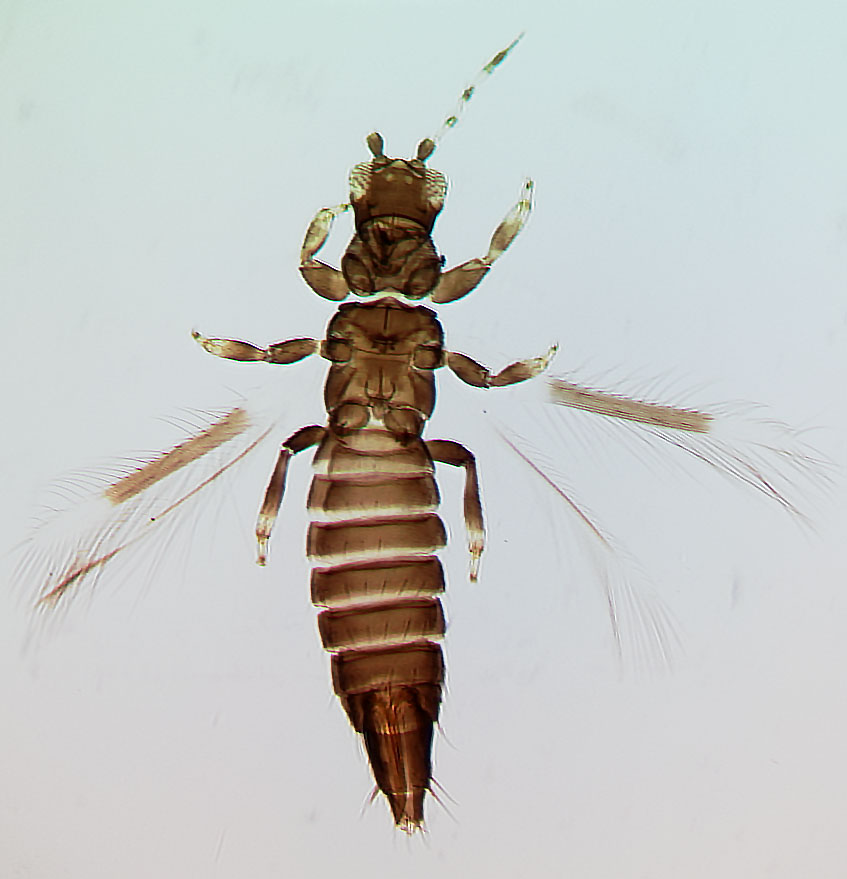
Body brown; all tarsi and apices of tibiae yellow; antennal segments I–II & VI–VIII brown, III–V extensively bright yellow with apex brown; fore wings banded, basal third and apex pale; one brown area medially. Head with several transverse lines of sculpture and three pairs of ocellar setae; ocellar region weakly sculptured. Antennae 8-segmented, III & IV with forked sense cones. Pronotum transversely striate on anterior half, but with irregular striae medially; one pair of long setae close to anterior margin, but no long posteroangular setae.Meso & metathoracic endofurca with spinula present. Metanotum with transverse lines of reticulation anteriorly, with weak sculpture posteromedially; campaniform sensilla absent; with two pairs of long setae, median pair arising behind anterior margin. Fore wing with first setal row incomplete, second vein with only two setae. Abdominal tergites I–VIII lateral thirds covered with microtrichia in closely spaced rows; II–VII with pair of short median setae; VIII with long posteromarginal comb of microtrichia. Sternites with reticulate sculpture, with three pairs of long marginal setae arising far in front of posterior margin.
Male unknown.
Intraspecific variation
Not recorded.
Genus and similar species information
This genus includes only two species, both of which are Neotropical in origin. They resemble some Scirtothrips species in general appearance (Mound & Marullo 1996), but have the sternal marginal setae arising well in front of the sterna posterior margin. Cercyothrips striatus can be distinguished from C. galbinus by its brown body colour.
World distribution
Described from Puerto Rico, it is also known from Southern Brazil.