Original reference: Moulton D (1907) A contribution to our knowledge of the Thysanoptera of California. Technical series, USDA Bureau of Entomology 12/3: 39–68.
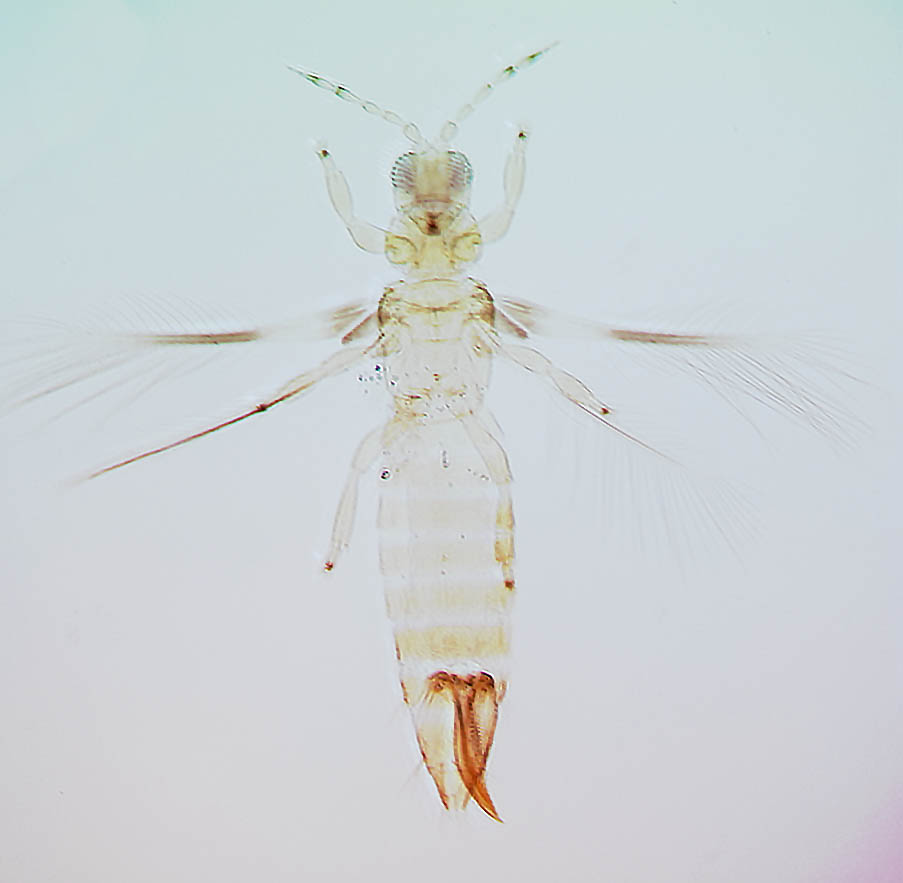
Body yellow; head and pronotum slightly shaded; antennal segments I–IV yellow, V–VI brown at apex, VII–VIII brown; fore wing banded, strongly shaded but with pale area sub-basally and apically. Head with few lines of sculpture posteriorly, ocellar setae I absent. Antennae 8-segmented, III & IV with forked sense cones. Pronotum without conspicuous reticulation, with two pairs of long posteroangular setae. Mesothoracic spinula present; metathoracic endofurca weak, without spinula. Metanotum with irregular sculpture medially; campaniform sensilla present; median setal pair short, arising behind anterior margin. Fore wing with first and second vein setal rows widely interrupted. Abdominal tergites with transverse lines of sculpture, lateral thirds with few sparse microtrichia; II–VIII with a pair of small and widely separated setae medially; VIII with dentate craspedum, spiracles with specialized area of granulate cuticle. Sternites with lobed craspedum; three pairs of long posteromarginal setae.
Male not studied.
Intraspecific variation
Pronotal posteroangular setae sometimes small.
Genus and similar species information
The genus Chaetanaphothrips includes 20 species, most of them restricted to Asia. These species have a specialized area of granulate cuticle around the spiracles on abdominal tergite VIII. There is only one other member of the genus recorded from Brazil. C. signipennis differs from C. orchidii in having ocellar setae I present, and the pronotum with only one pair of long posteroangular setae.
World distribution
Widespread in tropical and subtropical countries, especially in the Americas.
Mound LA & Marullo R (1996) The Thrips of Central and South America: An Introduction. Memoirs on Entomology, International 6: 1–488.
Nonaka T & Okajima S (1992) Descriptions of seven new species of the genus Chaetanaphothrips Priesner (Thysanoptera, Thripidae) from East Asia. Japanese Journal of Entomology 60: 433–447.
Published in: 23/12/2016 Posted by: Mariana Lindner