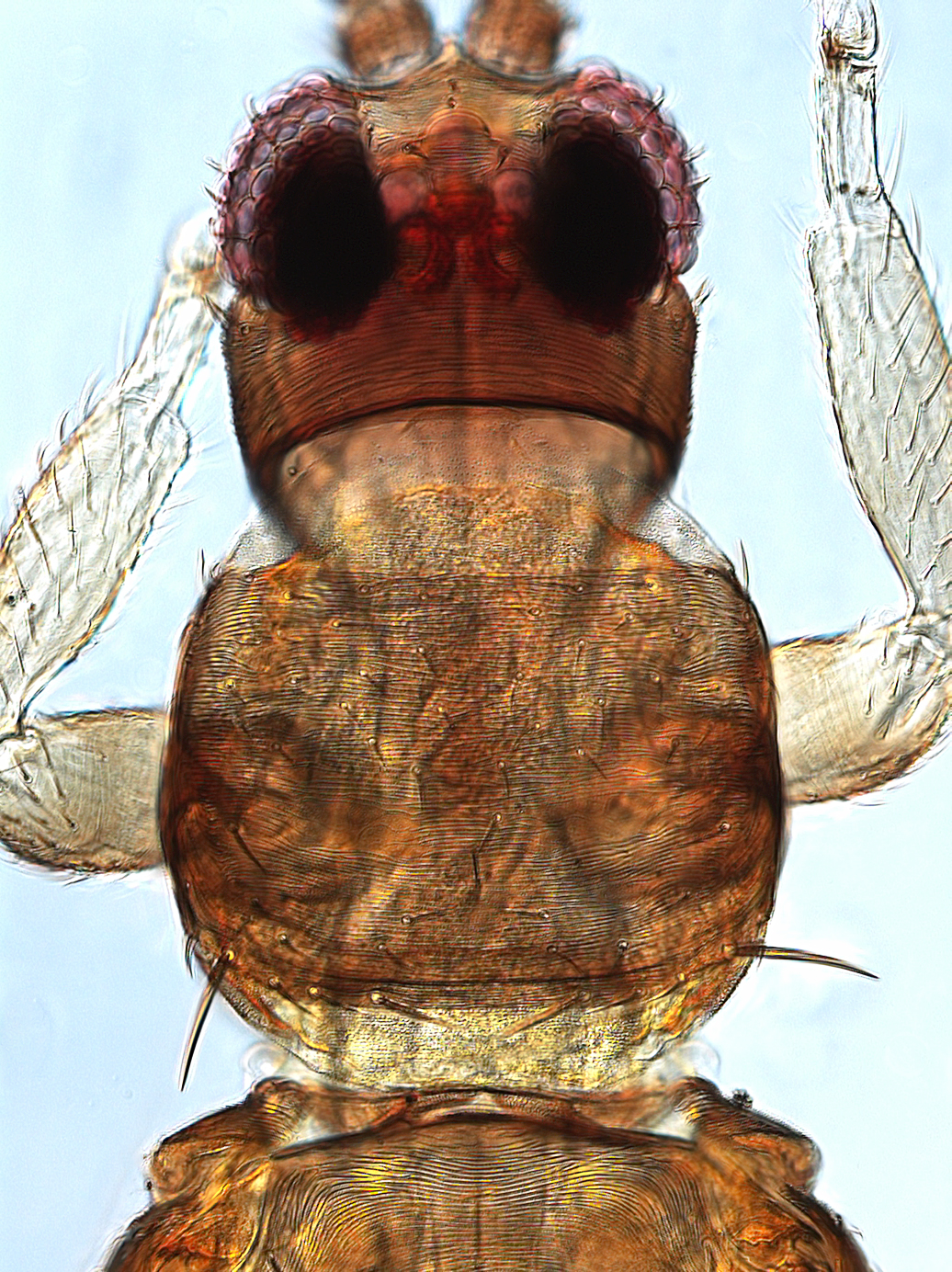
Body brown, all legs yellow; antennal segments I–VIII brown, III yellow apically; fore wings strongly shaded, basal third slightly paler. Head closely striate, three pairs of ocellar setae present. Antennae 8-segmented, III & IV with forked sense cones. Pronotum closely striate, with one pair of long posteroangular setae.Meso & metathoracic endofurca with well-developed spinula. Metanotum with transverse reticulate lines anteriorly, with longitudinal striations posteromedially; campaniform sensilla present; median setae arising behind anterior margin. Fore wing with first and second setal rows complete and closely spaced. Abdominal tergites I–VII lateral thirds with transverse lines of sculpture; II–VII with pair of short and wide apart median setae; III–VIII with lateral ctenidia; VIII with long posteromarginal comb of microtrichia and ctenidia placed posteriorly to the spiracle. Sternites with reticulate sculpture, with three pairs of long posteromarginal setae. Both sexes fully winged.
Male slightly paler than female; without pore plates on abdominal sternites.
Intraspecific variation
Outer setae on posterior angle on pronotum sometimes well-developed.
Genus and similar species information
This genus includes seven species, all of them with numerous transverse lines of sculpture on the pronotum, and both veins of fore wings with setal rows complete (Mound & Marullo 1996). Sakimura (1969) treated C. striatus as two distinct subspecies based on the length of the external posteroangular setae on the pronotum. This is the only Chaetisothrips species recorded outside of Central America.
World distribution
Described from Central America, it is widespread in Caribbean islands, and specimens from Brazil have been studied.
Possibly breeding on flowers. Adults and larvae, apparently of this species, have been studied from Chioccoca alba flowers (Rubiaceae) in South Brazil.
Economic importance
Not recorded.
References suggested
Mound LA & Marullo R (1996) The Thrips of Central and South America: An Introduction. Memoirs on Entomology, International 6: 1–488.
Sakimura K (1969) New species and subspecies of the genus Chaetisothrips from the Caribbean and Central American region (Thysanoptera: Thripidae). Florida Entomologist 52: 123–135.
Published in: 23/12/2016 Posted by: Mariana Lindner