Original reference: Johansen RM (1983) Nuevas trips (Insecta: Thysanoptera; Terebrantia, Thripidae, Thripinae) de La Sierra Madre Oriental y del eje Volcanico Transversal de Mexico. Anales del Instituto de Biologia. Universidad Nacional de Mexico 53: 91–132.
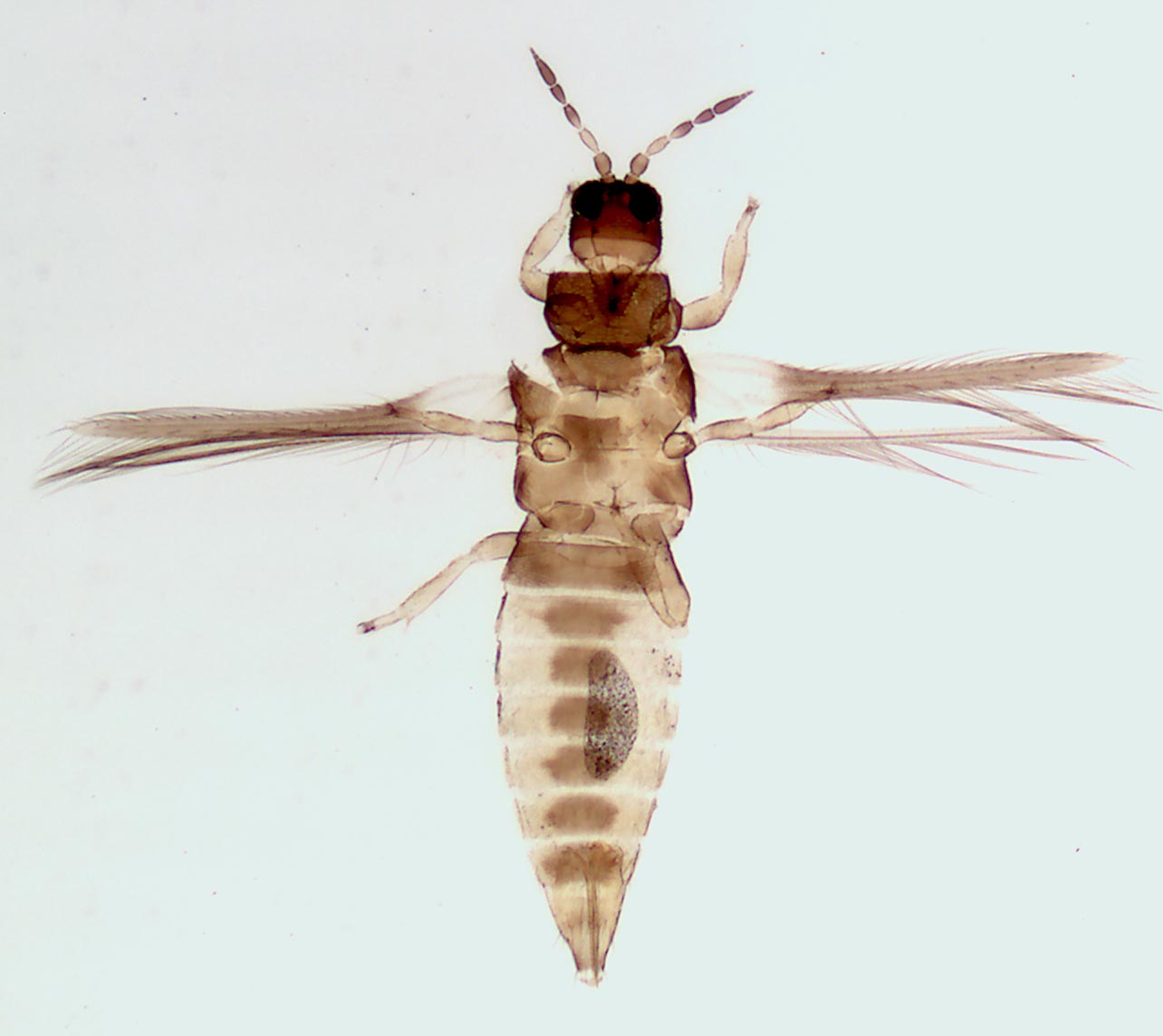
Body bicoloured; head, thorax and abdominal tergites I–II brown, III–X largely yellow with brown markings medially; all tarsi and fore tibiae yellow; antennal segments V–VIII brown; fore wings strongly shaded but sharply paler basally. Head strongly reticulate, with three pairs of minute ocellar setae. Antennae 8-segmented, III & IV with forked sense cones. Pronotum without long setae; strongly reticulate, reticles with faint internal markings. Mesothoracic spinula present but small; metathoracic endofurca without spinula. Metanotum with polygonal reticulation; campaniform sensilla absent; median setae arising well behind anterior margin. Fore wing with first setal row incomplete, second row complete; setae broad and grooved longitudinally. Abdominal tergites I–VIII lateral thirds with many transverse lines of sculpture bearing microtrichia; craspedum complete, dentate laterally but smooth medially; II–VI with pair of short and wide apart median setae; VIII with long posteromarginal comb of microtrichia. Sternites without discal setae, with three pairs of long marginal setae slightly in front of posterior margin. Both sexes fully winged.
Male with small pore plate on antecostal area of abdominal sternite III.
Intraspecific variation
The median setae on tergites II–IV sometimes long and close together.
Genus and similar species information
The genus Charassothrips comprises five species, all of them described from the Neotropics and with conspicuous reticulation on head and thorax. The abdominal tergites also bear a well-developed posteromarginal craspedum. C. incomparabilis can be recognized by the bicoloured abdomen and the broad fore wing setae. Goldarazena & Mound (2010) provided a key to the world Charassothrips species.
World distribution
Described from Mexico, it is also known from Brazil and Costa Rica.
Goldarazena A & Mound LA (2010). A new species of Charassothrips Hood from Colombia (Insecta, Thysanoptera, Thripidae) with an updated key to the known species. Journal of Insect Science 10 (70): 1–10.
Mound LA & Marullo R (1996) The Thrips of Central and South America: An Introduction. Memoirs on Entomology, International 6: 1–488.
Published in: 23/12/2016 Posted by: Mariana Lindner