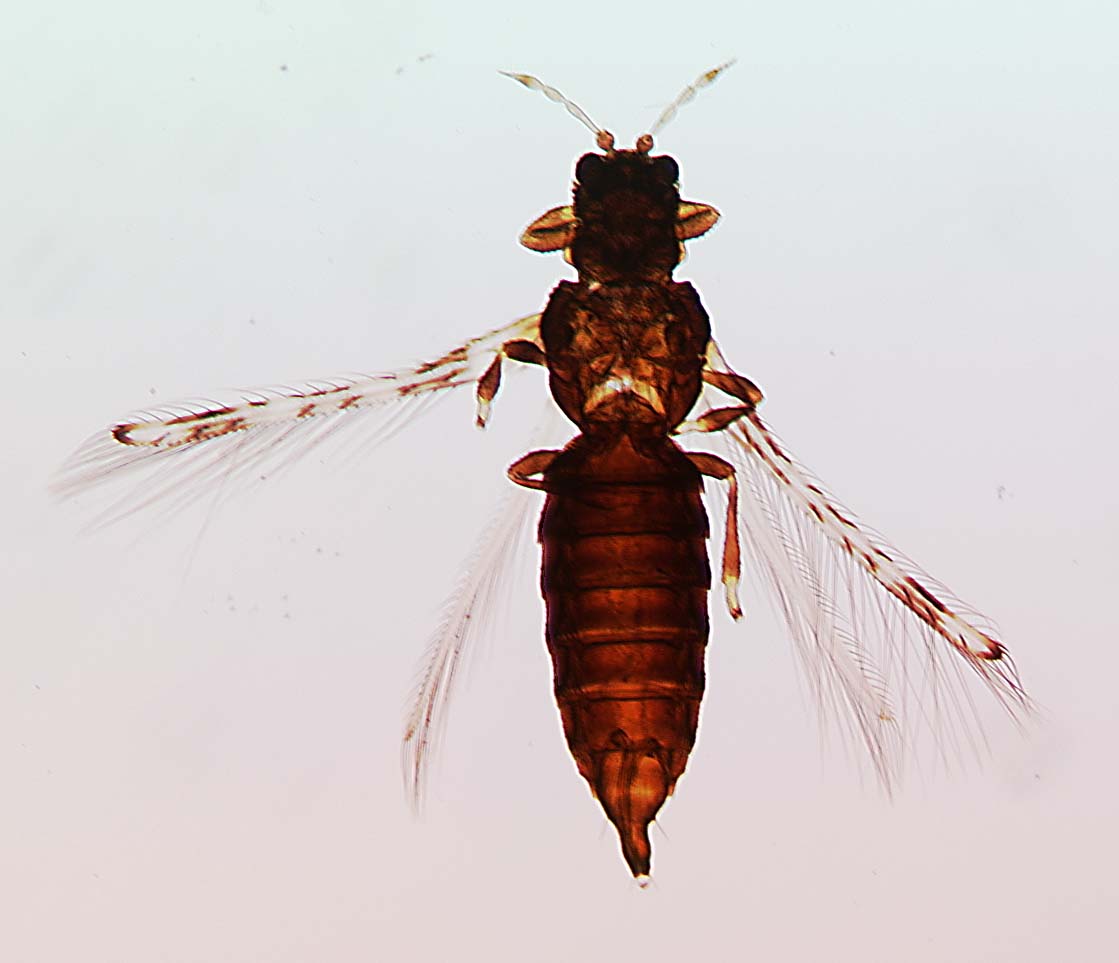
Body dark brown; tarsi yellow and tibiae extensively brown, antennal segments I–II and VI brown, III–IV yellow and V brown in apical half; fore wing banded, brown basally with a white band sub-basally, medially and sub-apically; apex dark. Head strongly sculptured and not distinctly constricted behind eyes; ocellar region strongly elevated. Antennae 6-segmented, III & IV with forked sense cones; VI elongated. Pronotum reticulate, without long setae; without internal markings on reticles. Mesothoracic endofurca without spinula and metathoracic endofurca with long curved paired arms extending to mesothorax. Mesonotum with sculpture converging posteriorly in midline, giving an appearance of a false longitudinal division, completely divided only in posterior 1/5. Metanotum with reticulate median area forming a triangle, paired campaniform sensilla present; one pair of long setae arising medially. Tarsi 1-segmented. Fore wing with first and second setal rows incomplete; veinal setae stout and dark, about 0.75 times as long as fore wing median width. Abdominal tergites II–X bearing reticulate sculpture; II–VIII with one pair of small and wide apart median setae; II with a group of recurved and stout microtrichia anterolaterally; X slightly elongate with complete longitudinal division, usually asymmetric; segment X constricted in basal fourth, widened medially and then narrowed again at apex. Sternites reticulate and with three pairs of small posteromarginal setae. Female macropterae.
Male unknown.
Intraspecific variation
Not recorded.
Genus and similar species information
Hoodothrips is a Neotropical genus closely related to the Old World genus Astrothrips. Comprises three species that have strongly fusiform setae on fore wings and a group of stout and recurved microtrichia on abdominal tergite II. Hoodothrips constrictus is very similar to H. brevipilus, which also has 6-segemented antenna, but has longer veinal setae on fore wings and segment X sharply constricted basally and apically.
World distribution
Described from Trinidad, it is widespread in Central America. It is also recorded from Argentina, Brazil and USA.