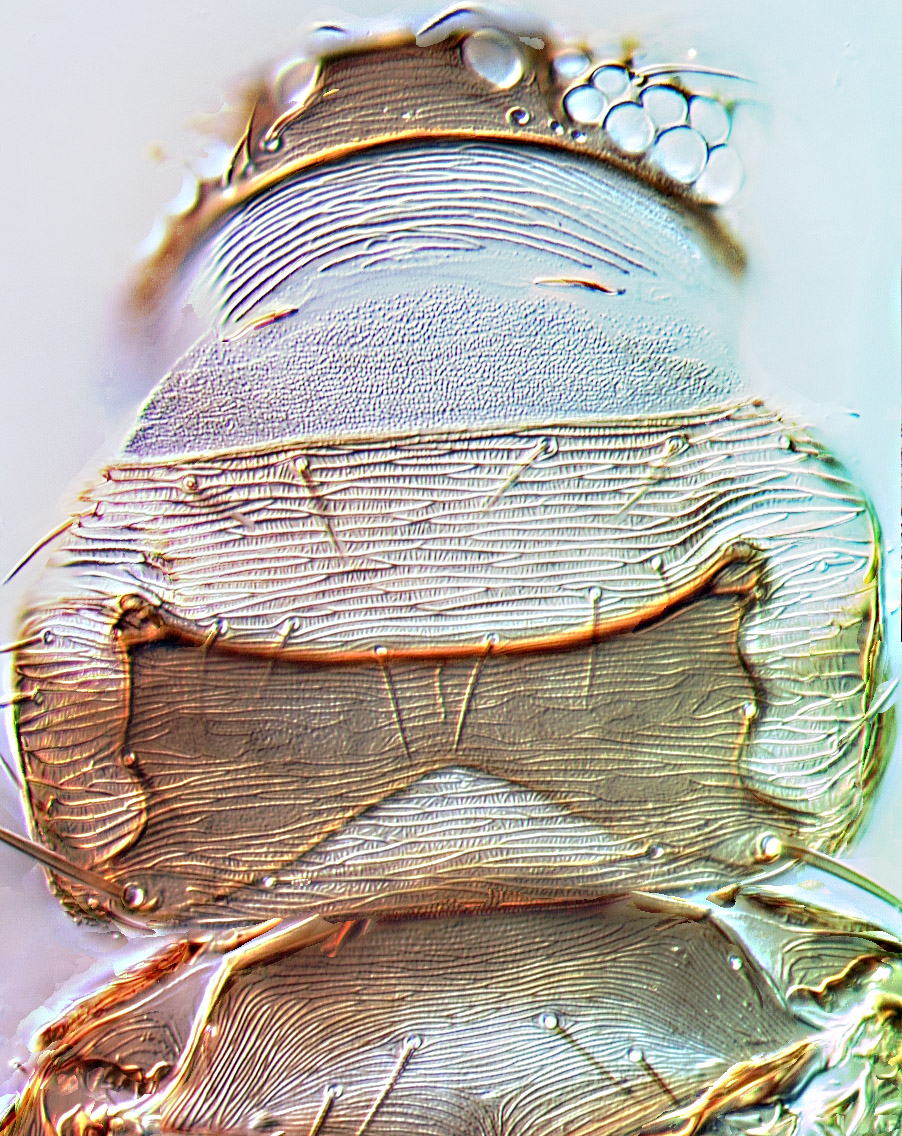
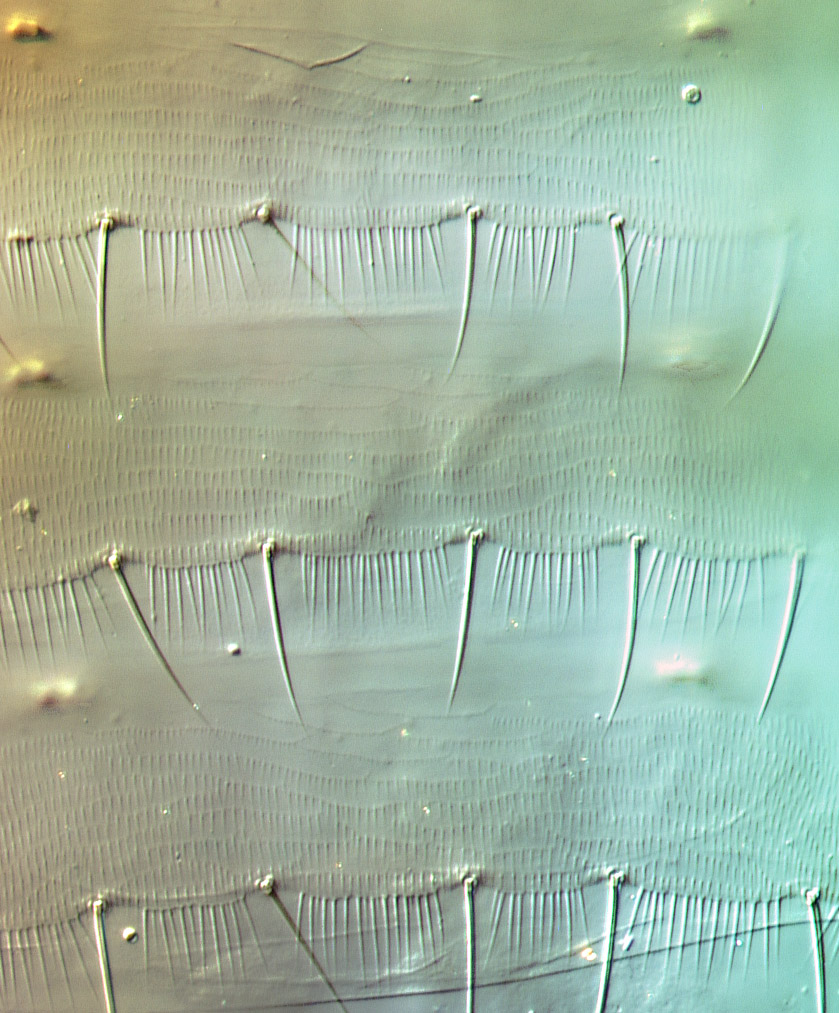
Body dark brown, abdominal tergite VI pale; fore wings dark with white sub-basal area and an indistinct paler area medially; antennal segments I–III (or IV) largely pale; hind femora brown, hind tibiae yellow. Head with occipital apodeme confluent with posterior margin of eyes, ocellar area transversely striate. Antennal segments III & IV with constricted apical neck. Pronotum with anterior area transversely striate to narrowly reticulate with many markings between the major lines, pronotal blotch well-defined; mesonotum and metanotum striate with markings between the striae. Fore wing second vein with two setae. Tergites II–VIII with comb of microtrichia, usually complete but very short on II–VI; tergite IX with 2 pairs of mid-dorsal setae. Sternites with microtrichia present medially, posterior margin with long fringe.
Male similar to female, but smaller, and tergite VII mostly pale with suffused brown area medially.
Intraspecific variation
Not recorded.
Genus and similar species information
About 40 species are included in Hydatothrips, most of them bicoloured and with banded fore wings. This group is closely related to Neohydatothrips and can be distinguished by the presence of a deeply V-shaped apodeme on metasternum. Hydatothrips sternalis is a dark species with dark fore wings, and the tergites usually have a complete posteromarginal comb. A key to Hydatothrips species from Neotropics is provided by Lima & Mound (2016).
World distribution
Described from Panama, but also recorded from Brazil, Ecuador and Martinique.
Unknown; specimens have been collected from various plants including Citrus.
Economic importance
Not recorded.
References suggested
Lima EFB & Mound LA (2016) Species-richness in Neotropical Sericothripinae (Thysanoptera: Thripidae). Zootaxa 4162(1): 1–45.
Mound LA & Marullo R (1996) The Thrips of Central and South America: An Introduction. Memoirs on Entomology, International 6: 1–488.
Nakahara N (1988) Generic assignments of North American species currently assigned to the genus Sericothrips Haliday (Thysanoptera: Thripidae). Proceedings of the Entomological Society of Washington 90: 480–483.
Published in: 29/12/2016 Posted by: Mariana Lindner