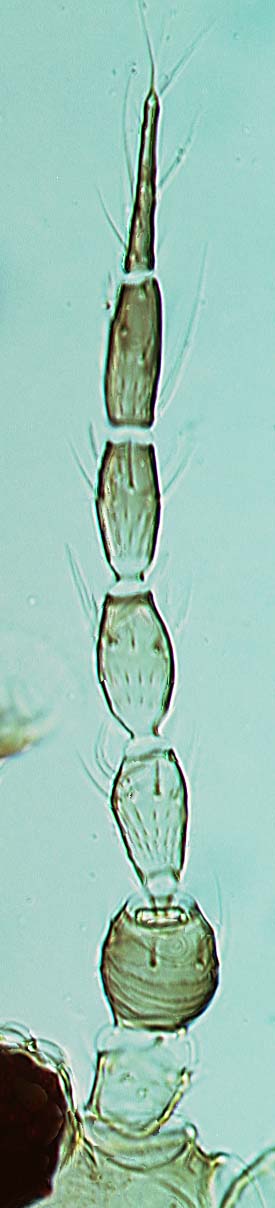
Body almost white coloured; all tarsi and tibiae yellow; anterior margin of the head slightly shaded; antennal segment II brown, III–VII shaded; fore wing uniformly dark. Head without reticulation; ocellar setae pair I absent. Antennae 7–segmented, III & IV with forked sense cones in female but simple in male; VII elongated. Pronotum with transverse sculpture lines and a pair of stout transverse apodemes latero-medially; reticles without internal markings; 4 pairs of posteromarginal setae, two pairs of long posteroangular setae. Mesothoracic endofurca with spinula and metathoracic endofurca lyre-shaped. Metanotum with closely spaced longitudinal lines of sculpture; paired campaniform sensilla absent; two pairs of setae, median pair small and far behind anterior margin. Tarsi 1-segmented. Fore wing first vein with two prominent setae on distal half and second vein absent. Abdominal tergites I–VIII covered with microtrichia arranged laterally on the sculpture lines; II–VIII with a pair of long and close together median setae; VIII with posteromarginal comb of microtrichia. Sternites without discal setae; three pairs of long posteromarginal setae. Both sexes fully winged.
Male without pore plates on abdominal sternites.
Intraspecific variation
Anterior margin of the head sometimes not distinctively shaded.
Genus and similar species information
TheNew Worldgenus Leucothrips includes five species, all of them small and white coloured, and with lyre-shaped metathoracic endofurca. This group is not clearly distinguished from the Neotropical genus Halmathrips, and is also closely related to Pseudodendrothrips. The other Leucothrips species recorded from Brazil, L. pictus, can be distinguished from L. nigripennis by the 8-segmented antennae and paler fore wings.
World distribution
Widely distributed in Europe, also recorded from India, Australia, Brazil and USA.
Breeding on leaves, particularly on fronds of several ferns.
Economic importance
Reported damaging fronds of cultivated ferns.
References suggested
Mohan Daniel A (1985) A new genus and species of fern infesting thrips (Thysanoptera: Insecta) with further notes on Mycterothrips nilgiriensis (Anan.). Current Science (Bangalore) 54(11): 528–530.
Mound LA (1999) Saltatorial leaf-feeding Thysanoptera (Thripidae, Dendrothripinae) in Australia and New Caledonia, with newly recorded pests of ferns, figs and mulberries. Australian Journal of Entomology 38: 257–273.
Published in: 29/12/2016 Posted by: Mariana Lindner