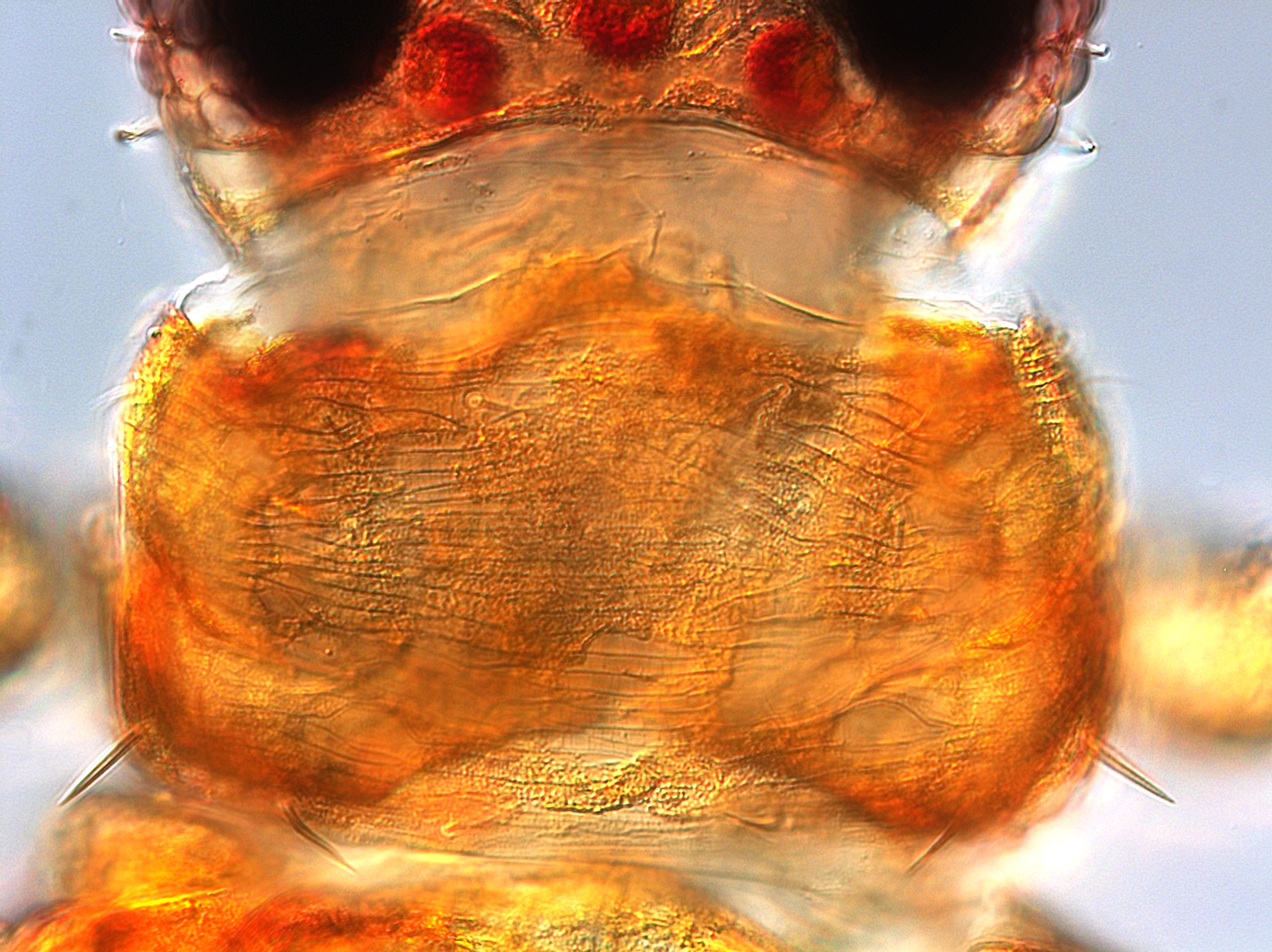
Species not studied on the current work. Body mostly yellow but with darker transverse bands on the base of abdominal tergites II–VIII, fore wings grey, darker on basal and anal regions. Head with fine longitudinal striation in front of ocelli. Pronotum with striate sculpture, fine lines between striations present. Metathoracic endofurca lyre-shaped. Hind tibia with two strong spurs on apex. Abdominal segment VIII with a complete comb of microtrichia.
Male not studied.
Intraspecific variation
Not recorded.
Genus and similar species information
The genus Pseudodendrothrips includes 20 described species, but the significance of some of the species in which the body colour is mainly yellow remains conjectural. This genus is commonly used for species with the hind tarsi exceptionally long but it is not satisfactorily distinguished from the Neotropical Leucothrips and Halmathrips. The species in all of these genera have a characteristic 'lyre-shaped' metathoracic endofurca and possibly represent a single clade. Pseudodendrothripsfulvus is differentiated from the other neotropical species of the genus by the body mostly yellow, contrasting to P. alboniger, but bearing brown spots on abdomen, differently from P. mori.
Breeding on leaves, being collected from Dalbergia sp.
Economic importance
Not recorded.
References suggested
Mound LA & Tree DJ (2016) Genera of the leaf-feeding Dendrothripinae (Thysanoptera, Thripidae), with new species from Australia and Sulawesi, Indonesia. Zootaxa 4109 (5):569–582.
Published in: 30/12/2016 Posted by: Mariana Lindner