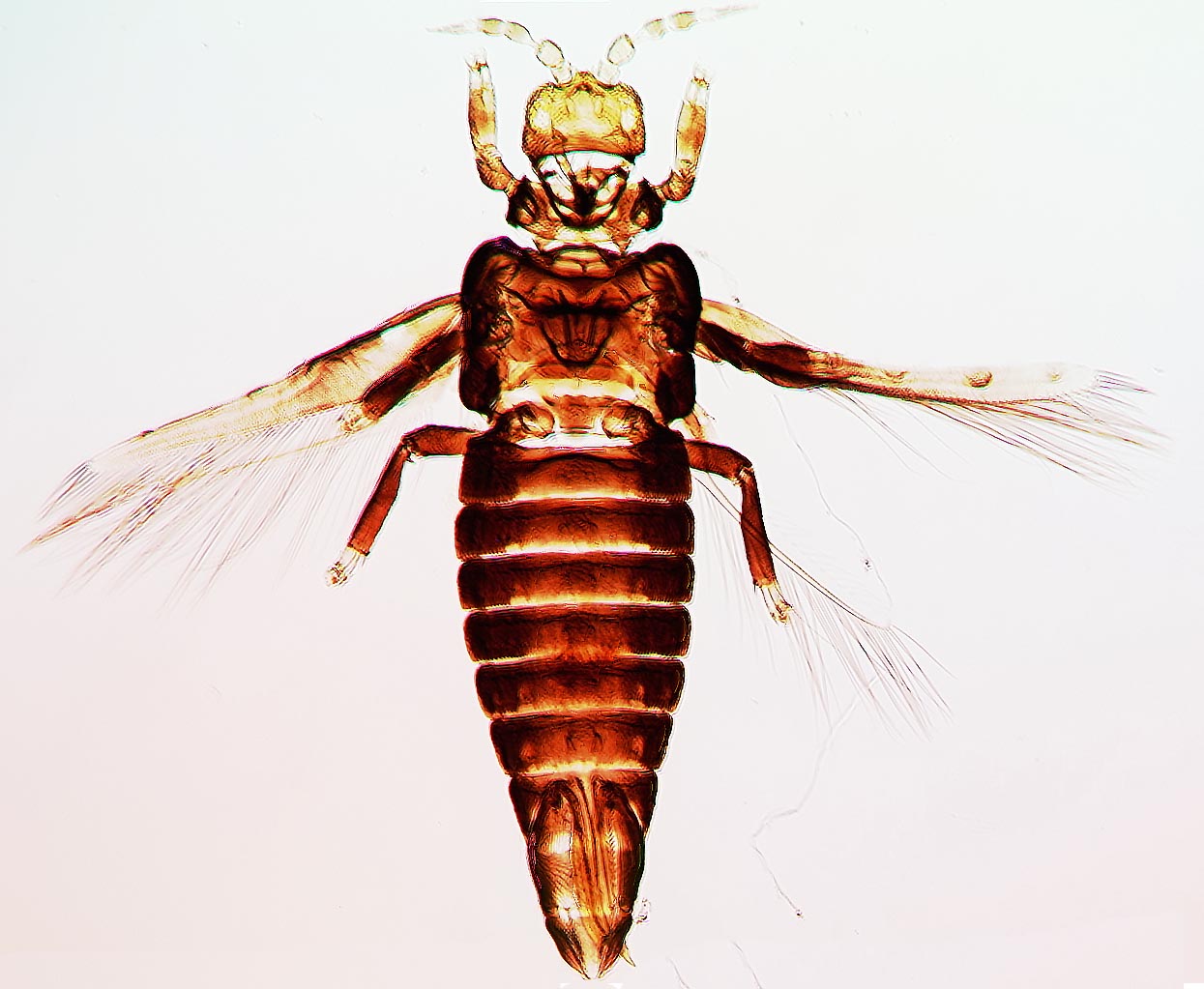
Body dark brown, tarsi paler; antennal segments brown, except for V and basal third of III, which are yellow; fore wing brown with dark swellings. Head strongly sculptured but not distinctly constricted behind eyes; ocellar region strongly elevated anteriorly. Antennae 8-segmented, III & IV with forked sense cones which lack basal stem, arising from a common socket; VIII long and slender. Pronotum short and transverse; without long setae; reticulate and with faint internal markings on reticles[AU1] . Mesothoracic endofurca without spinula and metathoracic endofurca with long curved paired arms extending to mesothorax. Metanotum forming a bold triangle medially enclosing transverse reticulation; paired campaniform sensilla absent; one pair of setae arising posteriorly. Tarsi 1-segmented. Fore wing exceptionally broad and with three blister-like swellings; with first and second setal row incomplete, the last one almost complete, with about 10 widely spaced setae. Abdominal tergite I eroded posteriorly; I–X with polygonal reticulation with internal markings; III–VIII with a pair of long median setae; II–X strongly depressed medially; VIII with long posteromarginal comb of microtrichia. Sternites reticulated and with three pairs of small posteromarginal setae. Both sexes fully winged.
Male with sternites III–VIII with large and transverse glandular areas; pore plate on III covering the median half on the sternite.
Intraspecific variation
Wilson (1975) considered the sensoria on antennal segments III and IV to be two simple sense cones, but these structures are here interpreted as single, basally forked sense cones.
Genus and similar species information
The genus Retithrips is possibly related to Heliothrips and includes one more species, R. javanicus, which can be distinguished from syriacus by the number of blister-like swellings on fore wing (Wilson 1975).
World distribution
Widely distributed in Africa and Asia, also recorded from USA and Brazil.