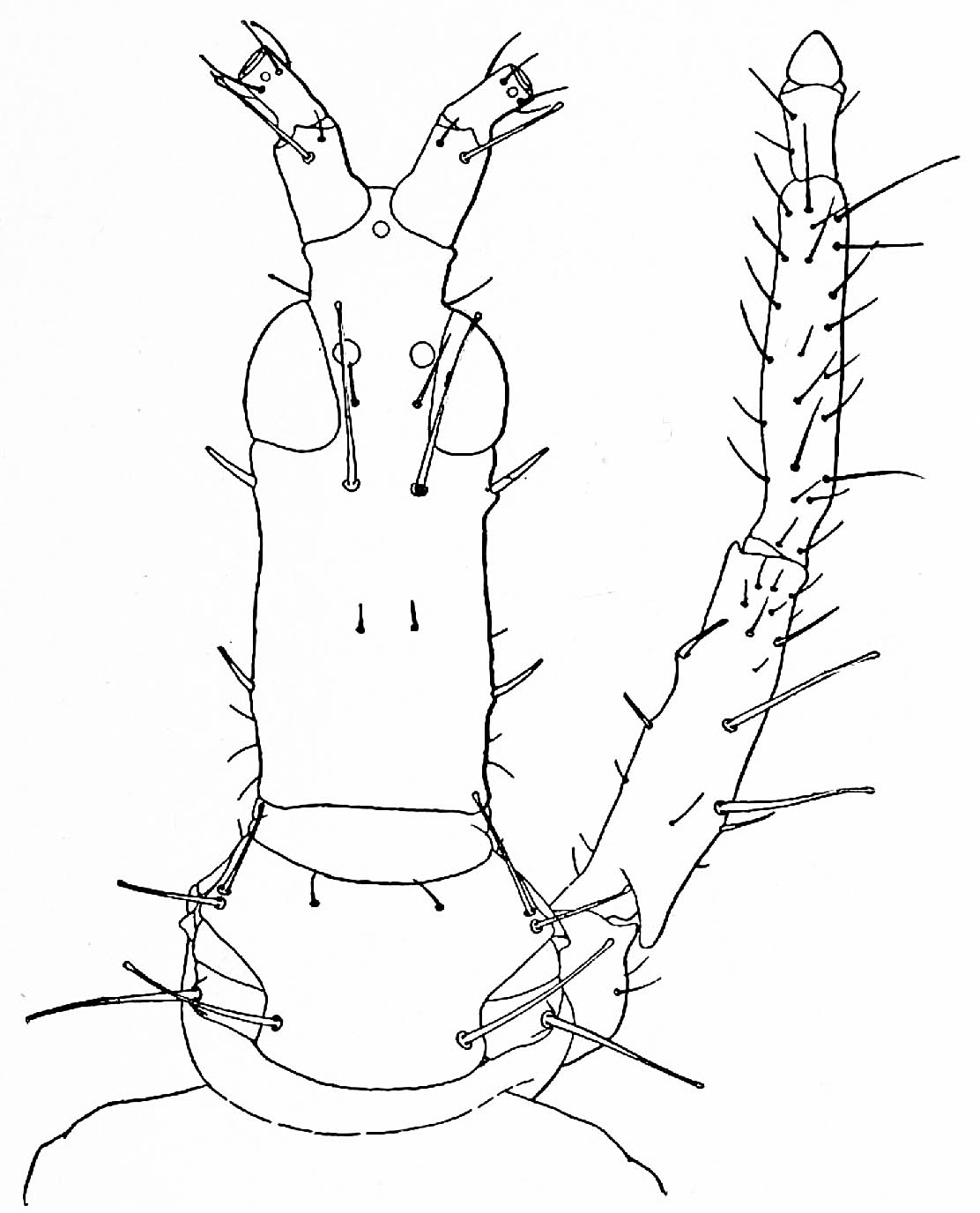
Actinothrips bondari Hood, 1928: 147.
Original reference: Hood JD (1928) A new Actinothrips (Thysanoptera) from Brazil. Bulletin of the Brooklyn Entomological Society 23: 147–150.
Family
Phlaeothripidae, Idolothripinae
Nomenclatural information
https://thrips.info/wiki/Actinothrips_bondari
Diagnosis
Female macropterous; body color mainly dark brown, darker on abdomen, fore tibiae and all tarsi yellowish; antennomeres I–II brown, III–V yellow with apexes gradually darker, VI light brown with pale pedicel, VII–VIII light brown; wings pale, slightly shaded basally, and with an almost black median line. Antennae 8-segmented, segments III–V extremely long and club-shaped. Head longer than wide, with one pair of long setae dorsally and two pairs laterally, all posterior to the eyes; lateral margins slightly sinuous; maxillary stylets wide apart, extending to half of head length. Pronotum with 4 pairs of well-developed setae (anteroangular, midlaterals, epimerals and posteroangulars), anteroangular and midlateral pairs very close together; prosternal basantra absent. Metanotum reticulated, with one pair of long and thick setae medially, and two or three thin setae on anterior angles. Metathoracic sternopleural sutures absent. Pelta triangular and wide, weakly reticulated medially and transversely striate posterolaterally; abdomen sculptured, tergites II–VII with 1 pair of wing-retaining setae. Tube cylinder-shaped, about 7–8x as long as basal width, with numerous lateral setae. All legs similar in appearance; fore femora with two long and capitate setae on outer margin, one long setae near apex on inner margin, and several shorter setae; fore tarsi without a tooth. Fore wings with about 34 duplicated cilia.
Male macropterous. Similar to females, without a tarsal tooth or pore plates. Abdominal segment VIII more than two times as long as wide, constrict medially, with three pairs of stout posterior setae.
Intraspecific variation
Unknown.
Genus and similar species information
Actinothrips is a genus with 13 species, all from the Neotropics. It belongs to a group of Idolothripinae genera with an elongate head, projected in front of eyes and with multiple long setae, basantra weakly developed or absent, metathoracic sternopleural sutures absent, and a very elongate tube, with multiple lateral setae. Males of several Actinothrips species are very morphologically diverse, with minor and major forms; while the females of different taxa tend to be very similar to each other, making the distinction between species difficult. Actinothrips bondari is very similar to A. pedalis, especially the females; males can be distinguished by the tarsal tooth (absent in A. bondari, present in A. pedalis) and shape of fore femora (similar to other femora in A. bondari, bulbous with a wide base in A. pedalis). A key to males of some Actinothrips species is available in Mound (1991).
Distribution around the world
Described from Brazil.
Distribution in Brazil
http://fauna.jbrj.gov.br/fauna/faunadobrasil/35048
Life history
Lives in dead twigs and leaves, where it feeds on fungal spores.
Economic importance
Not recorded.
References suggested
Attendance
Brasil, Rio Grande do Sul, Rio Grande
Campus Carreiros: Av. Itália km 8
Bairro Carreiros
Thysanoptera © Todos Direitos Reservados 2026