Original reference: Hood JD (1935) The Thysanopterous genus Actinothrips. Stylops 4: 247–254.
Family Phlaeothripidae, Idolothripinae
Nomenclatural information https://thrips.info/wiki/Actinothrips_trichaetus
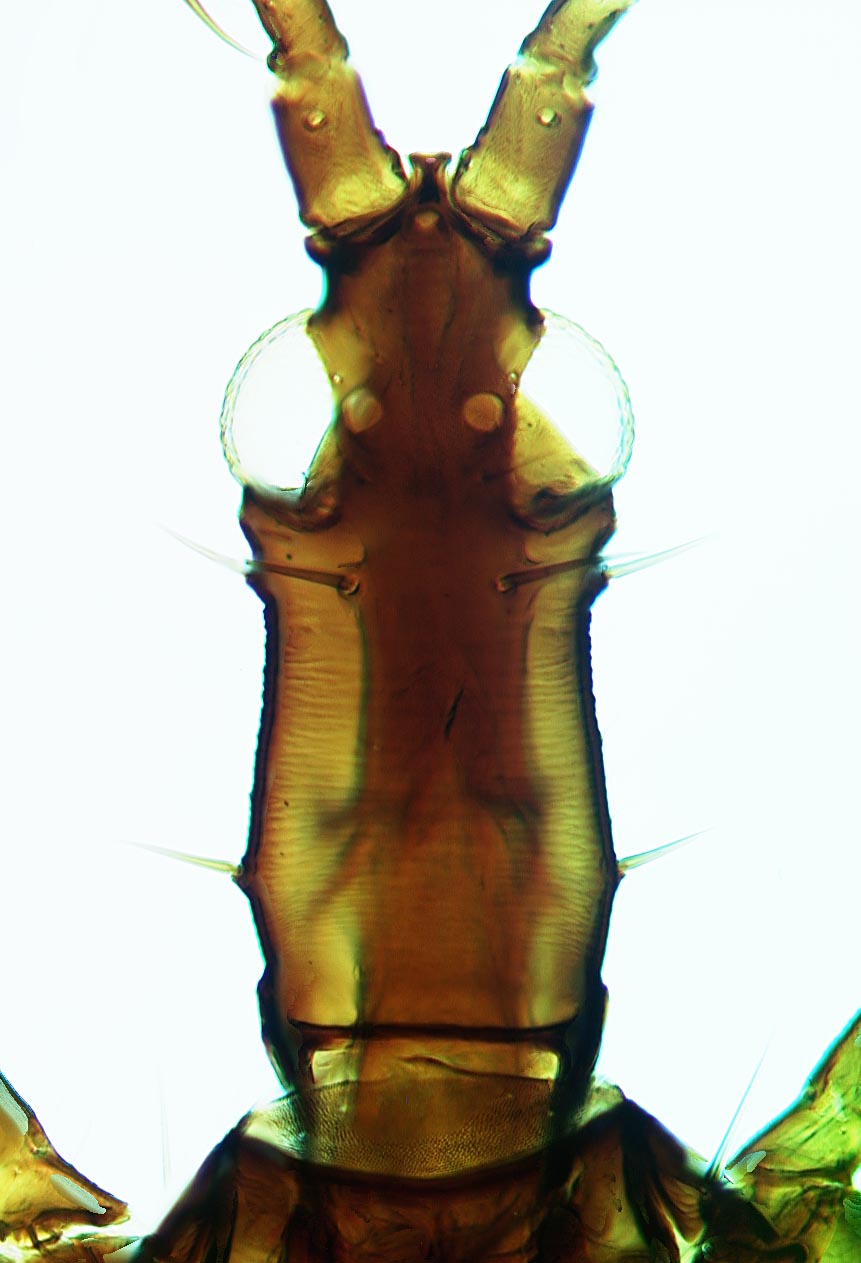
Diagnosis Body colour mainly brown. Antennae 8-segmented, antennomeres III–V extremely long and club-shaped. Head longer than wide, with a dorsal pair of long setae and two lateral pairs, all posterior to the eyes; lateral margins slightly sinuous; maxillary stylets wide apart. Prosternal basantra absent. Metathoracic sternopleural sutures absent. Pelta triangular and wide, with irregular reticulation medially and striations posteriorly and laterally; abdomen sculptured, tergites II–VII with 1 pair of wing-retaining setae. Pore plates absent. Tube cylinder-shaped, about 9x as long as basal width, with multiple lateral setae. Fore femora with a row of 3 setae apically; fore tarsi without a tooth.
Intraspecific variation Unknown.
Genus and similar species information Actinothrips is a genus with 13 species, all from the Neotropics. It belongs to a group of Idolothripinae genera with an elongate head, projected in front of eyes and with multiple long setae, basantra weakly developed or absent, metathoracic sternopleural sutures absent, and a very elongate tube, with multiple lateral setae. Males of several Actinothrips species are very morphologically diverse, with minor and major forms; while the females of different taxa tend to be very similar to each other, making the distinction between species difficult. A key to males of some Actinothrips species is available in Mound (1991).
Distribution around the world Described from Panama. Recorded from Brazil, Costa Rica, Ecuador and Trinidad and Tobago.
Distribution in Brazil Rio Grande do Sul.
Life history Lives in dead twigs and leaves, where it feeds on fungal spores.
Economic importance Not recorded.
References suggested Hood JD (1935) The Thysanopterous genus Actinothrips. Stylops 4: 247–254.