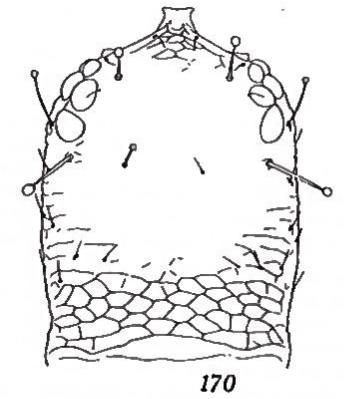
Female apterous; body color brown, head yellow with light brown apex, legs yellow with base of femora shaded, tube yellow with brown apex; antennomere I brown with yellow base, II almost white, III yellow with light brown apex, IV–VII brown. Antennae 7-segmented, antennomeres VII and VIII fused; antennomere III with 2 and IV with 2 sense cones. Head slightly longer than wide, weakly reticulated posteriorly and striate laterally; eyes reduced to few ommatidia, ocelli absent; dorsal surface with three pairs of capitate setae: one pair between eyes, one median postocular pair and one lateral postocular pair; median dorsal pair reduced and close to postocular setae; maxillary stylets parallel to each other, about 1/4 of head width apart. Pronotum weakly striated along posterior margin; with 5 pairs of well-developed and capitate setae; prosternal basantra present. Mesonotum with three pairs of long and capitate setae. Metathoracic sternopleural sutures present. Pelta wide, with a curved median area and two basal wings, sculpture weak or absent; abdominal tergites II–VII without wing-retaining setae. Tube cone-shaped, about 1.4x as long as basal width, without lateral setae. All legs similar in appearance, fore tarsi without a tooth.
Male not studied.
Intraspecific variation
Unknown.
Genus and similar species information
Allothrips is currently composed of 24 species, but some authors consider most of them subspecies of A. megacephalus and A. pillichellus. Members of this genus are usually apterous, their eyes are reduced to few ommatidia, they have only two sense cones on antennomere IV, and antennomeres VII and VIII are completely fused. The two species recorded in Brazil, A. brasilianus and A. megacephalus, can be distinguished by their colouration ( mainly brown in A. megacephalus, brown with yellow head, legs and tube in A. brasilianus) and size and position of the median dorsal pair of setae on head (short and almost in a line with the postocular setae in A. brasilianus; long, capitate and distanced from the postoculars in A. megacephalus).
Distribution around the world
Described from Brazil, and recorded in Hawaii (United States), Japan and Taiwan.