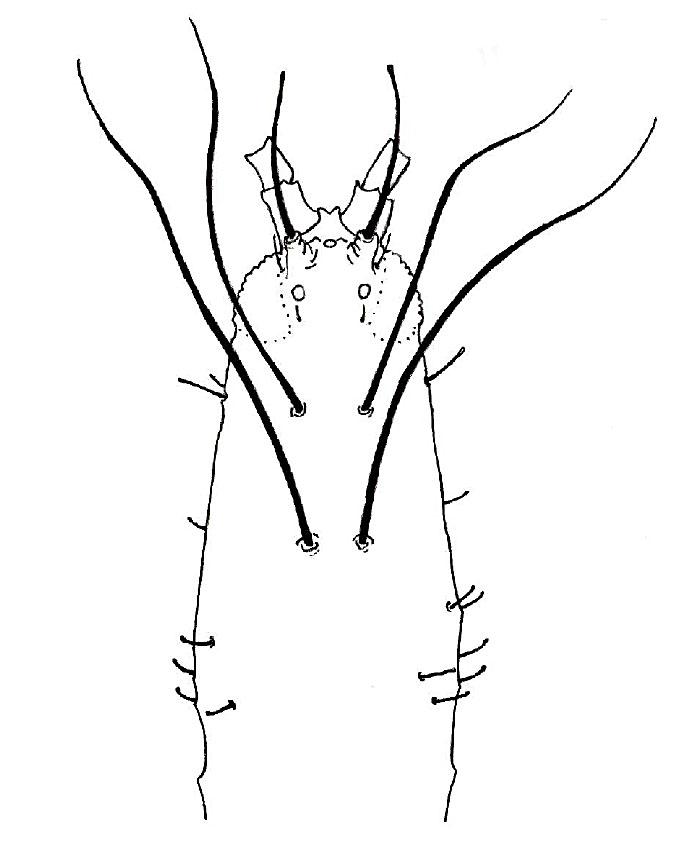
Anactinothrips gibbifer zur Strassen, 1980: 48.
Original reference: zur Strassen R (1980) Anactinothrips gibbifer n.sp. aus Baumkronen im Amazonas-Gebiet (Insecta: Thysanoptera: Phlaeothripidae). Senckenbergiana biologica 61: 47–56.
Family
Phlaeothripidae, Idolothripinae
Nomenclatural information
https://thrips.info/wiki/Anactinothrips_gibbifer
Diagnosis
Female macropterous; body color mainly dark brown. Antennae 8-segmented, antennomeres III and IV long and club-shaped. Head longer than wide, lateral margins convex; dorsal surface with three pairs of long and thick setae (an ocellar pair with basal tubercles, a postocular pair and a pair in the middle of head) and several shorter setae laterally. Prosternal basantra present. Metanotum with a pair of very long and thick median setae; metathorax lateroventral sclerites with microtrichia, sternopleural sutures absent. Pelta transverse and reticulated; abdominal tergites II–VII with 1 pair of wing-retaining setae. Tube cylinder-shaped, less than 4x as long as basal width, without lateral setae. All legs similar in appearance,, fore femora with long setae, fore tarsi with a small projection that does not form a proper tooth.
Male macropterous. Similar to female but with enlarged fore legs and a tarsal tooth. “Stridulatory” structure present on fore legs. Pore plates absent.
Intraspecific variation
Unknown.
Genus and similar species information
Anactinothrips is a genus with 15 described species, but it is possible some of them are synonymous to others. These thrips are usually dark, medium to large sized, with basantra present, without metathoracic sternopleural sutures, and tube without lateral setae. Males of Anactinothrips and Diceratothrips have a unique adaptation to their fore legs, with a series of ridges on the coxae and a posterior projection on the femora, which seem to work as a stridulatory structure or as a locking mechanism for the fore legs. Despite this unique structure, these genera probably belong to different evolutionary lineages, and Anactinothrips can be distinguished from Diceratothrips for lacking metathoracic sternopleural sutures, having a transverse pelta, and long setae on metanotum and laterals of abdominal segments. Anactinothrips gibbifer is distinguished from the other species in the genus for its large tubercles at the base of ocellar setae.A key to Anactinothrips species is available in Mound & Marullo (1996).
Distribution around the world
Described from Brazil.
Distribution in Brazil
http://fauna.jbrj.gov.br/fauna/faunadobrasil/27556
Life history
Probably lives in dead twigs and leaves, where it feeds on fungal spores.
Economic importance
Not recorded.
References suggested
zur Strassen R (1980) Anactinothrips gibbifer n.sp. aus Baumkronen im Amazonas-Gebiet (Insecta: Thysanoptera: Phlaeothripidae). Senckenbergiana biologica 61: 47–56.
Mound LA & Marullo R (1996) The Thrips of Central and South America: An Introduction. Memoirs on Entomology, International 6: 1–488.
Attendance
Brasil, Rio Grande do Sul, Rio Grande
Campus Carreiros: Av. Itália km 8
Bairro Carreiros
Thysanoptera © Todos Direitos Reservados 2026