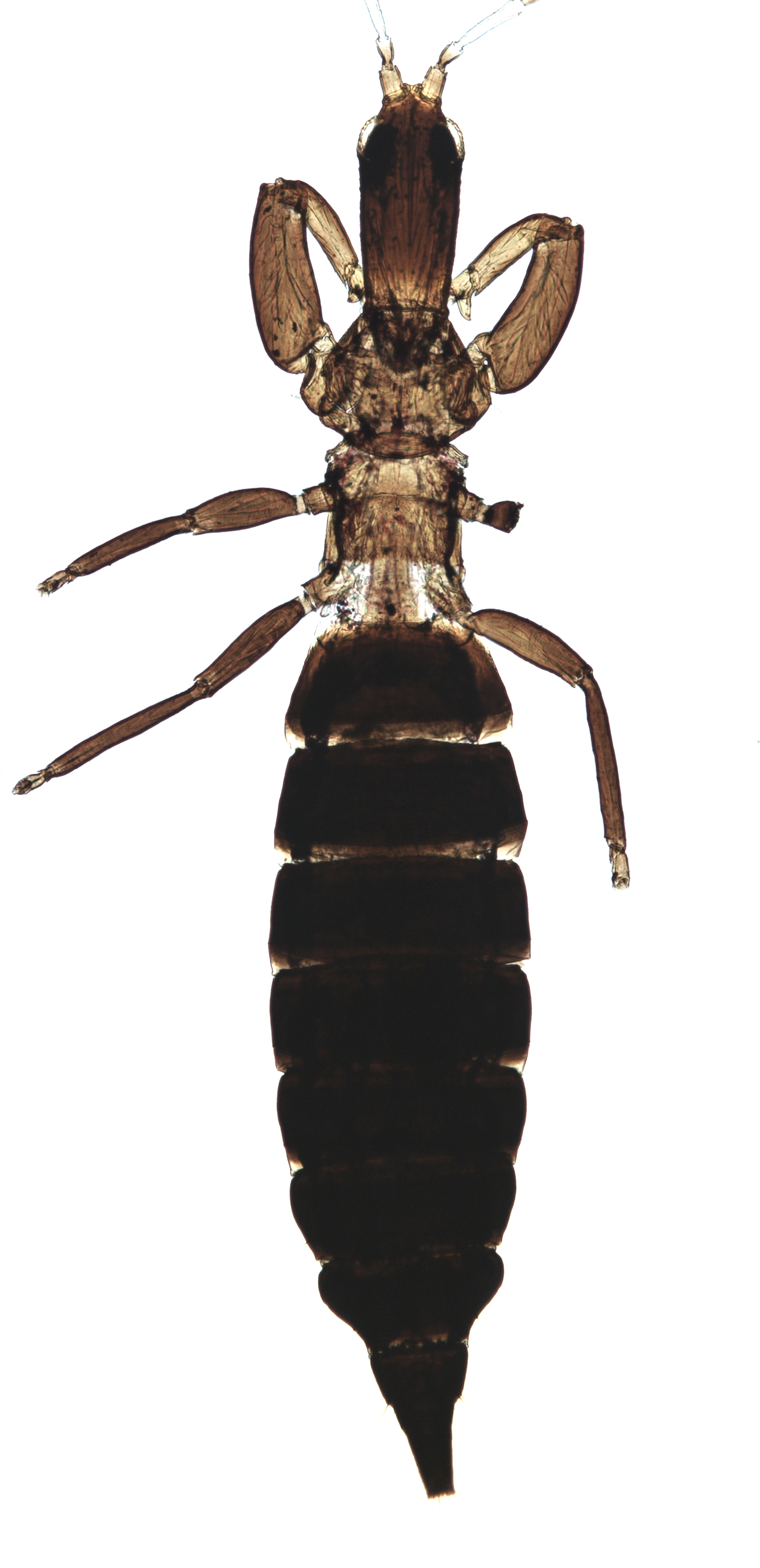
Male apterous; body bicoloured, with head dark brown and yellow at base, thorax light brown, pelta almost white, abdominal segments II–X dark brown; legs mainly brown, except for coxae, tarsi and fore tibiae, which are paler and yellowish; antennomeres I–II light brown, III almost white, IV light brown basally and brown apically, V–VIII dark brown. Antennae 8-segmented, antennomereIV with 2 sense cones. Head longer than wide, slightly constricted at base, dorsal surface reticulated in front of eyes and basally; eyes elongated ventrally, ocelli absent; maxillary stylets more than half of head width apart, extending to middle of head. Pronotum with 4 pairs of well-developed but short setae, midlateral pair very short; prosternal basantra present. Meso- and metathorax laterally constricted. Metanotum sculpture forming a concentric pattern, striate medially and reticulated near anterior and posterior margins; with two pairs of short setae, one medially and one laterally. Metathoracic sternopleural sutures present and elongate. Pelta almost trapezoidal, with irregular reticulation posteriorly;tergites II–VII without wing-retaining setae. Abdominal sternites without a pore plate. Tube with straight margins, about 1.7x as long as basal width, without lateral setae. Fore legs enlarged, fore tarsi with a large tooth.
Female apterous. Similar to male but with fore legs similar to the others and smaller tarsal tooth.
Intraspecific variation
Unknown.
Genus and similar species information
Compsothrips is a genus composed of 26 species, widely distributed in the tropics. The members of this genus are ant mimics, with a medially constricted body and lacking wings. Besides that, their head is usually elongated, the antennae are 8-segmented, basantra and metathoracic sternopleural sutures are present, and the abdomen is robust with a short tube. Antennomere IV has only two sense cones, contrasting the 4 sense cones more commonly seen in Idolothripinae. Compsothrips bicolor is distinguished from C. brasiliensis for having a bicolored body; from C. graminis for lacking pale spots laterally on abdominal segment V; and from C. hoodi for having the metanotum striate medially..