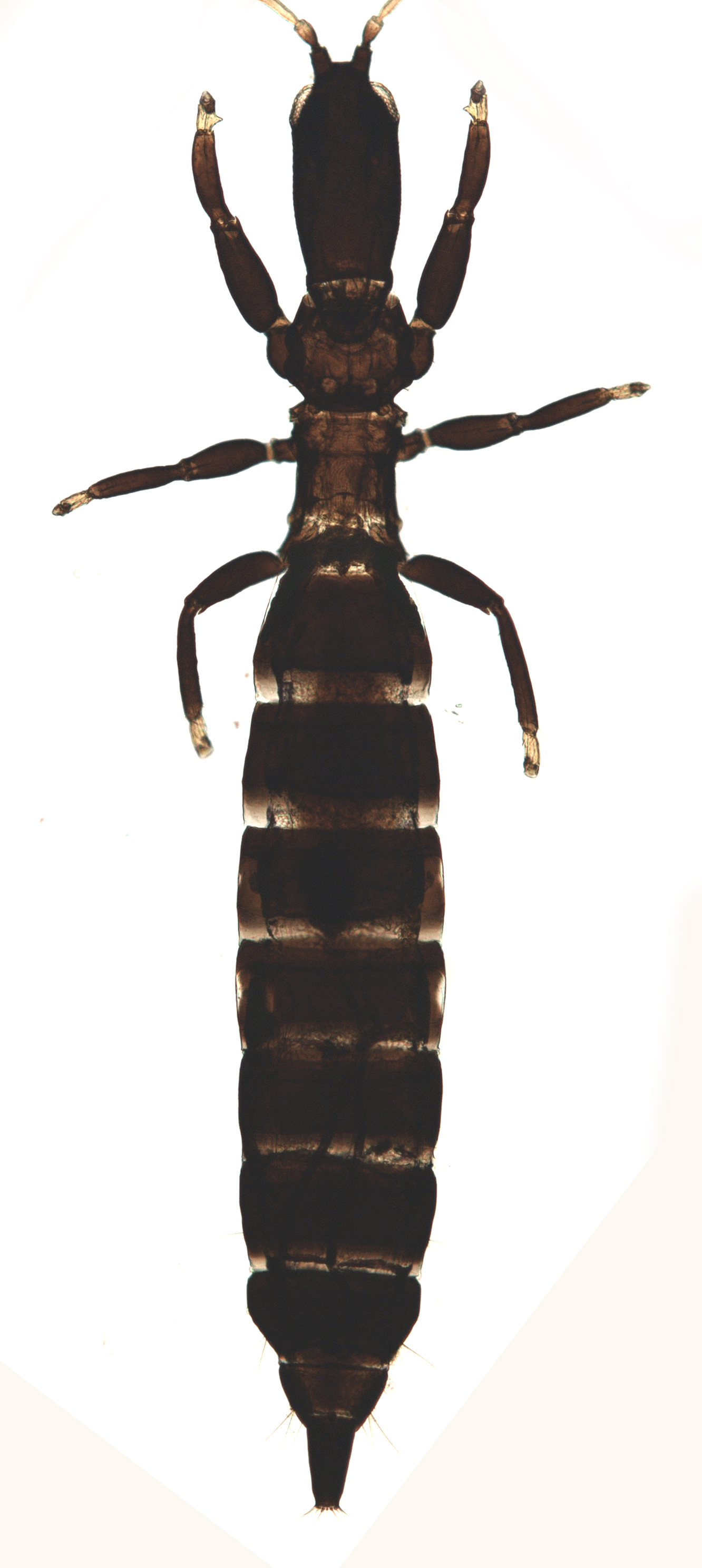
Female apterous; body color mainly dark brown, pelta and sides of abdominal segment II white, with a pair of white spots laterally on abdominal segment V, sometimes on VI as well; legs mainly dark brown, with trochanters and tarsi yellow and apex of fore tibiae paler; antennae dark brown, with apex of antennomere II and all of III yellow. Antennae 8-segmented, antennomereIV with 2 sense cones; VI without a small apical tubercle. Head longer than wide, slightly constricted at base, dorsal surface reticulated in front of eyes and basally; eyes elongated ventrally, ocelli absent; maxillary stylets more than half of head width apart, extending a little beyond the middle of head. Pronotum with 4 pairs of well-developed but short setae, midlateral pair very short; prosternal basantra present. Meso- and metathorax laterally constricted. Metanotum irregularly reticulate anteriorly, striate posteriorly, with two pairs of short setae: one medially and one laterally. Metathoracic sternopleural sutures present and elongate. Pelta almost trapezoidal.Tube with straight margins, about 1.8x as long as basal width, without lateral setae. Fore legs similar to other legs, fore tarsi with a small tooth.
Male apterous. Similar to female but with thorax and legs slightly paler and fore legs enlarged, with a long tarsal tooth. Pore plates absent.
Intraspecific variation The color of antennomere III is variable, in some specimens darker than described above.
Genus and similar species information
Compsothrips is a genus composed of 26 species, widely distributed in the tropics. The members of this genus are ant mimics, with a medially constricted body and lacking wings. Besides that, their head is usually elongated, the antennae are 8-segmented, basantra and metathoracic sternopleural sutures are present, and the abdomen is robust with a short tube. Antennomere IV has only two sense cones, contrasting the 4 sense cones more commonly seen in Idolothripinae. Compsothrips brasiliensis is the only Compsothrips species recorded in Brazil with a completely dark brown body.