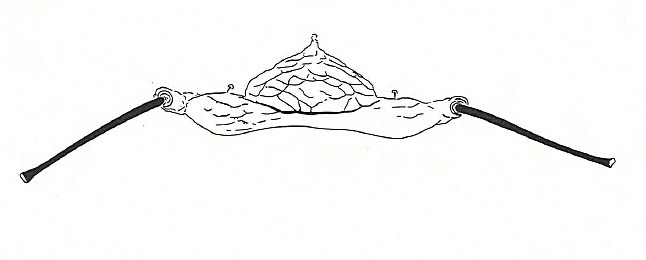
Female macropterous; body color mainly brown; fore femora white, fore tibiae light brown, hind legs brown; antennomeres IV–VI yellow. Antennae 8-segmented, antennomere III with 2 and IV with 2 sense cones, III shorter than IV; basal antennomeres with stout and capitate setae dorsally: I, and II with one, III and IV with two setae each. Head longer than wide, dorsal sculpture transversely striated, 2 pairs of stout and capitate dorsal setae, median pair about 0.67x as long as the postocular pair, located far behind it; maxillary stylets wide apart. Prosternal basantra absent. Metathoracic sternopleural sutures absent. Pelta entire and wide, with a pair of setae laterally; abdominal tergite II with 2 pairs of well-developed lateral setae, III with 2 pairs; II–VII with 1 pair of wing-retaining setae. Tube long, with several lateral setae. All legs similar in appearance, fore tarsi without a tooth. Fore wings without duplicated cilia.
Male macropterous and similar to female, fore legs without a tarsal tooth. Pore plates absent.
Intraspecific variation
Unknown.
Genus and similar species information
Zeugmatothrips is a genus with almost 20 species, distributed across the tropical forests in the Americas. It has a series of unusual characteristics, which helps differentiate this genus from other Idolothripinae: antennae with stout and capitate dorsal setae on the basal segments, antennomere III shorter than IV; head longer than wide, with the median dorsal setae stout and capitate, frequently as long as the postocular setae; tarsal tooth absent both in males and females; fore wings without duplicated cilia; tube long with several lateral setae. Zeugmatothrips bispinosus is very similar to Z. priesneri in several aspects, but can be distinguished from it by the leg coloration, especially the brown hind femora, instead of white. A key to Zeugmatothrips species is available in Mound & Palmer (1986).
Distribution around the world
Described from Peru and recorded from Brazil.
Distribution in Brazil
Pará (Mound & Palmer 1986).
Life history
Found mainly in tropical forests, where it lives in large dead leaves, feeding on fungal spores.