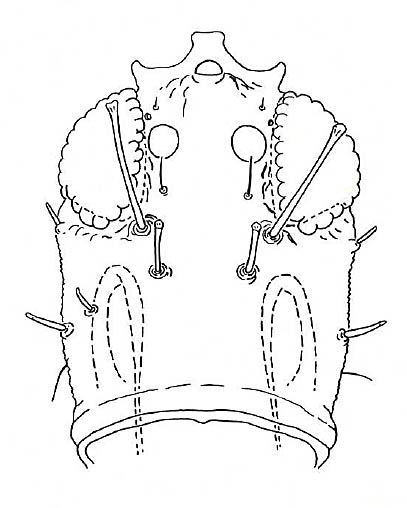
Female macropterous; body color uniformly dark brown, including legs; antennomere III brown with base and apex yellow, IV–VII yellow, VIII brown with yellow base. Antennae 8-segmented, antennomere III with 2 and IV with 4 sense cones, III shorter than IV; basal antennomeres with stout and capitate setae dorsally: I with one major and one minor setae, II with two, III–V with one seta each. Head longer than wide, dorsal sculpture reticulated; 2 pairs of stout and capitate dorsal setae, median pair shorter than the postocular pair, located far behind it; lateral setae short but stout; maxillary stylets wide apart. Prosternal basantra absent. Metathoracic sternopleural sutures absent. Pelta entire and wide, reticulated, with two pairs of long capitate setae on posterior angles. Abdominal tergite II with 2 pairs of well-developed lateral setae, III with 3 pairs; II–VII with 1 pair of wing-retaining setae. Tube almost cylinder-shaped, about 4.3x as long as basal width, with several lateral setae. All legs similar in appearance,fore tarsi without a tooth. Fore wings without duplicated cilia. Male macropterous and similar to female, fore legs without a tarsal tooth. Pore plates absent.
Intraspecific variation
Unknown.
Genus and similar species information
Zeugmatothrips is a genus with almost 20 species, distributed across the tropical forests in the Americas. It has a series of unusual characteristics, which helps differentiate this genus from other Idolothripinae: antennae with stout and capitate dorsal setae on the basal segments, antennomere III shorter than IV; head longer than wide, with the median dorsal setae stout and capitate, frequently as long as the postocular setae; tarsal tooth absent both in males and females; fore wings without duplicated cilia; tube long with several lateral setae. Zeugmatothrips mumbaca has a unique combination of traits within the genus, with legs uniformly dark, head with a few stout lateral setae, and the pelta is entire, transverse and with two pairs of long and capitate setae on the posterior angles. A key to Zeugmatothrips species is available in Mound & Palmer (1986).