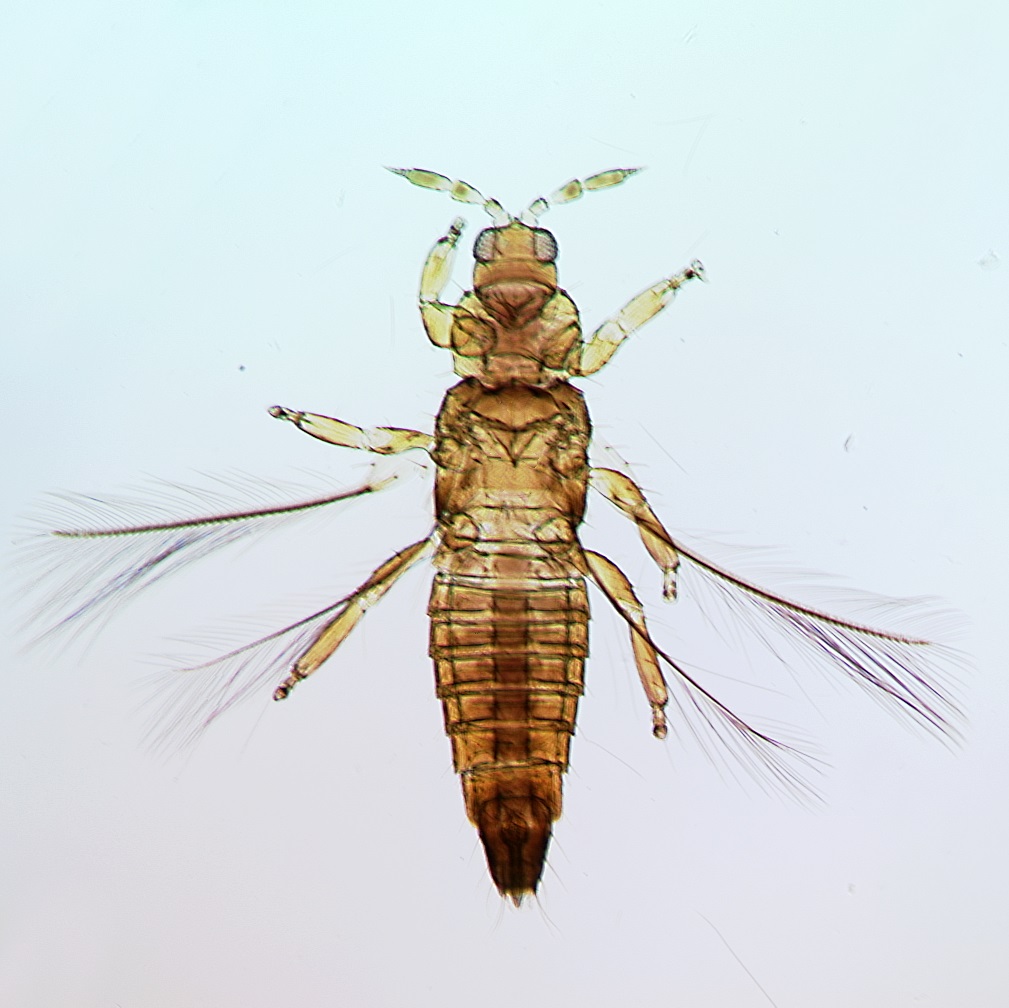
Aulacothrips amazonicus Cavalleri, Kaminski & Mendonça Jr., 2012: 63.
Original reference: Cavalleri A, Kaminski LA & Mendonca Jr. MS (2012) A new ectoparasitic Aulacothrips from Amazon rainforest and the significance of variation in antennal sensoria (Thysanoptera: Heterothripidae). Zootaxa 3438: 62–68.
Family
Heterothripidae
Nomenclatural information
http://thrips.info/wiki/Aulacothrips_amazonicus
Diagnosis
Body brown; all legs yellow; antenna extensively brown, segment II darker and III paler in basal third; abdominal tergites VII–VIII somewhat paler in lateral thirds; fore wings blackish brown but paler basally, with a dark median line. Head with one pair of long and expanded postocular setae; three pairs of ocellar setae present, pair II long and expanded. Antennae 9-segmented, segment III conical dorsally; III & IV enlarged, each with the continuous porous sensorium curved laterally toward base and extending to the midpoint of the segment. Pronotum reticulate, except a small area medially; six pairs of long and capitate setae arising marginally and one pair arising anteromedially; mesonotum reticulate; metascutum triangular and polygonally reticulate. Fore wing unusually slender, except basally; rows of setae absent. Abdominal tergites with strong polygonal reticulation and with a well developed craspedum bearing stout teeth; tergites II–VIII with a median furrow that bears two pairs of stout setae at lateral margins; II–VIII posterior margin with a fringe of small microtrichia placed medially and three pairs of long discal setae; IX with numerous long and pointed discal setae. Sternites II–VIII with about five pairs of stout and flattened setae placed laterally, IX with two rows of about five of such setae on each side.
Male smaller and with body largely yellowish brown, anterior margin of mesonotum and abdominal tergites IX–X clearly darker; lateral thirds and furrow on abdominal tergites II–VIII also darkened. Posterior margin of abdominal tergite VIII with only one pair of long and capitate setae; tergite IX posterior margin not extending toward X; antecostal ridge of sternite VII with a small circular pore plate, covered by a posterior extension of sternite VI.
Intraspecific variation
Not recorded.
Genus and similar species information
The South Americangenus Aulacothrips comprises five described species and its morphology contrasts with the remaining Heterothripidae. The abdominal tergites have a median furrow bearing large wing-retaining setae, and antennal segments III & IV are enlarged, each with a highly convoluted sensorium. Similar convoluted sensoria are also found in Lenkothrips species. Aulacothrips amazonicus has antennal segment III conical dorsally, and bears reduced sensorial areas that form a simple lateral loop to the mid-point of segments III & IV. It is also paler than A. dictyotus and A. minor, and has two pairs of long midlateral setae aligned to the pronotal lateral margin. A key to species is provided by Cavalleri et al. (2014).
World distribution
Known only from Brazil.
Distribution in Brazil
http://fauna.jbrj.gov.br/fauna/faunadobrasil/43498
Life history
Larvae and adults are ectoparasitic on Ramedia (Membracidae) in Amazonia. This species possibly breeds on various plants species, and larvae have been recorded infesting membracids on Solanum shrubs.
Economic importance
Not recorded.
References suggested
Cavalleri A, Kaminski LA & Mendonça Jr. MS (2010) Ectoparasitism in Aulacothrips (Thysanoptera: Heterothripidae) revisited: host diversity on honeydew-producing Hemiptera and description of a new species. Zoologischer Anzeiger 249: 209–221.
Cavalleri A, Kaminski LA & Mendonca MS (2012) A new ectoparasitic Aulacothrips from Amazon rainforest and the significance of variation in antennal sensoria (Thysanoptera: Heterothripidae). Zootaxa 3438: 62–68.
Cavalleri A & Kaminski LA (2014) Two new ectoparasitic species of Aulacothrips Hood, 1952 (Thysanoptera: Heterothripidae) associated with ant-tended treehoppers (Hemiptera). Systematic Parasitology 89(3): 271–278.
Attendance
Brasil, Rio Grande do Sul, Rio Grande
Campus Carreiros: Av. Itália km 8
Bairro Carreiros
Thysanoptera © Todos Direitos Reservados 2026