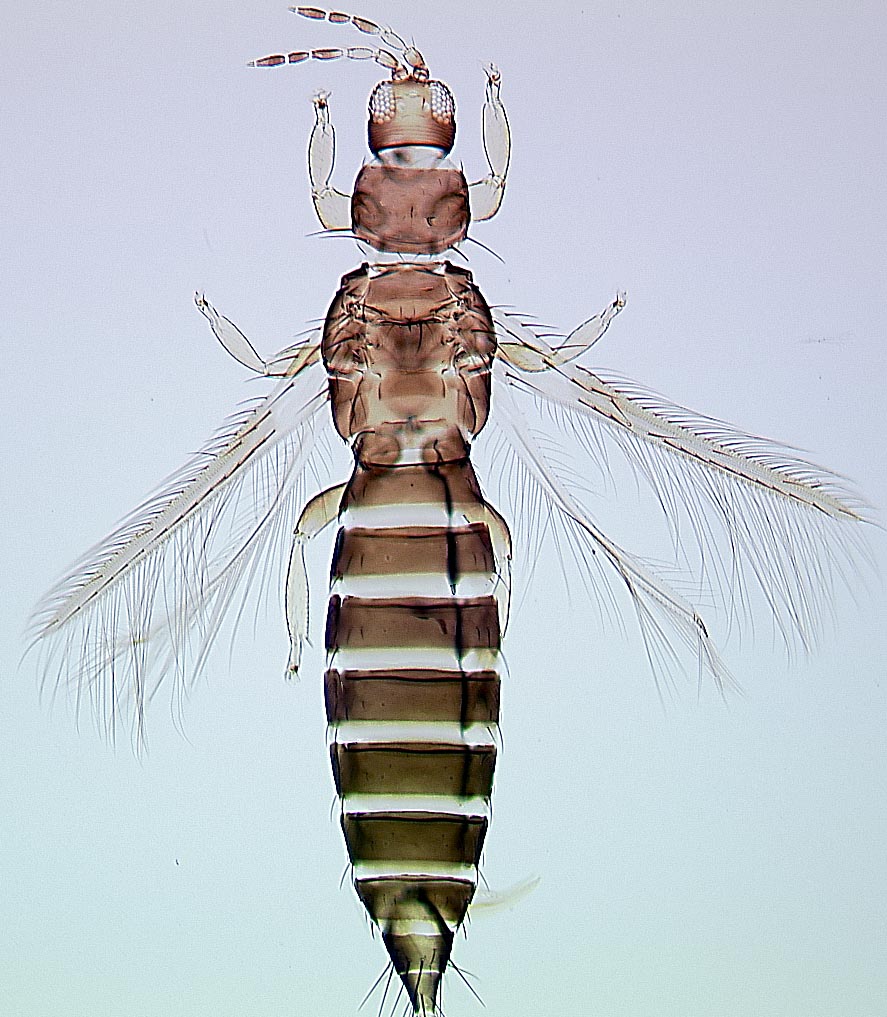
Thrips florum Schmutz, 1913: 1003.
Original reference: Schmutz K (1913) Zur Kenntnis der Thysanopterenfauna von Ceylon. Sitzungsberichte der Kaiserlichen Akademie der Wissenschaften 122 (7): 991–1089.
Family
Thripidae, Thripinae
Nomenclatural information
http://thrips.info/wiki/Thrips_florum
Diagnosis
Body colour brown, legs yellowish, antennal segment III yellow; fore wing brown with base paler. Head wider than long, with two pairs of ocellar setae; pair III stout and arising just outside anterior margins of ocellar triangle. Antennae 7-segmented (sometimes 8-segmented), III & IV slightly constricted at apex with short forked sense cones; segment VII short. Pronotum with two pairs of long posteroangular setae, three pairs of posteromarginal setae. Mesothoracic spinula long; metathoracic spinula absent. Mesonotum with no lines of sculpture around campaniform sensilla near anterior margin. Metanotum with lines of longitudinal sculpture medially, but transverse at anterior region; paired campaniform sensilla present; two pairs of long and stout setae, median pair arising at anterior margin. Tarsi 2-segmented. Fore wing first setal row widely interrupted and second vein with about 14 closely set setae. Abdominal tergite II with four lateral marginal setae; tergites V–VIII with ctenidia present laterally, on VIII posteromesad to spiracles; posterior margin of VIII with comb complete but microtrichia small and irregular; pleurotergites without discal setae. Sternite II with two pairs of marginal setae, III–VII with three pairs, median pair on VII arising in front of margin; sternite II with 1–4 discal setae, III–VII with discal setae varying in number from 6–14 in a regular transverse row. Both sexes fully winged.
Male similar to female in structure but paler; abdominal tergite VIII with no marginal comb; sternites III–VII with transverse pore plates; tergite IX with median S1 setae longer than S2 and arising closer to S2 than to each other.
Intraspecific variation
Microtrichia on posteromarginal comb on tergite VIII sometimes arising in groups.
Genus and similar species information
Thrips is the largest genus amongst Terebrantia, comprising more than 280 described species. This group is primarily from Holartic and Old World tropics, with all members lacking ocellar setae I and with ctenidia on abdominal tergite VIII posteromesad to spiracles. Thrips florum is a brown species that usually have the subapical veinal seta on the fore wing clavus longer than the apical seta, and the mesonotum has no lines of sculpture around the anterior pair of campaniform sensilla.
World distribution
Widely distributed across Asia, from India to the Pacific, Fiji and eastern Australia. Also reported from Central America, Brazil, Nigeria and USA.
Distribution in Brazil
http://fauna.jbrj.gov.br/fauna/faunadobrasil/195627
Life history
Species collected in a variety of flowers worldwide; in Brazil it was recorded from flowers of Gardenia jasminoides (Rubiaceae) (Lima et al. 2018) and Guapira infundibuliformis (Nyctaginaceae).
Economic importance
Not recorded.
References suggested
Lima EFB, Miyasato LA & Fontes LS (2018) Species Identification in the Thrips Genus-Group in Brazil. Neotropical Entomology, published online [DOI: 10.1007/s13744-018-0597-4]
Mound LA & Masumoto M (2005) The genus Thrips (Thysanoptera, Thripidae) in Australia, New Caledonia And New Zealand. Zootaxa 1020: 1–64.
Nakahara S (1994) The genus Thrips Linnaeus (Thysanoptera: Thripidae) of the New World. Technical Bulletin. United States Department of Agriculture 1822: 1–183.
Attendance
Brasil, Rio Grande do Sul, Rio Grande
Campus Carreiros: Av. Itália km 8
Bairro Carreiros
Thysanoptera © Todos Direitos Reservados 2026