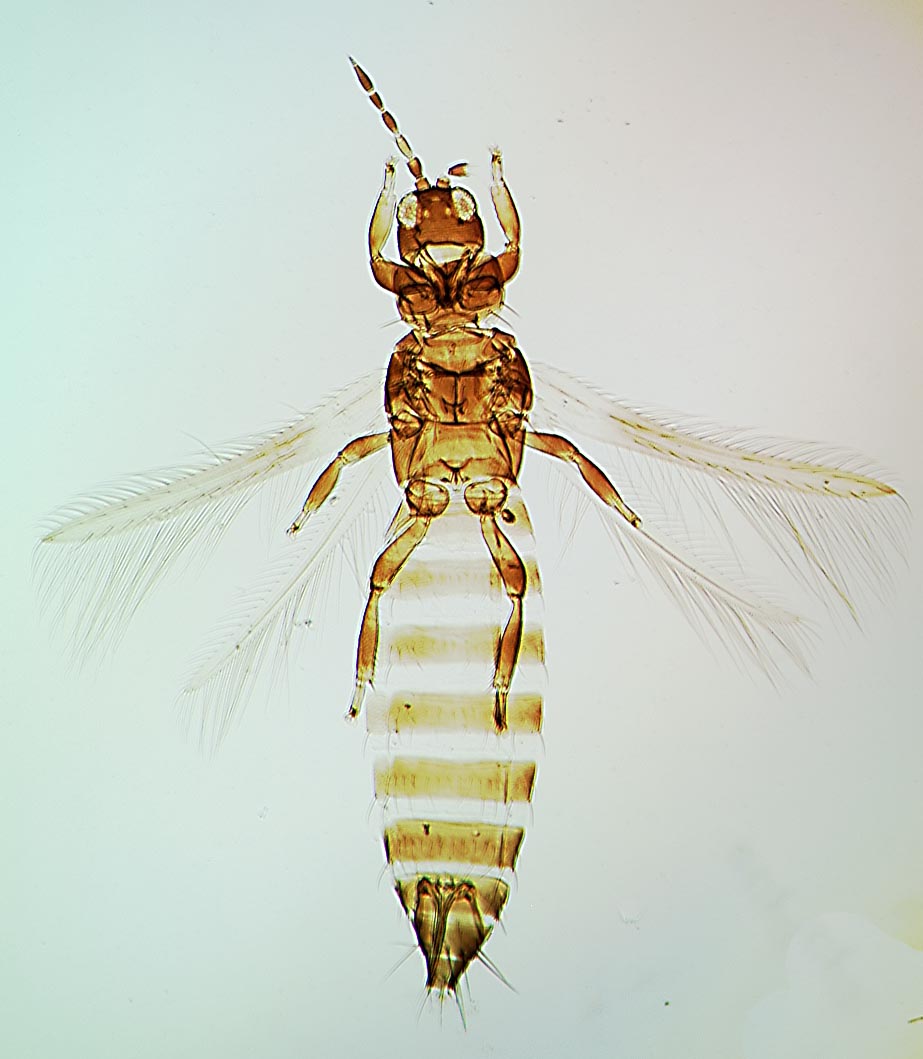
Body colour dark brown, including tibiae; all tarsi yellow; antennal segments dark brown, except for III which is paler; fore wings largely brown but paler at base. Head with two pairs of ocellar setae; pair III short and arising just at anterior margin of ocellar triangle. Antennae 8-segmented, III & IV with forked sense cones. Pronotum rectangular and with two pairs of long posteroangular setae; anteroangular and anteromarginal setae minute. Mesothoracic spinula long; metathoracic spinula absent. Metanotum reticulate medially, with elongated reticles on posterior half; weak internal markings inside most reticles; paired campaniform sensilla absent; two pairs of setae, median pair short and arising behind anterior margin. Tarsi 2-segmented. Fore wing with first row of setae interrupted and second row essentially complete. Abdominal tergite II with three lateral marginal setae; V–VIII with ctenidia laterally, ctenidia on VIII posteromesad to spiracles; VIII with a complete and irregular posteromarginal comb; pleurotergites with rows of fine microtrichia. Sternite II with two pairs of marginal setae, III–VII with three pairs; sternites III–VII with about 12 discal setae. Both sexes fully winged.
Male lacks posteromarginal comb of microtrichia on abdominal tergite VIII; with transverse pore plates on sternites III–VII.
Intraspecific variation
Not recorded.
Genus and similar species information
Thrips is the largest genus amongst Terebrantia, comprising more than 280 described species. This group is primarily from Holartic and Old World tropics, with all members lacking ocellar setae I and with ctenidia on abdominal tergite VIII posteromesad to spiracles. Thrips simplex is a dark brown species, which is characteristic in having 8-segmented antennae and lacking metanotal campaniform sensilla. A key to four Thrips species reported to Brazil is given by Monteiro et al. (2001).
World distribution
Possibly originated from Southern Africa, it is now distributed around all continents.
Breeding on flowers and leaves, and possibly oligophagous on Iridaceae plants. Frequently collected on Gladiolus, but also on Crocosmia and Neomarica.
Economic importance
Known as the 'Gladiolus thrips', this species is considered a pest to Gladiolus around the world.
References suggested
Monteiro RC; Mound LA & Zucchi RA (2001) Espécies de Thrips (Thysanoptera: Thripidae) no Brasil. Neotropical Entomology 30(1): 61–63.
Mound LA & Masumoto M (2005) The genus Thrips (Thysanoptera, Thripidae) in Australia, New Caledonia And New Zealand. Zootaxa 1020: 1–64.
Nakahara S (1994) The genus Thrips Linnaeus (Thysanoptera: Thripidae) of the New World. Technical Bulletin. United States Department of Agriculture 1822: 1–183.
Published in: 17/06/2017 Posted by: Mariana Lindner