Original reference: Lindeman K (1889) Die schädlichsten Insekten des Tabak. Byull' Moskovskogo Obshchestva Ispytatelei Prirody 1888: 10–77.
Family
Thripidae, Thripinae
Nomenclatural information
http://thrips.info/wiki/Thrips_tabaci
Diagnosis
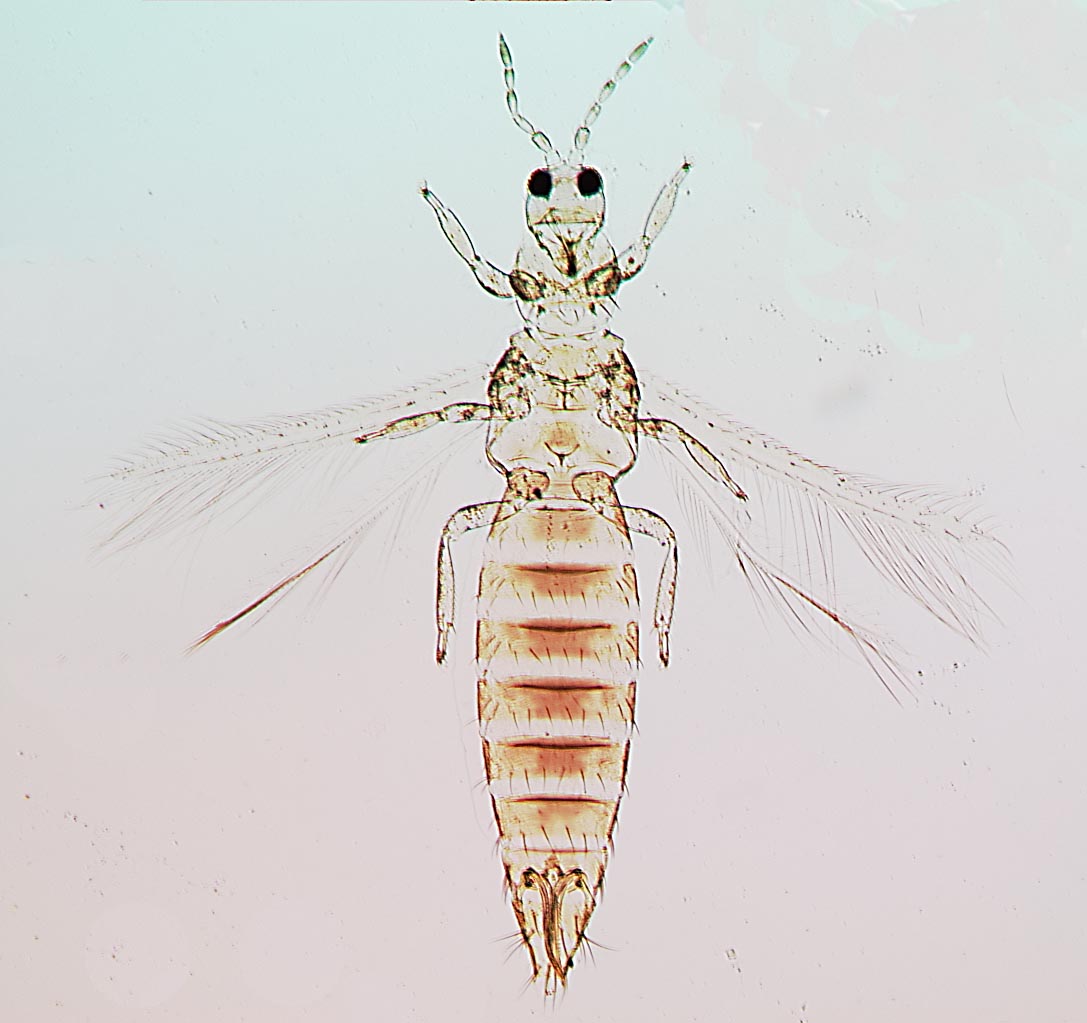
Body colour variable, from yellow to dark brown; antennal segment I yellow, II & VI–VII brown, III–V brown in apical half; fore wings pale to weakly shaded. Head with two pairs of ocellar setae; ocellar setae III short and arising just at anterior margin of ocellar triangle. Antennae 7-segmented, III & IV with forked sense cones. Pronotum rectangular and with two pairs of long posteroangular setae; anteroangular and anteromarginal setae minute. Mesothoracic spinula long; metathoracic spinula absent. Metanotum with irregular reticles medially, with lines converging to midpoint of posterior margin; paired campaniform sensilla absent; two pairs of setae, median pair short and arising behind anterior margin. Tarsi 2-segmented. Fore wing with first row of setae interrupted and second row essentially complete. Abdominal tergite II with three lateral marginal setae; V–VIII with ctenidia laterally, ctenidia on VIII posteromesad to spiracles; VIII with a complete posteromarginal comb of long microtrichia; pleurotergites with rows of fine microtrichia. Sternites without discal setae, II with two pairs of marginal setae, III–VII with three pairs. Both sexes fully winged.
Male yellow and with transverse pore plates on sternites III–V.
Intraspecific variation
Body length and colour highly variable. In Brazil, most specimens have uniformly brown colour, sometimes with lateral thirds of abdominal segments slightly paler.
Genus and similar species information
Thrips is the largest genus amongst Terebrantia, comprising more than 280 described species. This group is primarily from Holartic and Old World tropics, with all members lacking ocellar setae I and with ctenidia on abdominal tergite VIII posteromesad to spiracles. Thrips tabaci is characteristic in bearing fine microtrichia on abdominal pleurotergites. A key to four Thrips species reported to Brazil is given by Monteiro et al. (2001).
World distribution
Described from Mediterranean, it is now distributed around all continents.
Primarily breeding on flowers and leaves, but eventually feeding on mites and other thrips species. In Brazil is frequently collected on onions.
Economic importance
Referred as the 'Onion thrips', this species is highly polyphagous and is considered a pest of several plants, particularly tobacco, onions, garlic and greenhouse plants. It is also an important vector of Tospoviruses in various crops.
References suggested
Monteiro RC; Mound LA & Zucchi RA (2001) Espécies de Thrips (Thysanoptera: Thripidae) no Brasil. Neotropical Entomology 30(1): 61–63.
Mound LA & Masumoto M (2005) The genus Thrips (Thysanoptera, Thripidae) in Australia, New Caledonia And New Zealand. Zootaxa 1020: 1–64.
Nakahara S (1994) The genus Thrips Linnaeus (Thysanoptera: Thripidae) of the New World. Technical Bulletin. United States Department of Agriculture 1822: 1–183
Published in: 17/06/2017 Posted by: Mariana Lindner