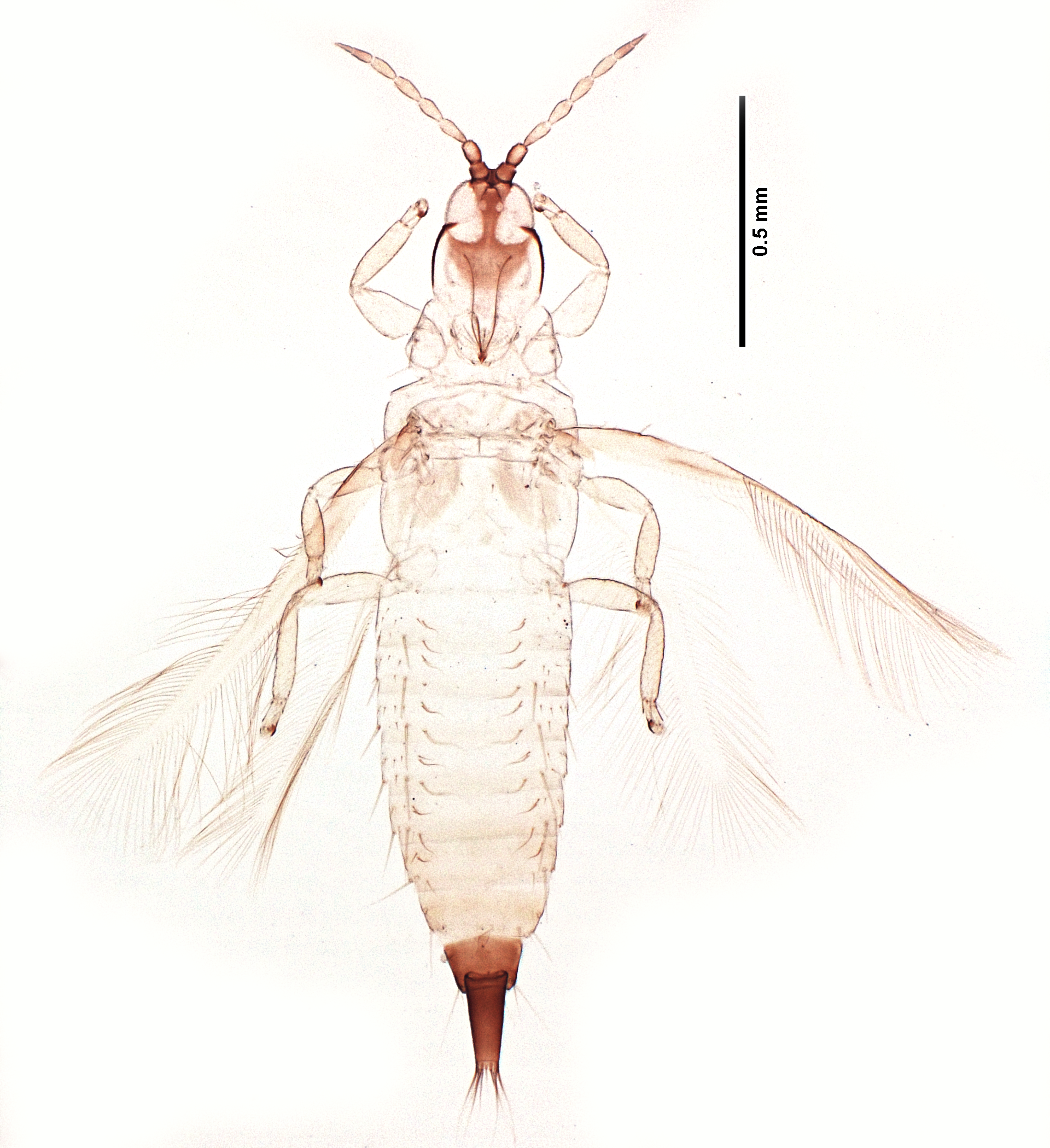
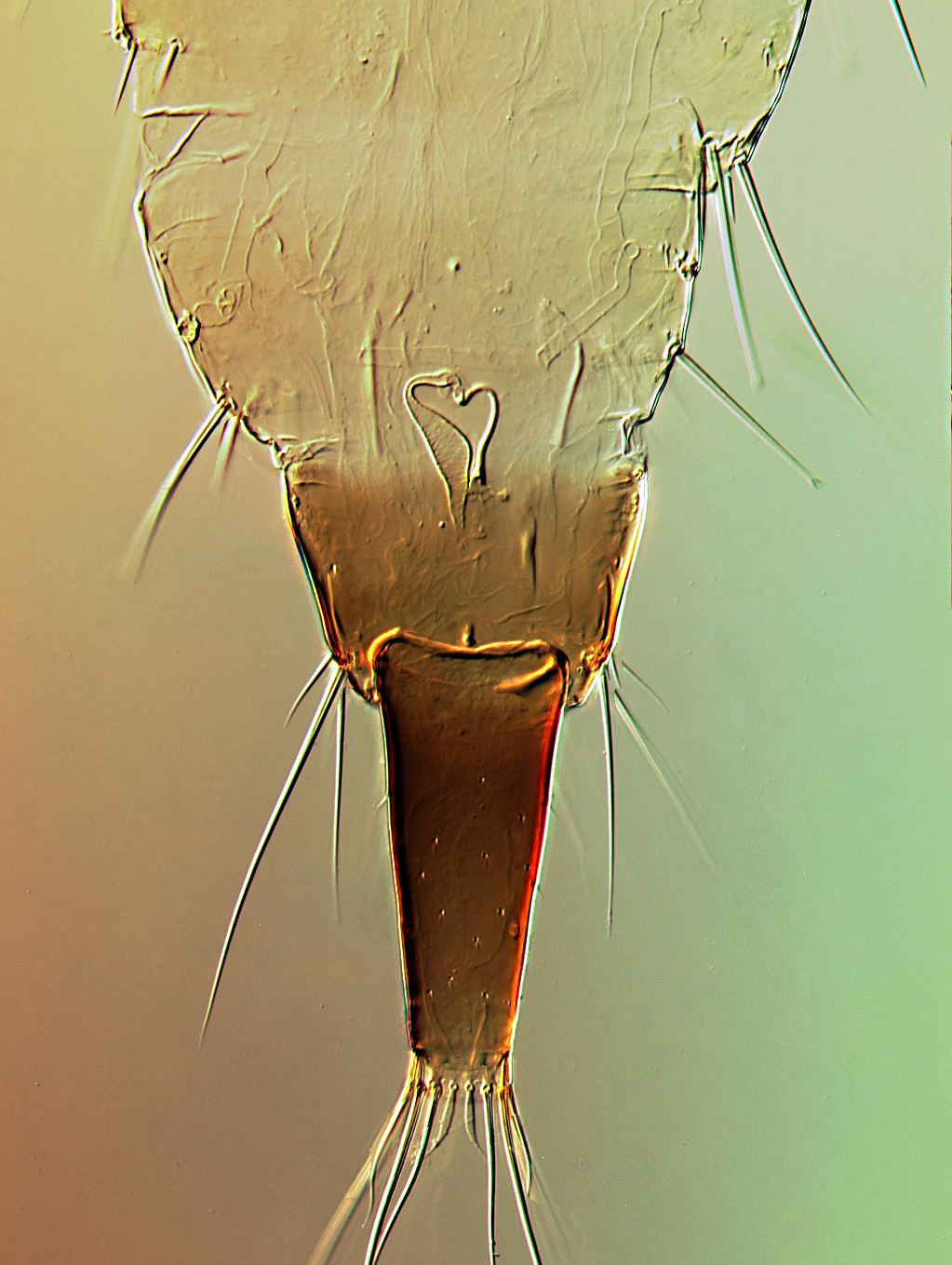
Holopothrips fulvus Morgan 1929: 6.
Original reference: Morgan AC (1929) A new genus and five new species of Thysanoptera foreign to the United States. Proceedings of the Entomological Society of Washington 31: 1-9. https://www.biodiversitylibrary.org/part/54418
Family
Phlaeothripidae, Phlaeothripinae
Nomenclatural information
http://thrips.info/wiki/Holopothrips_fulvus
Diagnosis
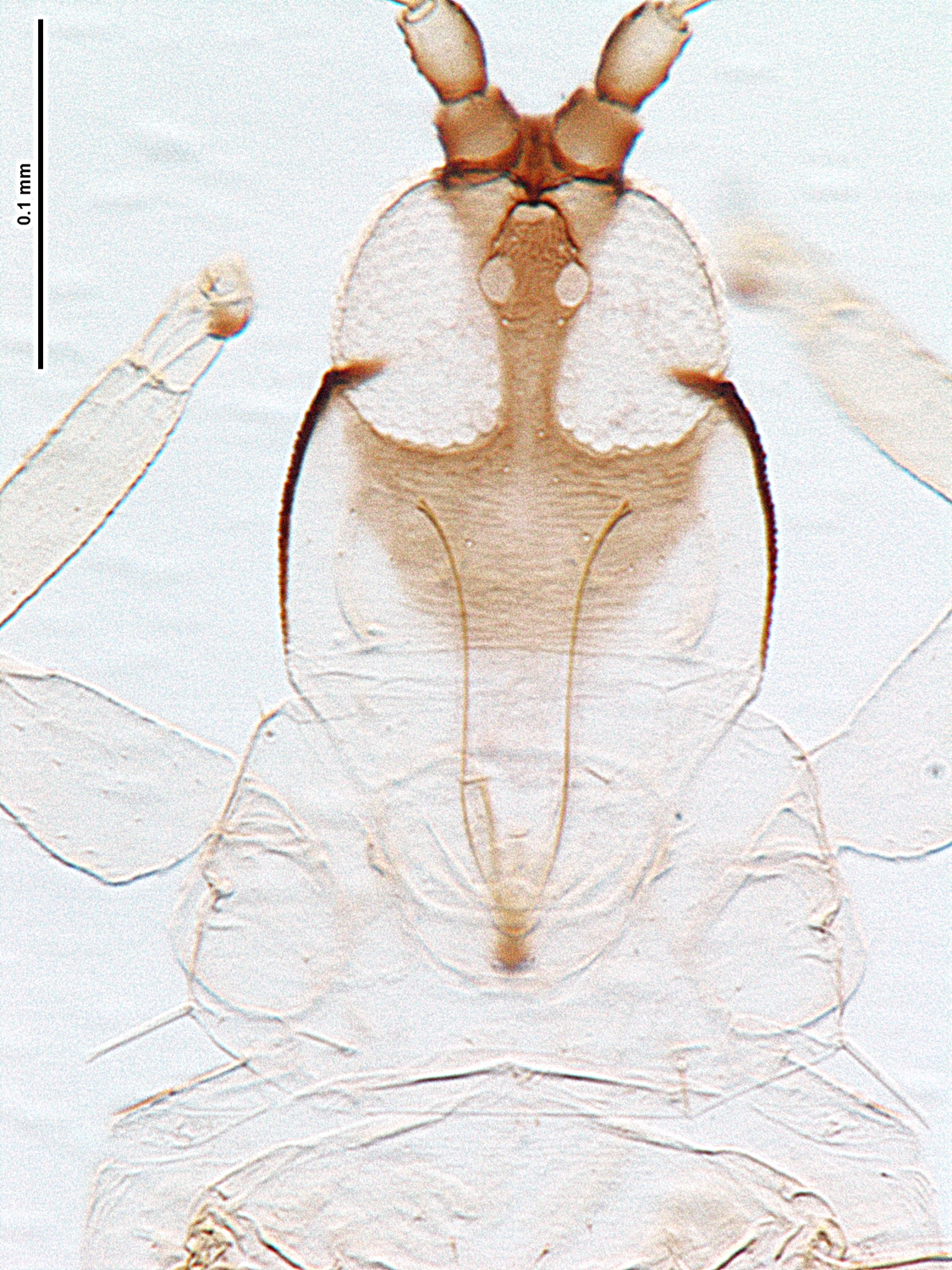
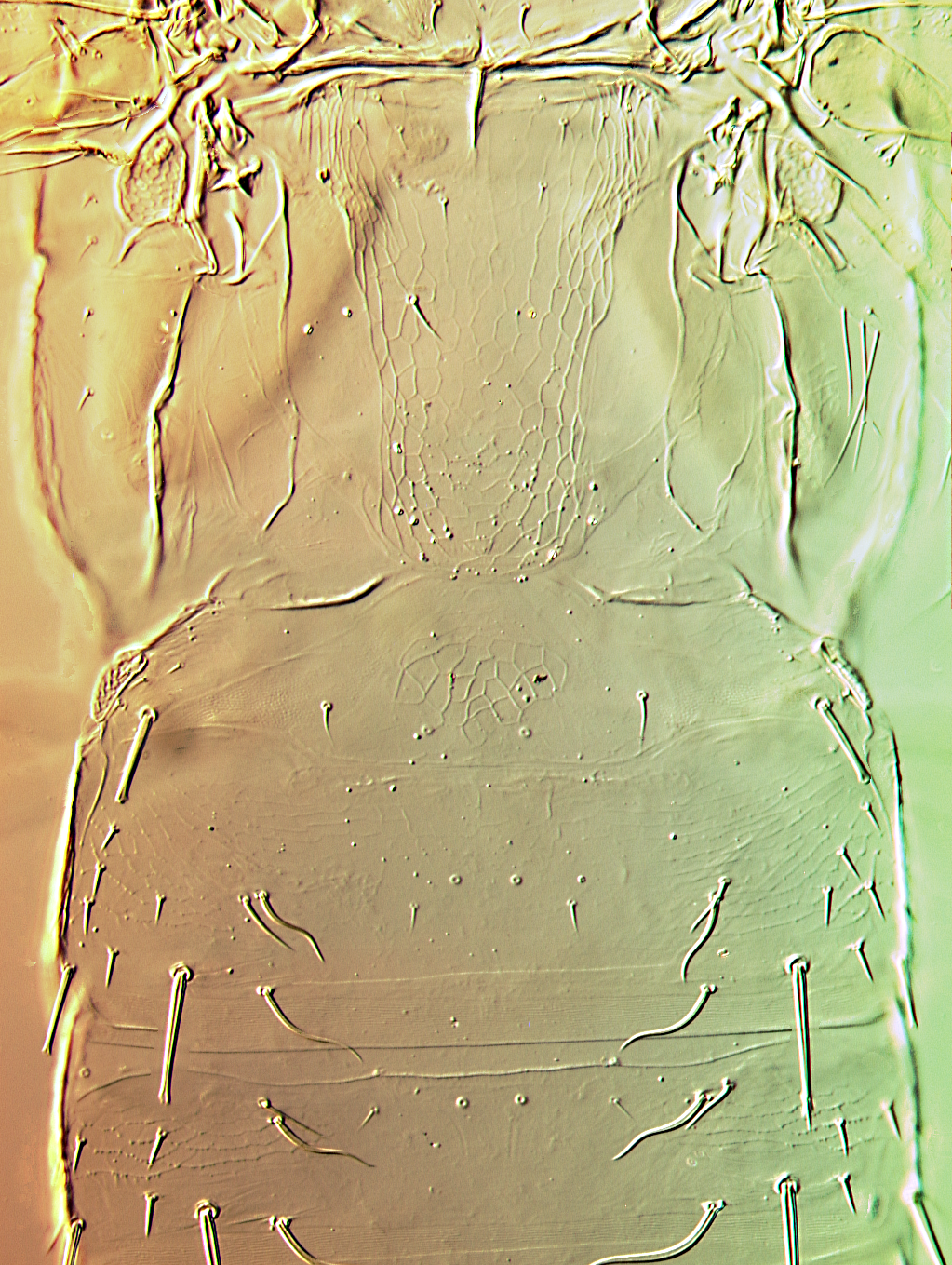
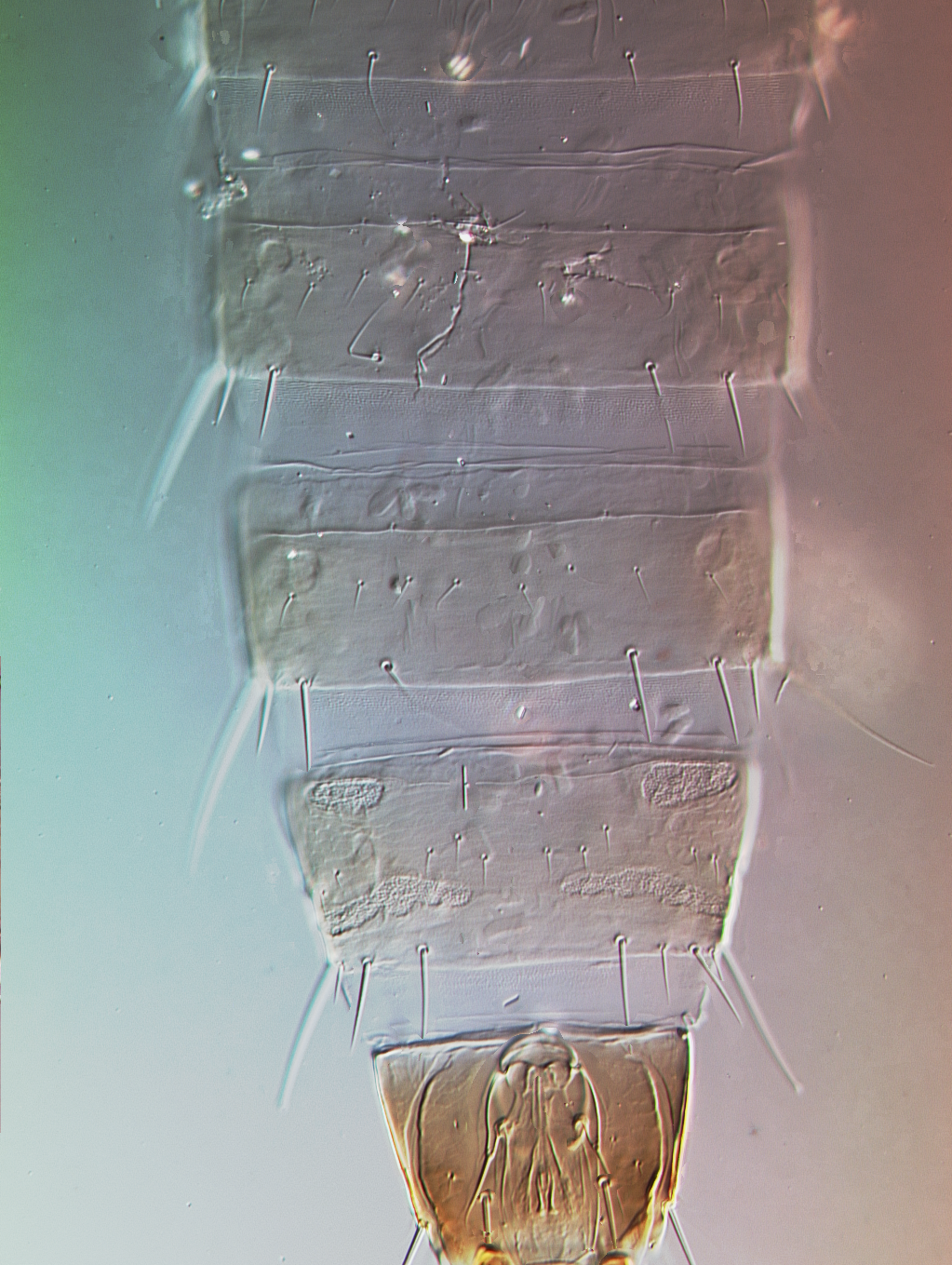
Body mainly yellow, with head brown anteromedially but yellow on cheeks and posteriorly, abdominal segments IX–X brown; antennomere I brown, II brown with paler apex, III yellow with darkened base, IV–VI yellow, VII–VIII light brown; fore wings clear with brownish base. Head length and width subequal, with curved cheeks; dorsal surface with transverse lines of sculpture; postocular setae reduced to three pairs of minute setae; maxillary stylets parallel, with a maxillary bridge, about 1/4 of the head width apart; mouth cone rounded. Antennae 8-segmented, III–IV usually with three sense cones each. Pronotum without sculpture, notopleural sutures incomplete; major pronotal setae well developed and capitate, 1 pair of setae on epimeral region. Mesonotum reticulated. Metanotum with 3 or more pairs of anterior discal setae and one median major pair; sculpture fully reticulate, without internal markings. Fore wings with about 6 duplicated cilia. Pelta triangular, basal angles slightly projected; reticulated sculpture without internal markings. Abdominal tergites II–VII with three pairs of wing-retaining setae. Both sexes macropterous.
Females bear an enlarged spermatheca. Males are slightly smaller, with punctuated pore plates on abdominal sternite VIII: two anteroangular plates and two lateral plates, the latter posterior to discal setae.
Intraspecific variation
Head coloration seems to be variable between sexes, with males having a smaller brown spot than females. Some specimens may show reduction in the number and/or size of sense cones on antennomeres III or IV.
Genus and similar species information
Holopothrips is a genus with about 60 known species, distributed almost exclusively in the Neotropics. Several species in this genus are associated with plant galls, as inducers or invaders, in plants of many families. Most Holopothrips species bear three pairs of wing-retaining setae on tergites II–VII, males have complex pore plates and frequently in other sternites besides VIII, and the female spermatheca is visible. About 40 species in this genus have been described or recorded from Brazil. Holopothrips bicolor and H. fulvus are the only two Holopothrips species recorded in Brazil whose body is mostly yellow, with only the head, some antennomeres and final abdominal segments brown. Holopothrips fulvus is easily distinguished from H. bicolor for having a bicolored head, abdominal segment VIII yellow, and males with pore plates only on abdominal sternite VIII. A key to the species of Holopothrips is available in Lindner et al. 2018.
Distribution around the world
Described from Bahia, Brazil.
Distribution in Brazil
http://fauna.jbrj.gov.br/fauna/faunadobrasil/39879
Life history
Phytophagous species. Collected from Anacardium occidentale (Anacardiaceae); Caryocar villosum (Caryocaraceae); possibly Gossypium sp. (Malvaceae).
Economic importance
It damages leaves and pseudofruits in cashew (Lima et al. 2017).
Suggested references
Morgan AC (1929) A new genus and five new species of Thysanoptera foreign to the United States. Proceedings of the Entomological Society of Washington 31: 1-9. https://www.biodiversitylibrary.org/part/54418
Mound LA, Marullo R (1996) The Thrips of Central and South America: An Introduction. Memoirs on Entomology, International 6: 1-488.
Lima MGA, Dias-Pini NS, Lima EFB, Maciel GPS, Vidal-Neto FC (2017) Identification and pest status of Holopothrips fulvus (Thysanoptera: Phlaeothripidae) on dwarf-cashew crops in northeastern Brazil. Revista Brasileira de Entomologia 61(4): 271-274. doi: https://doi.org/10.1016/j.rbe.2017.07.007
Attendance
Brasil, Rio Grande do Sul, Rio Grande
Campus Carreiros: Av. Itália km 8
Bairro Carreiros
Thysanoptera © Todos Direitos Reservados 2026