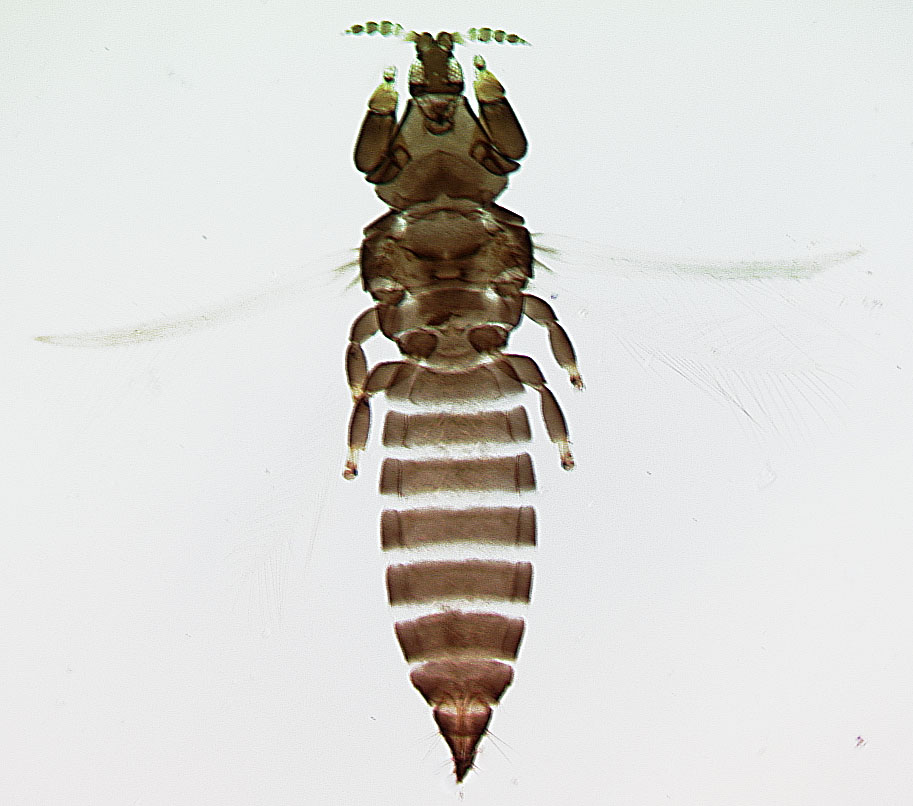
Body dark brown, including antennae; tarsi yellow; mid & hind tibiae dark brown, fore tibia with yellow apex; fore wing uniformly shaded. Head without strong sculpture, slightly prolonged in front of eyes; vertex with three or four pairs of setae. Antennae 8-segmented, III & IV each with a simple sense cones; antennal segment I enlarged, II asymmetric with external lateral margin strongly produced. Pronotum trapezoidal, without reticulation; with two pairs of short and conspicuous posteroangular setae; setae on anterior margin not distinctly longer than discal setae. Meso & metathoracic endofurca weakly developed, without spinula. Fore coxae enlarged, fore tibiae prolonged externally to midpoint of distal tarsal segment. Metanotum reticulate medially; paired campaniform sensilla present; two pairs of conspicuous setae, median pair arising behind anterior margin. Tarsi 2-segmented. Fore wing first and second veins with few and sparse setae. Abdominal tergites reticulate, anteriorly with many rows of conspicuous tubercles; II–VIII with paired median setae wide apart; VIII with a lobed craspedum. Sternites without discal setae or craspeda; three pairs of long posteromarginal setae; ovipositor unusually small. Female macropterous and male apterous.
Male slightly paler than female, mainly on thorax and fore legs, not so bicoloured; ocelli and wings absent; metanotum rectangular; large circular pore plates on abdominal sternites III–VII.
Intraspecific variation
Freshly emerged individuals are bicoloured.
Genus and similar species information
The New World genus Arorathrips includes about 15 species, all of them having antennal segment II strongly asymmetric, and segments III & IV with simple sense cones. It is closely related to Chirothrips but differs in having the mesothoracic endofurca reduced. Arorathrips mexicanus can be distinguished from the other Arorathrips species by the fore tibiae prolonged laterally around the tarsus and by fewer setae on the vertex.
World distribution
Widely distributed throughout tropical and subtropical countries, especially on Central and South America.
Mound LA & Marullo R (1996) The Thrips of Central and South America: An Introduction. Memoirs on Entomology, International 6: 1–488.
Nakahara S & Foottit RG (2012) Review of Chirothrips and related genera (Thysanoptera: Thripidae) of the Americas, with descriptions of one new genus and four new species. Zootaxa 3251: 1–29.
Published in: 14/07/2018 Posted by: Mariana Lindner