Original reference: de Santis L (1958) Las especies Argentinas del genero Leptogastrothrips (Thysanoptera: Tubulifera). Revista de la Facultad de Agronomía de La Plata 34: 95–102.
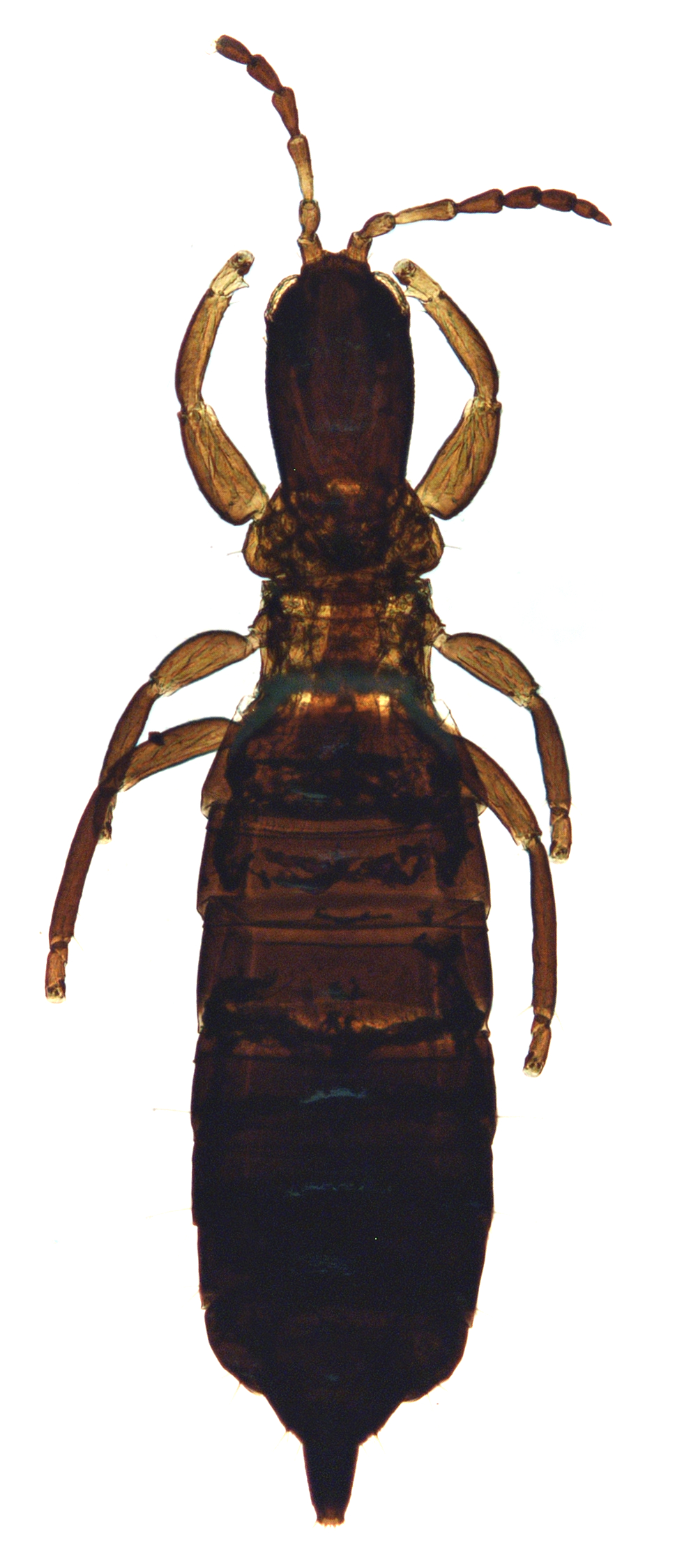
Female apterous; body bicoloured, with head, abdomen and antennomeres V–VIII dark brown; mid and hind tibia and antennomere IV brown, lighter than head; thorax, femora, fore tibia, tarsi and antennomeres I–III yellowish to light brown. Antennae 8-segmented, antennomereIV with 2 sense cones. Head longer than wide, slightly constricted at base, dorsal surface reticulated especially basally; eyes elongated ventrally, ocelli absent; maxillary stylets more than half of head width apart, extending to middle of head. Pronotum with 4 pairs of well-developed but short setae, midlateral pair very short; prosternal basantra present. Meso- and metathorax laterally constricted. Metanotum polygonally reticulated, with a pair of short median setae. Metathoracic sternopleural sutures present and elongate.Tube with straight margins, about 1.4x as long as basal width, without lateral setae. All legs similar, fore tarsi with a tooth.
Male apterous. Similar to female except for having a swollen fore femora and a larger tarsal tooth. Pore plates absent on abdominal sternites.
Intraspecific variation
Colouration is variable between specimens, with some having the base of the head or basal abdominal segments paler, or basal antennomeres darker.
Genus and similar species information
Compsothrips is a genus composed of 26 species, widely distributed in the tropics. The members of this genus are ant mimics, with a medially constricted body and lacking wings. Besides that, their head is usually elongated, the antennae are 8-segmented, basantra and metathoracic sternopleural sutures are present, and the abdomen is robust with a short tube. Antennomere IV has only two sense cones, contrasting the 4 sense cones more commonly seen in Idolothripinae. Compsothrips hoodi is distinguished from C. bicolor and C. graminis for having the metanotum with polygonal reticulation, not striate medially; and from C. brasiliensis for having a bicolored body.
Lives in the bases of dead grasses, where it feeds on fungal spores. Ant mimic.
Economic importance
Not recorded.
References suggested de Santis L (1958) Las especies Argentinas del genero Leptogastrothrips (Thysanoptera: Tubulifera). Revista de la Facultad de Agronomía de La Plata 34: 95–102.
Mound LA & Marullo R (1996) The Thrips of Central and South America: An Introduction. Memoirs on Entomology, International 6: 1–488.
Cavalleri A & Gonçalves S (2022) Novos registros e checklist das espécies de Thysanoptera do Pampa Brasileiro. Entomological Communications 4: ec04014: 1–3.
Published in: 20/10/2022 Posted by: Mariana Lindner