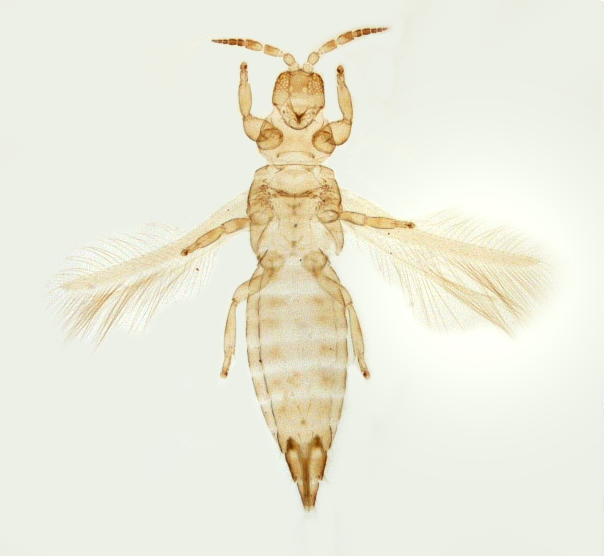
Diagnosis Body mainly yellow, with abdominal segments VIII–X darker; antennomeres I–II yellow, III–IV yellow with apical half light brown, V brown with base lighter, VI–IX brown; fore wings pale. Head about 1.3 times wider than long, without long setae; ocellar region with three pairs of minute setae, III at lateral margins of ocellar triangle. Antennae 9-segmented; antennomere III longer than IV, both with a long and continuous sensorial area extending laterally until the middle of the segment. Pronotum weakly sculptured and without long setae. Mesonotum striate.Fore wings with two complete rows of setae. Abdominal tergites I–VIII with a well developed comb of microtrichia on posterior margin, incomplete or absent on median area of I–V, but complete on VI–VIII; lateral thirds of tergites with dense lines of microtrichia. Sternites II–VI with 6 pairs of posteromarginal setae ahead of posterior margin, VII with 4 pairs ahead of posterior margin and 1 pair on discal area; lateral thirds of sternites with thin microtrichia.
Male smaller than female, abdominal sternites IV–VIII with a pore plate on anteromedian region.
Intraspecific variation Some specimens have the head brown on anterior two thirds and/or brown circular spots on abdominal tergites III–VI.
Genus and similar species information The Lenkothrips genus comprises eight species of flower feeding thrips, all described from South America. These species resemble Heterothrips species in external morphology, but they differ in having the circumpolar sensorial areas on antennal segments III–IV extending into a continuous lateral loop to the base of their segments. Lenkothrips pantanal is the only species in the genus with a prominently yellow body. An updated key to species is provided by Lima et al. (2024).
Distribution around the world Described from Brazil.