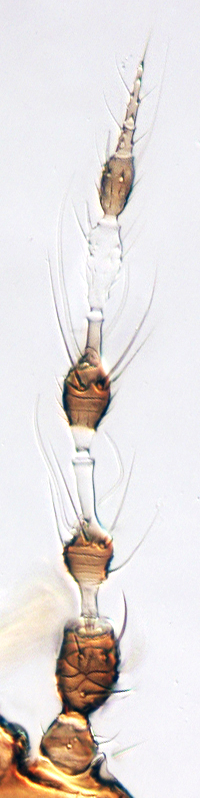
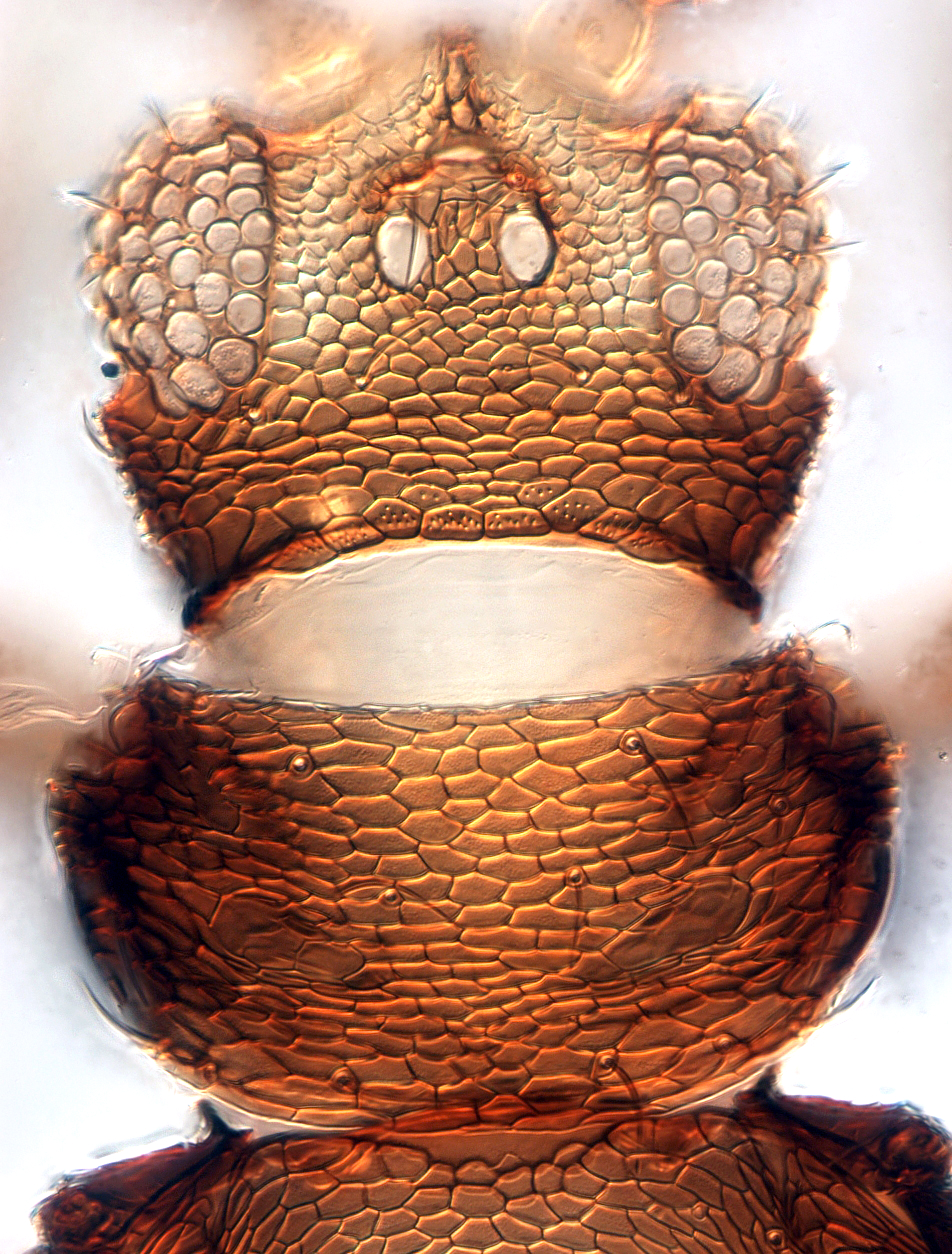
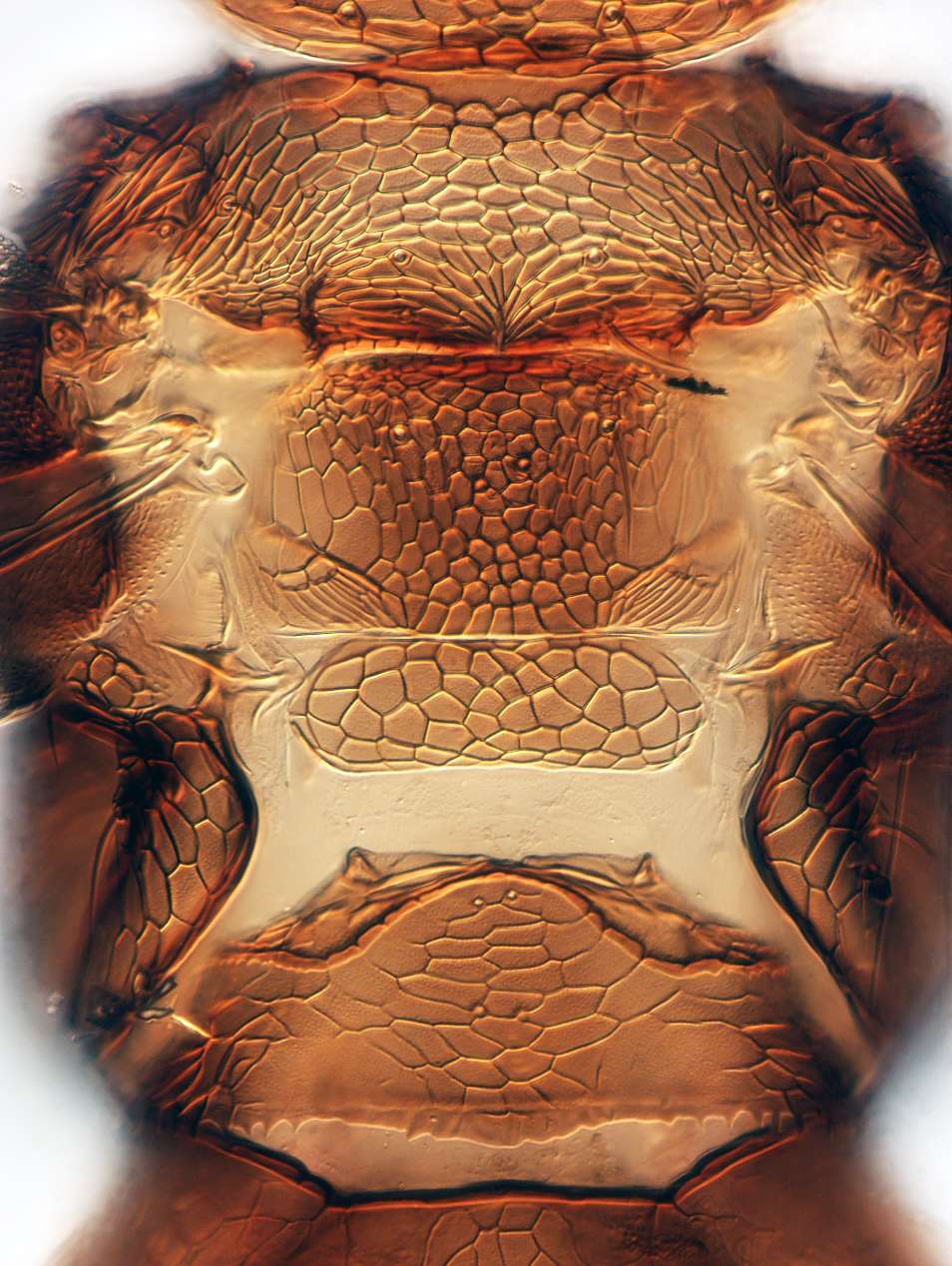
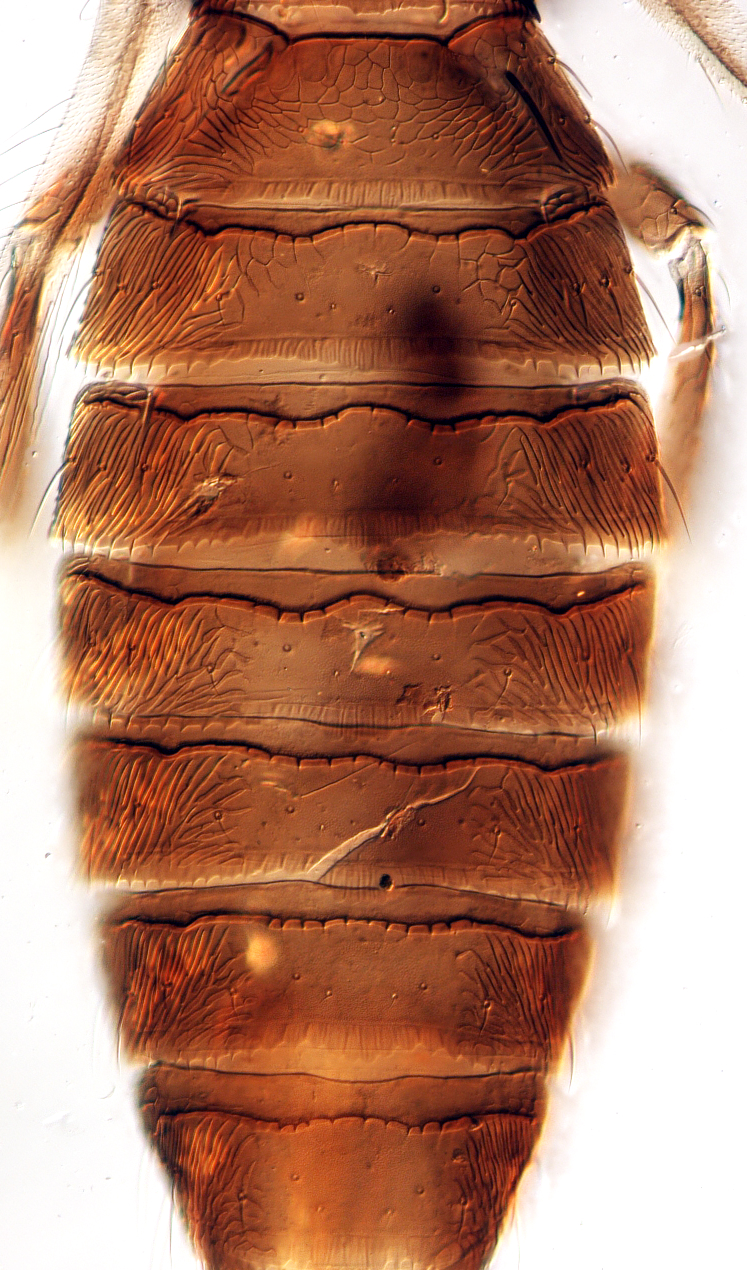
Diagnosis Body brown, with area between ocellar triangle and compound eyes paler; mid and hind legs brown with tarsi and junctions between segments yellow, fore legs lighter. Antennal segments I and VII–VIII light brown, II and VI brown, III brown with basal and apical necks yellow, IV brown medially with base and apex lighter, V pale; fore wings brown with pale spot sub-basally. Head strongly sculptured, constricted behind eyes and basally. Antennae 8-segmented, III & IV with long apical neck and forked sense cones, on IV the cone is long enough to reach antennomere VI. Pronotum reticulate, without internal markings. Mesothoracic endofurca without spinula, metathoracic endofurca without spinula and with stout arms, reaching mesothorax. Mesonotum without a median longitudinal split. Metanotum reticulate, without a strong triangle; one pair of robust setae; campaniforme sensilla present medially. Tarsi 1-segmented. Fore wings with first row of setae interrupted medially, two setae distally; second row with 8 or 9 setae equally spaced between them; setae stout, wing cilia wavy. Abdominal tergites III–VIII with oblique striae on lateral thirds, a few reticles near median region; median setae short and distanced from each other; posterior margins with craspeda; tergite VIII with teeth arising from craspedum on lateral thirds; X without a longitudinal split. Abdominal sternites with three pairs of setae, pairs 1 and 2 near posterior margin, 3 ahead of posterior margin.
Male unknown.
Intraspecific variation Not recorded.
Genus and similar species information The genus Oneilliella has five Neotropical species, all with a dark and strongly reticulated body; metanotum sculpture not forming a strong triangle; metafurca stout and long, without spinula, reaching the mesosternum; and abdominal tergite X without a complete longitudinal split. Oneilliella chicoi is similar to O. williamsi, both with antennomere III bearing a long apical neck and forewings with stout setae; but O. chicoi has the base of antennomere III pale, forked sense cone on antennomere IV reaching midpoint of segment VI, and two distal setae on forewing first vein. A key to the Neotropical species of Oneilliella is available in Lima et al. (2024).
Distribution around the world Described from Brazil.