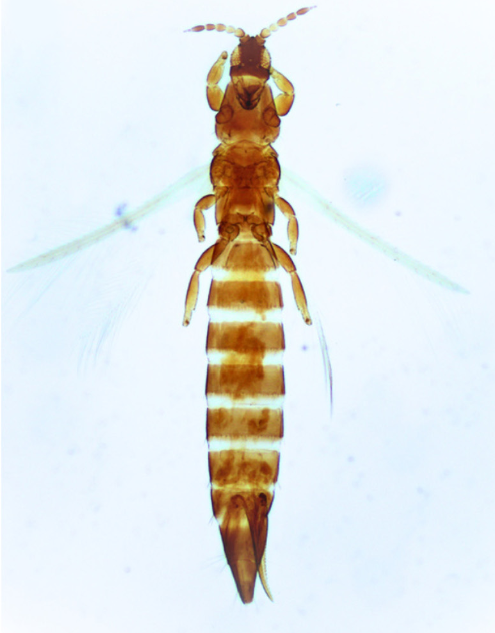
Chirothrips longiventralis Cavalleri, Ataíde & Moreira, 2026: 398.
Original reference: Cavalleri A, Ataíde KF & Moreira WS (2026) Far from home: a new grass-feeding Chirothrips (Thysanoptera, Thripidae) from South Brazil Zootaxa 5845 (2): 397–400. DOI: https://doi.org/10.11646/zootaxa.5845.2.12
Family
Thripidae, Thripinae
Nomenclatural information
https://thrips.info/wiki/Chirothrips_longiventralis
Diagnosis
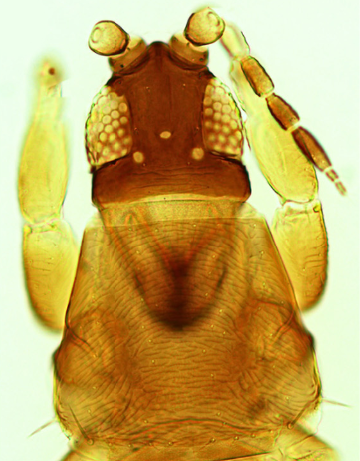
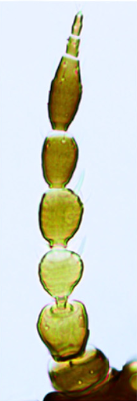
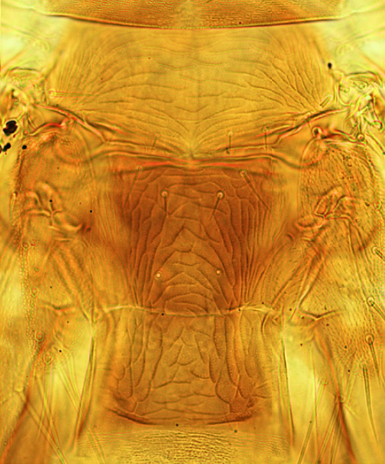
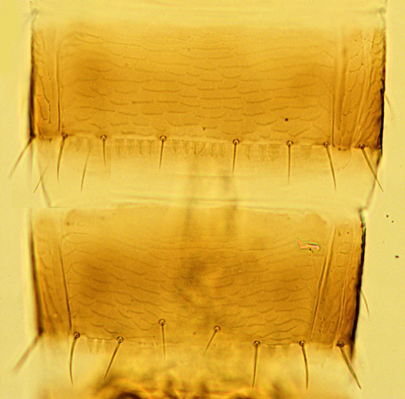
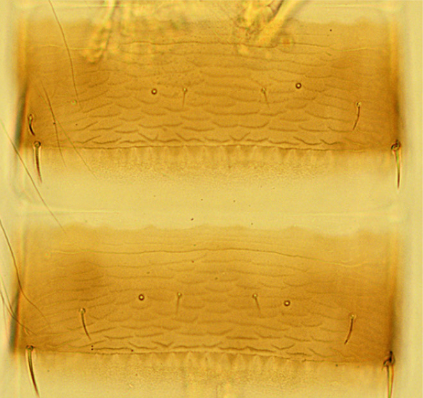
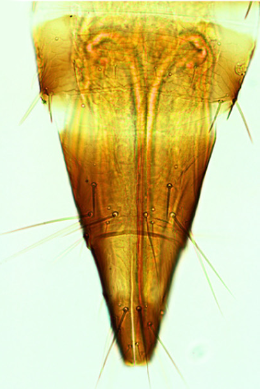
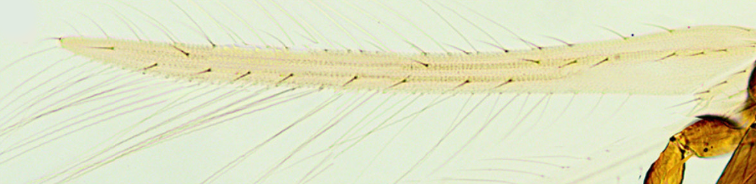
Body brown, with head and abdominal segments IX–X darker; legs brown, tibiae with lighter apexes, tarsi yellow; antennae mostly brown, antennomere II yellowish apically, III–IV yellowish brown, IV slightly darker than III; fore wings shaded. Head about as long as wide, slightly projected anteriorly; vertex with three pairs of minute setae, dorsum with five pairs of postocular setae. Antennae 8-segmented, III and IV with simple sense cones; antennal segment I enlarged, II symmetric, without lateral projection, IV and V with base constricted into a short pedicel. Pronotum almost trapezoidal, with transverse lines of sculpture; two pairs of moderately long posteroangular setae. Mesonotum with transverse lines of sculpture. Metanotum irregularly reticulated medially and with longitudinal lines laterally; paired campaniform sensilla present; median setal pair arising far from anterior margin. Meso & metathoracic endofurca without spinula. Tarsi 2-segmented; fore legs only slightly thicker than the other legs. Fore wing first and second veins with few and sparse setae. Abdominal tergites with transverse lines of sculpture; II–VIII with a pair of short and wide apart median setae, posterior margin with craspedum formed by partially overlapping lobes. Sternites with transverse lines of sculpture; three pairs of long posteromarginal setae; ovipositor elongate, reaching or surpassing the tip of abdominal segment X. Female macropterous.
Male unknown.
Intraspecific variation
Unknown.
Genus and similar species information
The genus Chirothrips includes more than 40 species, but species-level taxonomy of this group is not satisfactory (Mound & Marullo 1996). All members have short antennae, enlarged fore legs and trapezoidal pronotum. The genus is closely related to Arorathrips, but differs in having the mesothoracic endofurca well-developed, invaginated medially and with paired lateral arms. Chirothrips longiventralis is easily distinguished from the other species from this genus recorded in Brazil, C. manicatus, for having a symmetrical antennomere II, without the strong lateral projection seen in C. manicatus. Besides that, C. longiventralis has the fore legs less swollen, and much shorter ocellar setae. Nakahara & Foottit (2012) provided a key to Chirothrips species reported from the Americas.
Distribution around the world
Described from Brazil.
Distribution in Brazil
Rio Grande do Sul (Cavalleri et al. 2026).
Life history
Lives and reproduces in grasses.
Economic importance
Not recorded.
Suggested references
Mound LA & Marullo R (1996) The Thrips of Central and South America: An Introduction. Memoirs on Entomology, International 6: 1–488.
Nakahara S & Foottit RG (2012) Review of Chirothrips and related genera (Thysanoptera: Thripidae) of the Americas, with descriptions of one new genus and four new species. Zootaxa 3251: 1–29. DOI: https://doi.org/10.11646/zootaxa.3251.1.1
Cavalleri A, Ataíde KF & Moreira WS (2026) Far from home: a new grass-feeding Chirothrips (Thysanoptera, Thripidae) from South Brazil Zootaxa 5845 (2): 397–400. DOI: https://doi.org/10.11646/zootaxa.5845.2.12
Attendance
Brasil, Rio Grande do Sul, Rio Grande
Campus Carreiros: Av. Itália km 8
Bairro Carreiros
Thysanoptera © Todos Direitos Reservados 2026