The identification of a specimen can be quite laborious since traditional dichotomous keys generally establish a unique pathway to be followed and do not present any form of adaptation to user's needs. In order to improve the identification process, taxonomists have been developing a series of tools and methodologies that involve the use of computational algorithms. Among these new methods, multiple access keys (or interactive keys) are among the most modern and important. These keys are interactive computer programs that use a matrix of species and characters, allowing the user to select any character in any order.
These interactive systems have many advantages over traditional keys, such as: (i) the unrestricted use of characters, (ii) exclusion, selection or prioritization of characters, (iii) the ease of updating the data matrix and (iv) the display of large amounts of images and information at low cost. The user of the multiple access keys can even express his uncertainty by informing more than one state for a given character, without compromising the identification result. They also allow the display of characters by means of high definition images for comparisons of taxa and characteristics. Finally, studies indicate that the percentage of accuracy in the identification of taxa made by non-specialists is higher in interactive keys when compared to traditional keys.
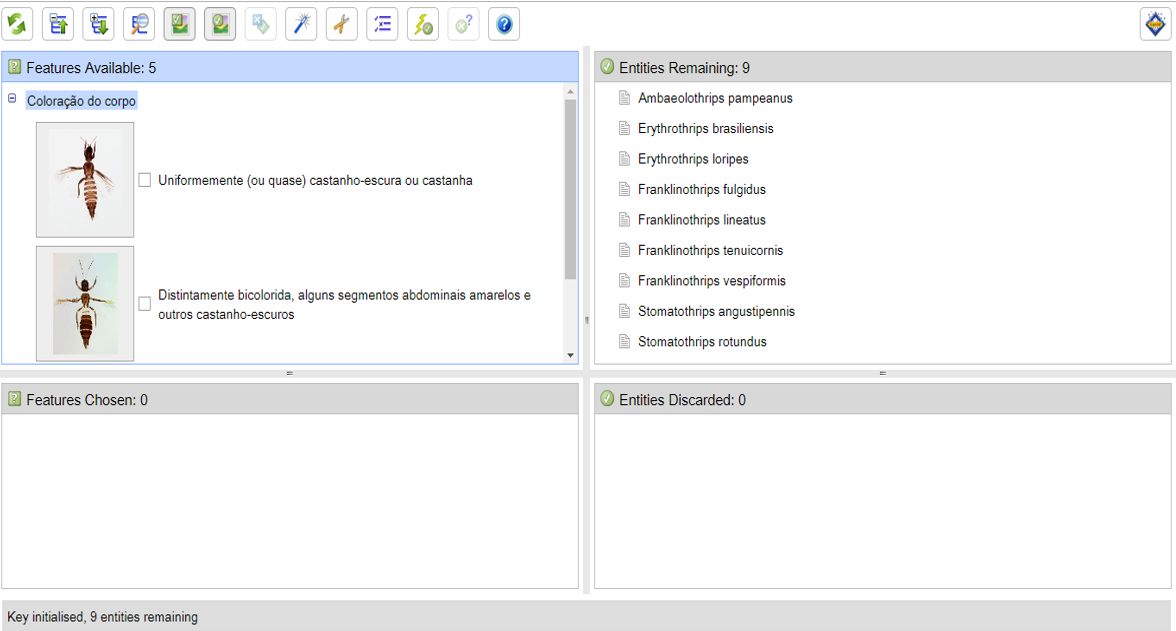
The identification system "The Thrips of Brazil" was developed through the platform called Lucid3.5, developed by CBIT (Centre for Biological Information Technology), University of Queensland, Australia. The keys were made using characteristics of the external morphology of the insects, such as: structure and shape of different parts of the body, chaetotaxy, sculpture, colour.
Click here to start the identification of thrips collected in Brazil.
Attendance
Brasil, Rio Grande do Sul, Rio Grande
Campus Carreiros: Av. Itália km 8
Bairro Carreiros
Thysanoptera © Todos Direitos Reservados 2026